The Church at Auvers: moment and letters
The forked road belongs to the painting; the violet and cobalt belong to the letter.
-
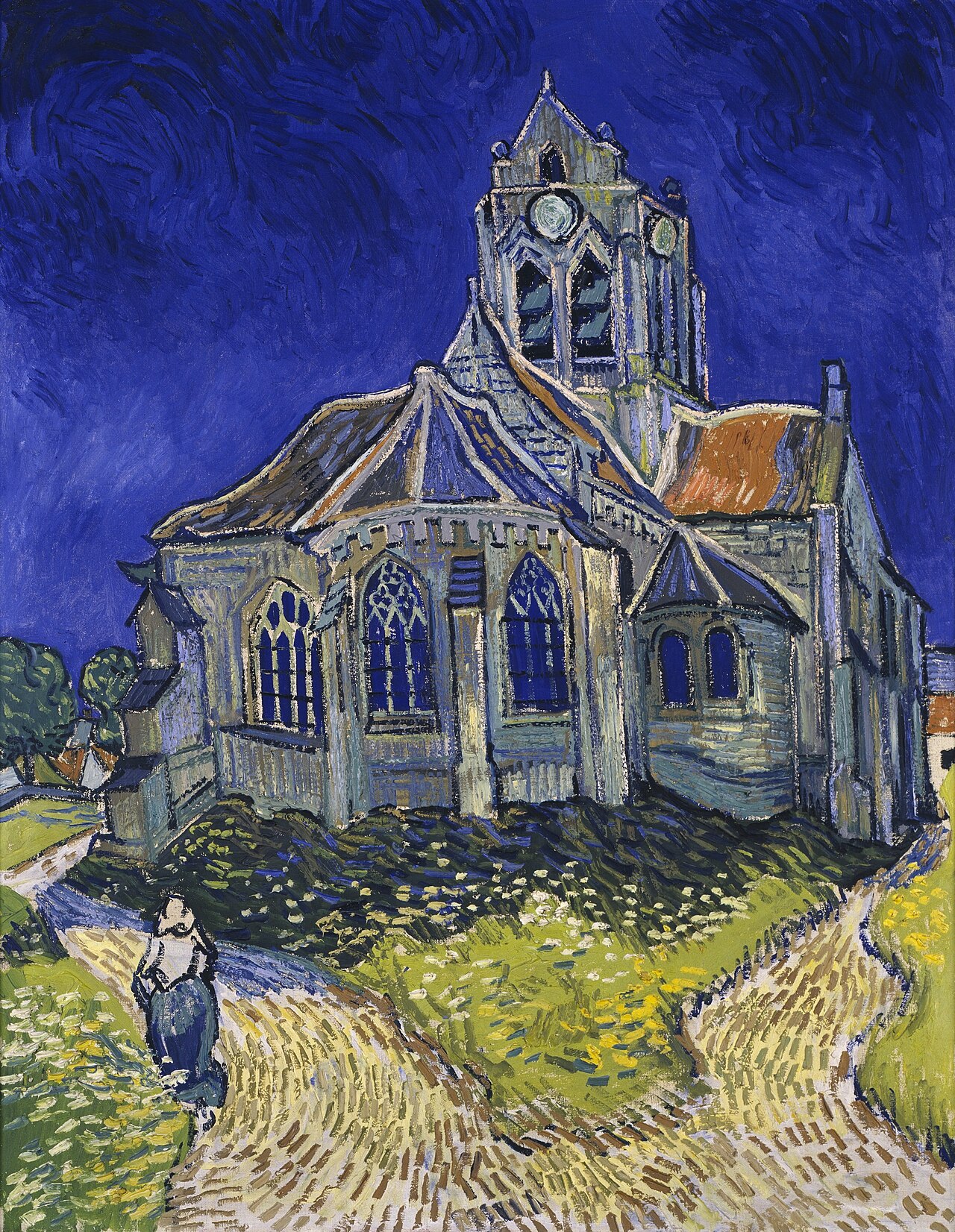
F789 The Church at Auvers 1890 -
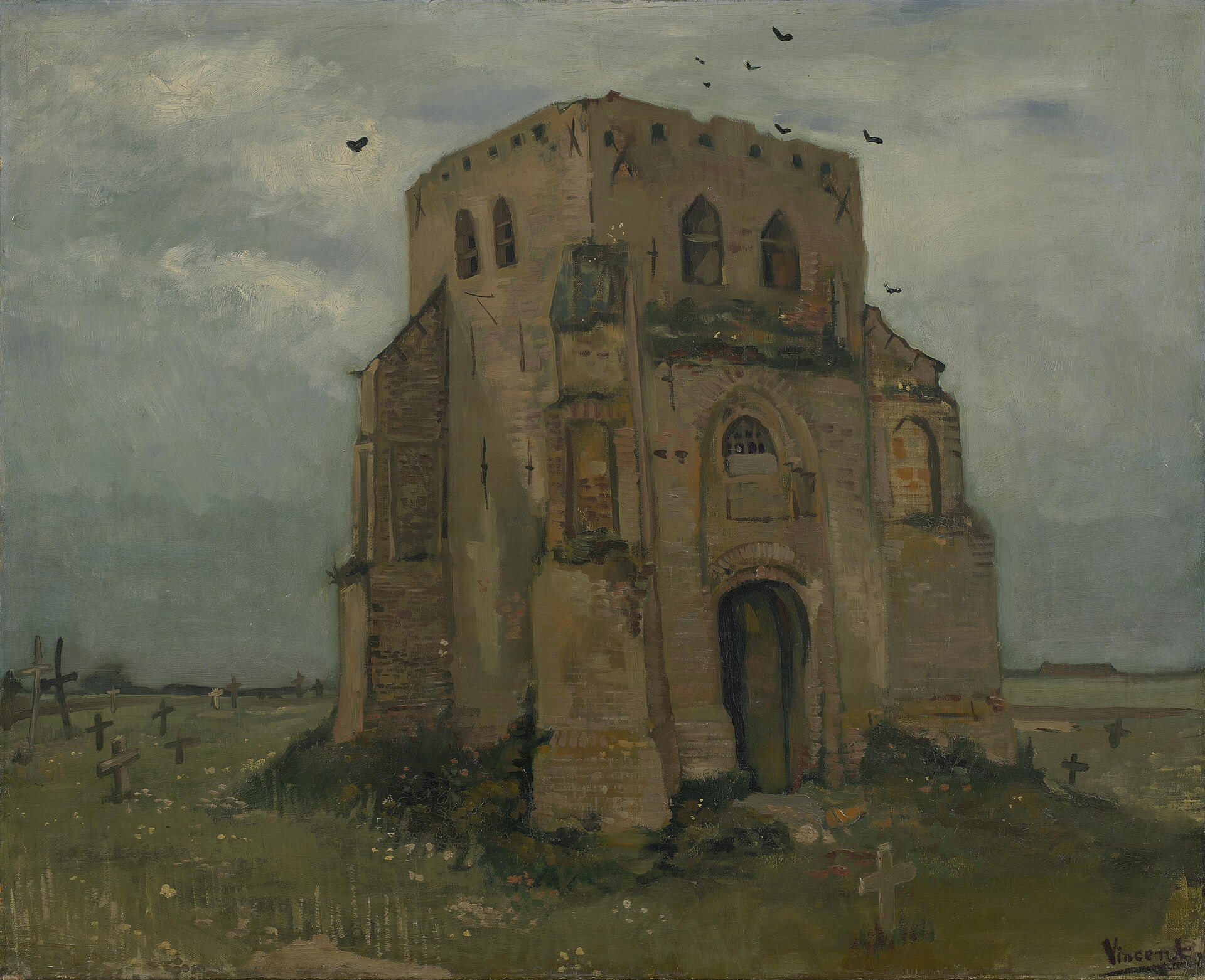
F84 The Old Church Tower at Nuenen (The Peasants' Churchyard) 1885
Painting
Oil on canvas, 94 × 74 cm. The twelfth-century parish church of Auvers — rough stone walls, triangular roofs, stained-glass windows. He did not paint it as a grey medieval building. The walls are violet leaning toward red, the roof split into violet and orange, the windows ultramarine patches, the sky pure cobalt, the path orange-toned and forking into two. The whole church tilts slightly within the frame, the wall lines are not vertical — like a building about to lift off the ground. Not the portrait of an old building, but the look of a building once lit by colour.
Letter
June 1890. He wrote to Theo: "I have a larger picture of the village church — an effect in which the building appears purplish against a sky of a deep and simple blue of pure cobalt, the stained-glass windows appear as patches of ultramarine blue, the roof is violet and partly orange." Another sentence: "It's more or less the same thing as the studies I did at Nuenen of the old tower and the cemetery, only now the colour is probably more expressive, more sumptuous." He drew the line himself — the Auvers church and the Nuenen old tower, the same motif crossing five years, two completely different colour systems.
Place
Notre-Dame d'Auvers, a few minutes from the Ravoux Inn. Twelfth-century, still on its spot; everyone in the village had walked past it, no one had painted it. He made this in June, less than a month into Auvers and less than two months before the end. It rhymes, across five years, with the Nuenen tower he painted before he understood colour — the same building twice, with a different man behind the easel.
Auvers had Daubigny's garden, Dr. Gachet, and its old Gothic church.
He painted it beneath a deep-blue sky, with a forked road in the foreground and the building leaning slightly forward. In a letter to his sister he described the effect: the building appeared purplish against a sky of a deep, simple blue of pure cobalt. The letter gives a precise account of the colour relation; it does not assign the church one fixed spiritual meaning.
The letter also connects this new church painting to earlier studies of the old tower and churchyard at Nuenen, while noting that the colour was now more expressive and sumptuous.
Events
- The Colour Experimenter · Letter 877
Less than a month after arriving in Auvers, he decided to paint the twelfth-century parish church — Notre-Dame d'Auvers
- The Colour Experimenter · Letter 877
Completed The Church at Auvers. 'The building purplish, the sky pure cobalt, the windows ultramarine, the roof violet and partly orange.' The colour experimenter's most direct recipe
- Synaesthetic Precision · Letter 878
The whole church tilts slightly within the frame — wall lines not vertical, the building seeming to lift off the ground
- Synaesthetic Precision · Letter 877
'It's more or less the same thing as the studies I did at Nuenen of the old tower and the cemetery, only now the colour is probably more expressive, more sumptuous.' A self-quotation across five years
- The Colour Experimenter · Letter 879
In the letter, linked the Auvers church to the Nuenen old tower of five years before — same motif, two entirely different colour systems
From the Letters
J'ai un plus grand tableau de l'église du village — un effet où le bâtiment paraît violacé contre un ciel d'un bleu profond et simple de cobalt pur, les fenêtres à vitraux paraissent comme des taches bleu d'outremer, le toit est violet et en partie orangé. I have a larger picture of the village church — an effect in which the building appears purplish against a sky of a deep and simple blue of pure cobalt, the stained-glass windows appear as patches of ultramarine blue, the roof is violet and partly orange.
C'est à peu près la même chose que les études que j'ai faites à Nuenen de la vieille tour et du cimetière, seulement à présent la couleur est probablement plus expressive, plus somptueuse. It's more or less the same thing as the studies I did at Nuenen of the old tower and the cemetery, only now the colour is probably more expressive, more sumptuous.
Letter Sources
Van Gogh letter records referenced on this page, linked to the Van Gogh Letters Project. vangoghletters.org
Technique Evidence
This work appears as evidence in this site’s technique-evolution axis.
- The Burning Seventy Days 1890.05 – 1890.07 Open period F789 / JH2006 Church at Auvers Speed Representative work from the 70-day Auvers burst