Tree Roots: moment and letters
No surviving letter explains this picture. That a thing has no footnote does not mean it is incomplete.
-
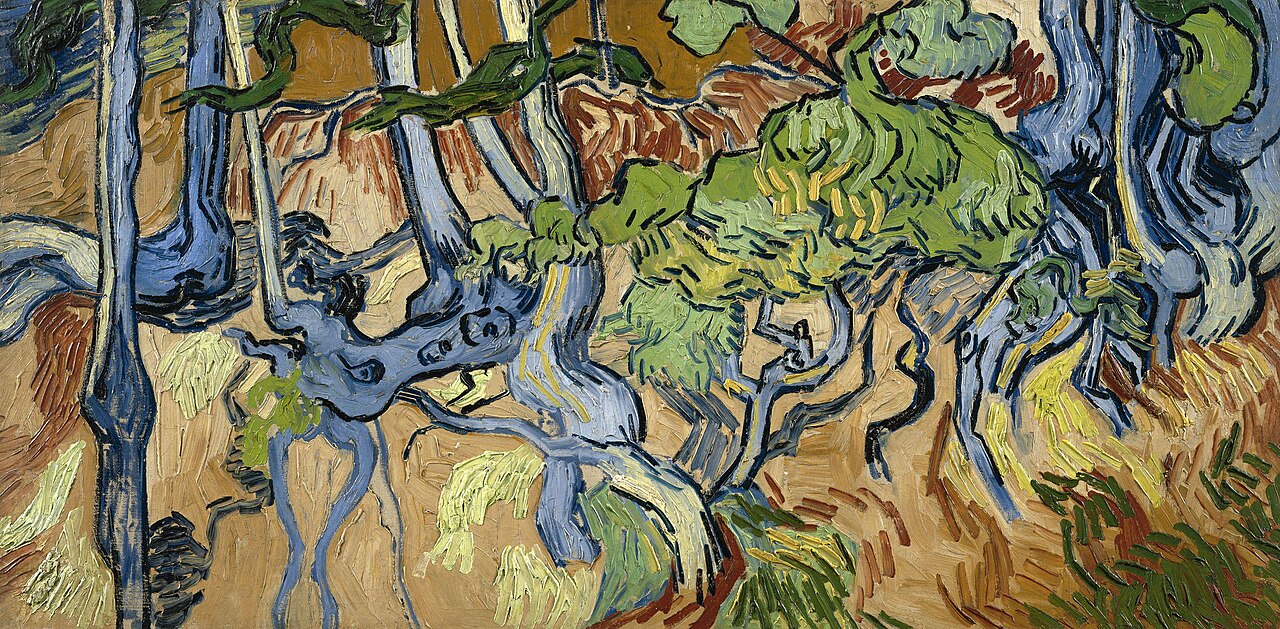
F816 Tree Roots 1890 -
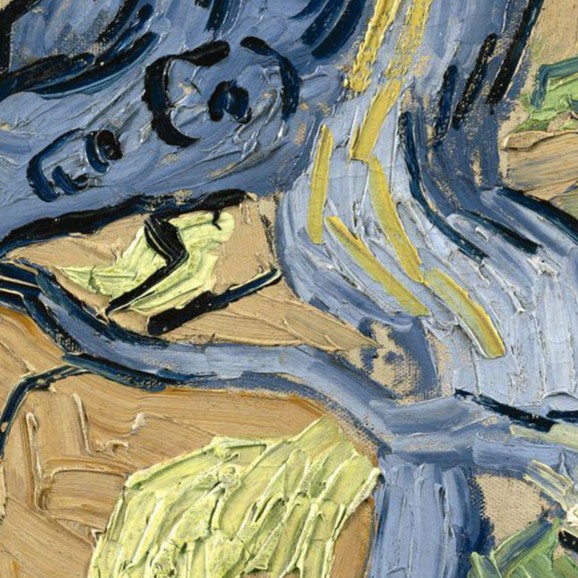
F816-crop Tree Roots — detail (blue/yellow paint clash) 1890
Painting
Oil on canvas, 50 × 100 cm. Tree roots and trunks tangled in soil — no sky, no horizon, no figure. Only roots: exposed, twisted, gripping the earth. Colour is a weave of blue-green and ochre-yellow. Brushstrokes extremely violent, as if wrestling with the canvas. The painting looks unfinished. Perhaps it is unfinished.
Letter
No letter documents this painting. No description, no explanation, no colour formula. This is the most silent work in Vincent's entire oeuvre — he painted it but told no one. We are not even certain it is the last. We only know it was painted in the final days.
Place
Auvers, a slope near Rue Daubigny. In 2020 researchers confirmed the location through a 1905 postcard — just a few minutes' walk from the Auberge Ravoux. He passed this spot every day in his last weeks. Tree roots exposed from the earth bank, like a living wall.
In July he painted fields, gardens, and buildings in quick succession. The Van Gogh Museum now identifies Tree Roots as his last work, painted on the morning of 27 July; no surviving letter is known to mention it.
Tangled roots, earth, the base of a tree trunk. No sky, no distance, only the ground and the things gripping the ground. No letter has so far been found explaining what he was thinking at the time, and no known conversation mentions this picture.
The painting's place at the end of the sequence is now better supported than it once was. Its meaning is not.
Events
- Synaesthetic Precision
Painted Tree Roots on the slope near the Ravoux Inn — oil on canvas, 50 × 100 cm. Twisted roots tangled in the soil, like a person trying to grasp the earth
- Synaesthetic Precision
Highly unusual colour — silvery violet, emerald, orange-brown, deep blue — every patch pushed to the edges of the canvas. The least 'landscape-like' of his landscapes
- Synaesthetic Precision
Based on the angle of light in the painting, scholars argue this was likely painted on the morning of 27 July 1890 — the same morning of the day he died
- Synaesthetic Precision
Likely his last painting — an unfinished struggle. No letter mentions it. Pure visual silence. The strength of this node lies in saying nothing at all
Technique Evidence
This work appears as evidence in this site’s technique-evolution axis.