1890 · F816 · JH2113
Roots and Tree Trunks
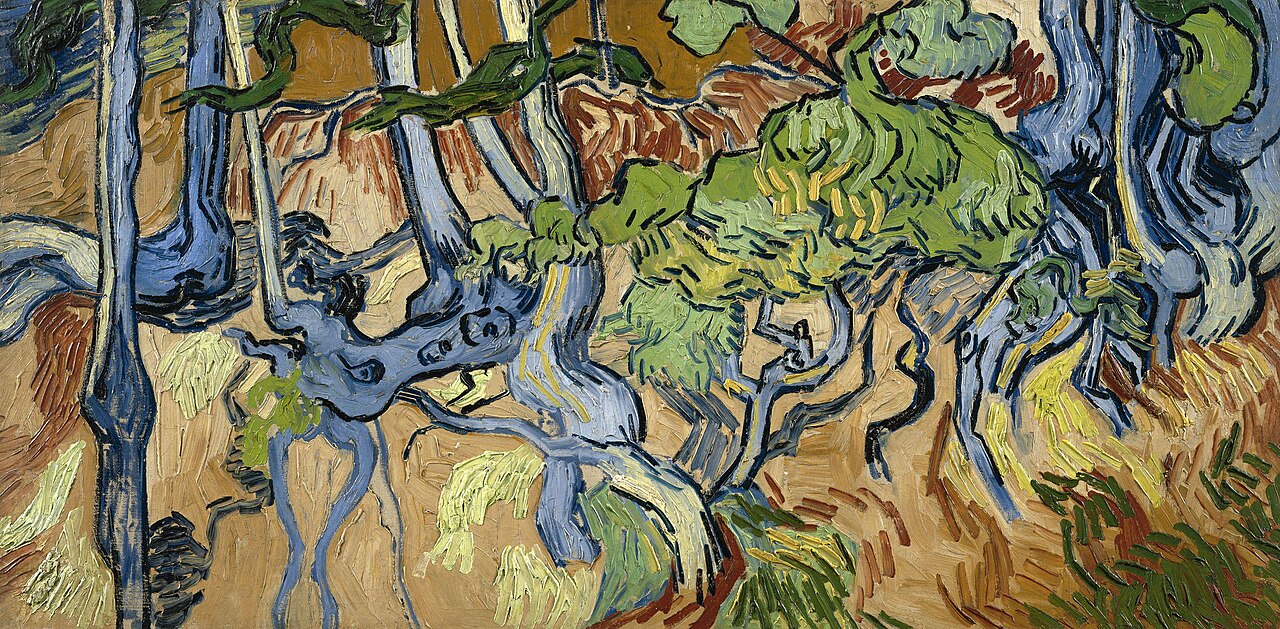
Roots and Tree Trunks brings the viewer close to a bank of tangled roots rather than offering a distant landscape.
Roots and Tree Trunks meaning and analysis
Roots and Tree Trunks brings the viewer close to a bank of tangled roots rather than offering a distant landscape.
Continue with this work in the context of Tree Roots.
Meaning
The painting makes persistence, entanglement and growth visible without fixing them as one symbol.
Visual Analysis
Cropping removes horizon and sky, so colour and line become the subject.
Symbolism
Roots can suggest origin and endurance, but their immediate material presence matters first.
Technique
Dense blue, green and ochre strokes interlock across the surface.
Period Context
It was painted in Auvers in July 1890 among Van Gogh's last works.
Related Letters
The Auvers correspondence records rapid work in the local landscape during this final period.
FAQ
- Is Tree Roots one of Van Gogh's last paintings?
- It is among the works painted in his final Auvers period.
- What does Tree Roots mean?
- It focuses on tangled growth, material energy and close observation.
- Why is there no horizon?
- The close crop makes roots, colour and brushwork the main subject.
The last painting. July 27, 1890 — he was working on this the final day of his life. Roots and trunks tangled together, nearly abstract. No sky, no horizon, only the material conflict of pigment. Blue and yellow wrestling on canvas.