1890 · F789 · JH2006
The Church at Auvers
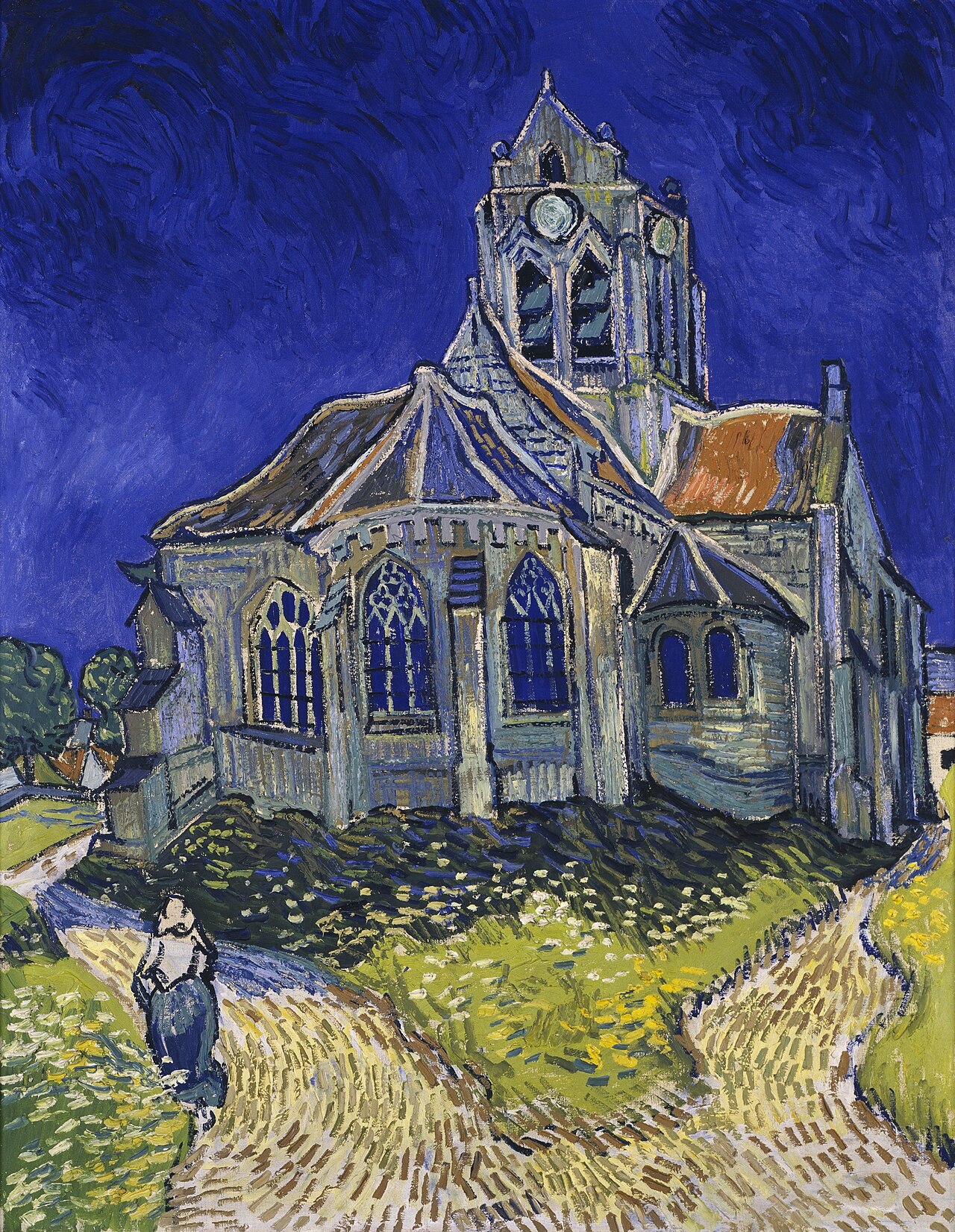
The Church at Auvers is not a straightforward architectural portrait. Van Gogh turns the building, the paths and the surrounding ground into a landscape of unstable lines and competing directions.
The Church at Auvers meaning and analysis
The Church at Auvers is not a straightforward architectural portrait. Van Gogh turns the building, the paths and the surrounding ground into a landscape of unstable lines and competing directions.
Continue with this work in the context of The Seventy Days of Auvers.
Meaning
The church appears solid as an institution yet visually unsettled. Its dark roof and twisting outlines make the familiar building feel exposed to weather and movement.
The two paths do not provide a single route toward the church. They split the foreground and keep the viewer moving around, rather than calmly entering, the image.
Visual Analysis
The building sits high in the composition, with blue sky pressing close behind it. Its silhouette is recognizable, but the walls and roof seem to pulse against the surrounding colour.
The foreground is divided by paths and green banks. Those diagonal movements make the picture less like a stable view and more like an encounter with a changing place.
Symbolism
The church has often invited biographical readings about faith, distance and belonging. Those readings can be useful, but the painting does not state a single verdict about religion.
More securely, the paths and separated spaces create a feeling of approach without easy arrival.
Technique
Strong blue and violet surround the dark church, while green and yellow animate the ground. The colour relations are expressive rather than descriptive.
Contour and brushwork refuse rigid architecture: edges bend, roofs ripple and the ground keeps moving in short strokes.
Period Context
The work was painted in Auvers-sur-Oise in June 1890, during Van Gogh's final period of intense production.
It belongs with the Auvers landscapes, portraits and village scenes that test how familiar places can be made psychologically and formally active.
Related Letters
Letters from Auvers show Van Gogh working quickly across fields, houses and village motifs. The church belongs to that concentrated final campaign, where local subjects became occasions for colour and structure rather than topographical record.
FAQ
- What does The Church at Auvers mean?
- It presents a familiar church through unstable contours, divided paths and intense colour, inviting questions about place, distance and movement rather than one fixed symbol.
- When did Van Gogh paint The Church at Auvers?
- He painted it in June 1890 during his Auvers-sur-Oise period.
- Why do the paths split in The Church at Auvers?
- The divided paths organize the foreground and create an approach that does not resolve into one simple route toward the building.