The Last Letter
Among the last things he left behind was an unfinished letter that never arrived, beside a completed version that did. This timeline begins with that unfinished draft, and ends with it too. What remains is what we are doing: reading the draft carefully, seeing the unsold paintings through. But a gaze supplied later cannot go back to 1890. What was absent that year remains absent. Harder still, we are absent today as well: people still walk ahead of the old measures, passed over by our politeness, our silence, and our safe taste. That shot did not stop in Auvers. It simply changed hands.
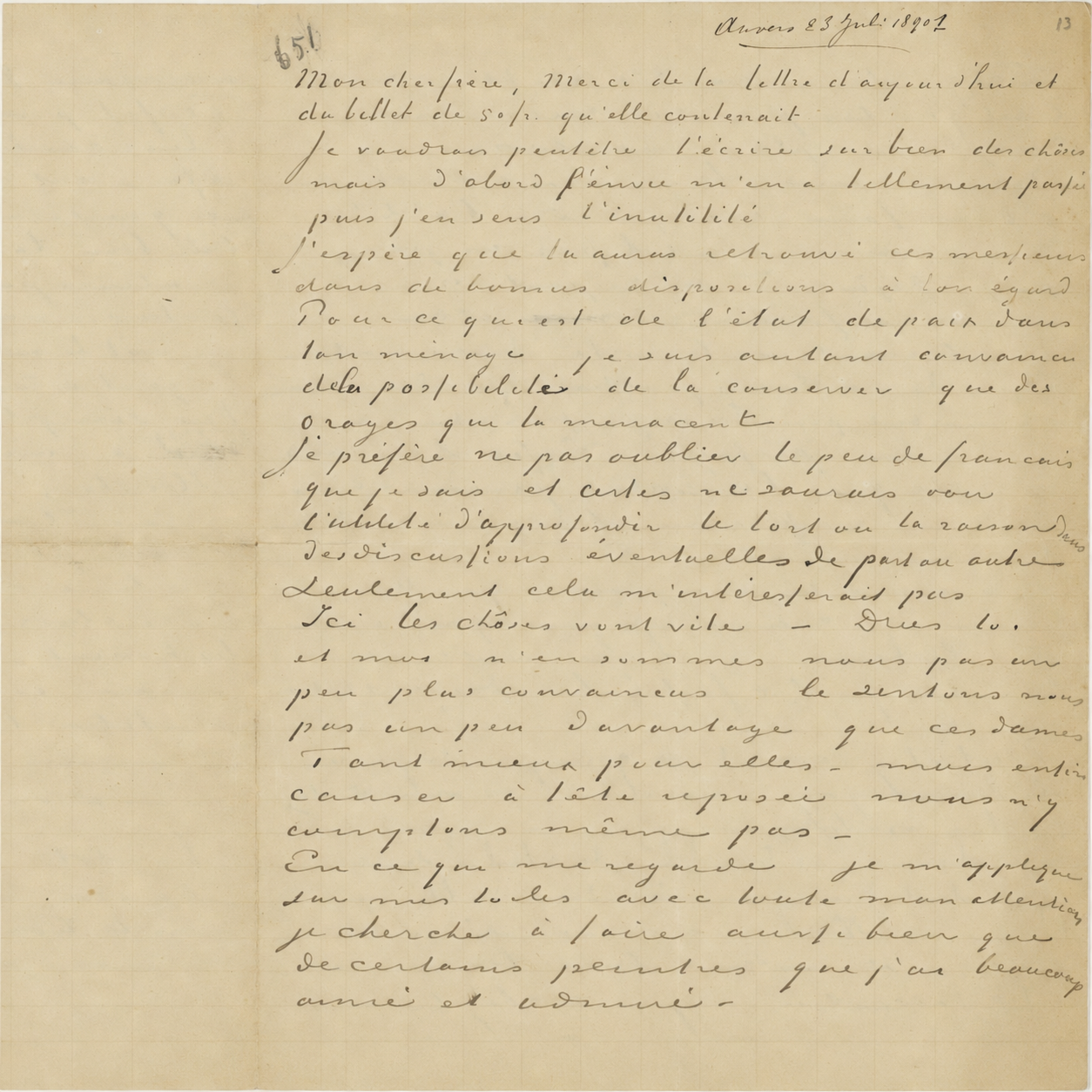
No painting at this knot — only a letter.
On 27 July he went out to the fields, came back in the afternoon, told the innkeeper's daughter that his stomach hurt, and went upstairs. Theo, hearing the news, hurried to his side.
Among the papers left from his final days was RM25, an unfinished draft of a letter to Theo that he had on him on 27 July. It speaks of painting, money, and the pressure within their bond. But it was not the only final letter: a completed version, letter 902, dated 23 July, was sent and reached Theo. Read together, the two manuscripts preserve revision rather than a single final utterance.
This is the last node of the timeline, and also the starting point of another way of reading: all those paintings, letters, nodes look different when read beside the unfinished RM25 and the completed letter 902, sent on the same day. One draft stayed with him; the other reached Theo. Coming in from any node, that double ending remains in view.
And the person who has seen all this does not stand outside the matter. The paintings he did not sell in his lifetime are printed today on mugs, tote bags, subway ads — we are the ones buying them belatedly. The fields no one looked at then now wait in lines to be seen. Seeing came too late, and belated seeing does not cancel the absence at the time: this account is not settled. It is not handed from that age to the reader, as though we could finally pay it back. It presses onto us — including the person writing this book, and the person reading it.
Nor is this about standing at the edge of the stage and identifying a culprit. It is more like a chorus: we stand inside the plot, while also speaking for those still seated in the dark. We mourn him, but we cannot remove ourselves and say that this has nothing to do with us.
Events
- Synaesthetic Precision · Letter 898
Wrote to Theo and Jo. 'They are vast stretches of wheat under troubled skies, and I did not need to go out of my way to try to express sadness and extreme loneliness.'
- Synaesthetic Precision · Letter 902
Wrote and sent letter 902 — the last surviving letter that can be confirmed as having reached Theo. 'My own work, I am risking my life for it and my reason has half foundered.'
- Synaesthetic Precision · RM25
The same day, RM25 — the unfinished earlier version of letter 902 — was left unsent. 'There are many things I would like to write to you about but I feel the uselessness of it.'
- Synaesthetic Precision
Returned to the Ravoux Inn that afternoon, wounded, the unsent RM25 still on him. The Ravoux family called for Doctor Gachet. Gachet sent word to Theo
- Synaesthetic Precision
Early morning, 29 July 1890. Theo at his bedside. Vincent died, aged 37. This node has no painting — only an unsent letter and a stretch of white space
From the Letters
Eh bien, mon travail à moi, j'y risque ma vie et ma raison y a fondré à moitié. Well, my own work, I am risking my life for it and my reason has half foundered.
Il y a bien des choses que je voudrais t'écrire mais j'en sens l'inutilité. There are many things I would like to write to you about but I feel the uselessness of it.
Letter Sources
Van Gogh letter records referenced on this page, linked to the Van Gogh Letters Project. vangoghletters.org