The Carlyle Moment in The Hague
He read Carlyle and called Sartor resartus ‘beautiful — and honest — and humane’; in a letter about his own work that year, he also quoted Carlyle’s ‘the result of an idea must be an action’.
-
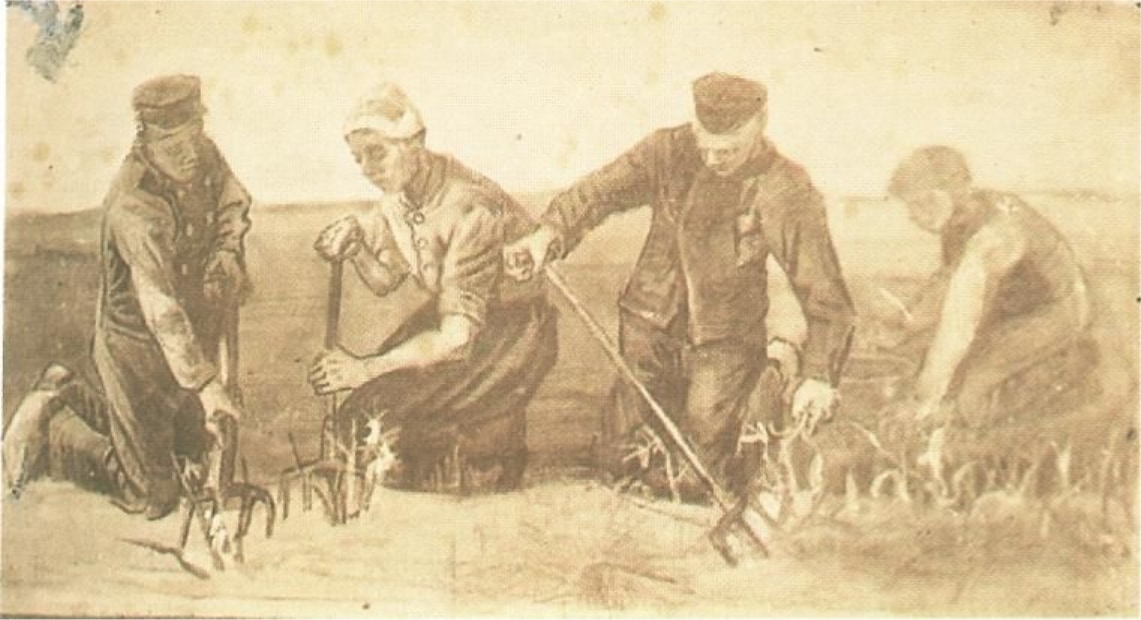
F1034 Four Potato Diggers 1883
Events
- The Ferocious Reader · Letter 294
He wrote that Carlyle’s ‘Blessed is he who has found his work’ was absolutely true; when he said he wanted to make figures from the people for the people, the course of events could affect him only indirectly — making the drawings themselves was his main concern.
- The Ferocious Reader · Letter 325
He told Rappard he was reading Carlyle’s Sartor resartus, in which ‘old clothes’ stand for all manner of forms and, in religion, all dogmas — ‘beautiful — and honest — and humane’. Some said Carlyle not only strips mankind naked but skins it too; that was not true, he wrote, but Carlyle was honest enough not to call the shirt the skin.
- The Ferocious Reader · Letter 356
He quoted Carlyle: the result of an idea must not be a feeling but an action. He also cited the ‘Worship of sorrow’, and said he found something of it in Degroux and Daumier.
- The Ferocious Reader · Letter 358
He wrote that the dealer Tersteeg would probably always remain ‘the everlasting no’ to him; against that, one finds an everlasting yes in the example of men of character. In the same letter he said that Legros’s etching Carlyle in his Study often came to mind when he tried to imagine Millet, or anyone else, as he really was.
- The Ferocious Reader · Letter 359
He told Rappard that Taine’s remark on Dickens and Carlyle — ‘the essence of the English character is the absence of happiness’ — whatever its accuracy, was evidence of very deep reflection: looking into the darkness until one sees something more in it where others no longer see anything.
- The Translator · Letter 363
He sent Theo photographs of recent drawings and listed them in his letter: Sower, Potato Grubbers and Peat Diggers.
From the Letters
Blessed is he who has found his work zegt Carlyle en dat is gedecideerd waar. Blessed is he who has found his work, says Carlyle, and that’s absolutely true.
ik lees op ’t moment “Sartor resartus” – de philosophie van oude kleeren – van hem/ onder de “oude kleeren” rekent hij allerlei vormen en in zake van godsdienst alle dogma’s – mooi is het – en trouw – en humaan. At the moment I’m reading his ‘Sartor resartus’ — the philosophy of old clothes — under ‘old clothes’ he includes all manner of forms, and in the case of religion all dogmas. It’s beautiful — and honest — and humane.
Een echt Engelsch woord is dat van Carlyle/ “the result of an idea must not be a feeling but an action” A truly English remark is the one by Carlyle, ‘The result of an idea must not be a feeling but an action’.
Tersteeg zal voor mij wel blijven denk ik “the everlasting no” To me Tersteeg will I think remain ‘the everlasting no’.
Toch geraakt hij daarmee (Taine) tot merkwaardig diepe gezegden. Zoo las ik een woord van hem – over Dickens en Carlyle/ “le fond du caractère anglais, c’est l’absence du bonheur.” Nu wil ik op de meerdere of mindere juistheid niet aandringen/ alleen zeggen dat zulke woorden bewijzen zijn van zeer diep nadenken/ kijken met de oogen in de duisternis tot men er nog wat in ziet waar een ander niets meer ziet. Still, through that he (Taine) arrives at curiously deep pronouncements. For example, I read a remark of his — about Dickens and Carlyle: ‘the essence of the English character is the absence of happiness.’ Now I don’t want to insist on the greater or lesser accuracy, but just say that such words are evidence of very deep reflection, looking into the darkness with one’s eyes until one sees something more in it where others no longer see anything.
Letter Sources
Van Gogh letter records referenced on this page, linked to the Van Gogh Letters Project. vangoghletters.org