The Dickens Winter in The Hague
He read the life of Dickens, collected the wood engravings of English magazines, and drew one bowed old man again and again.
-
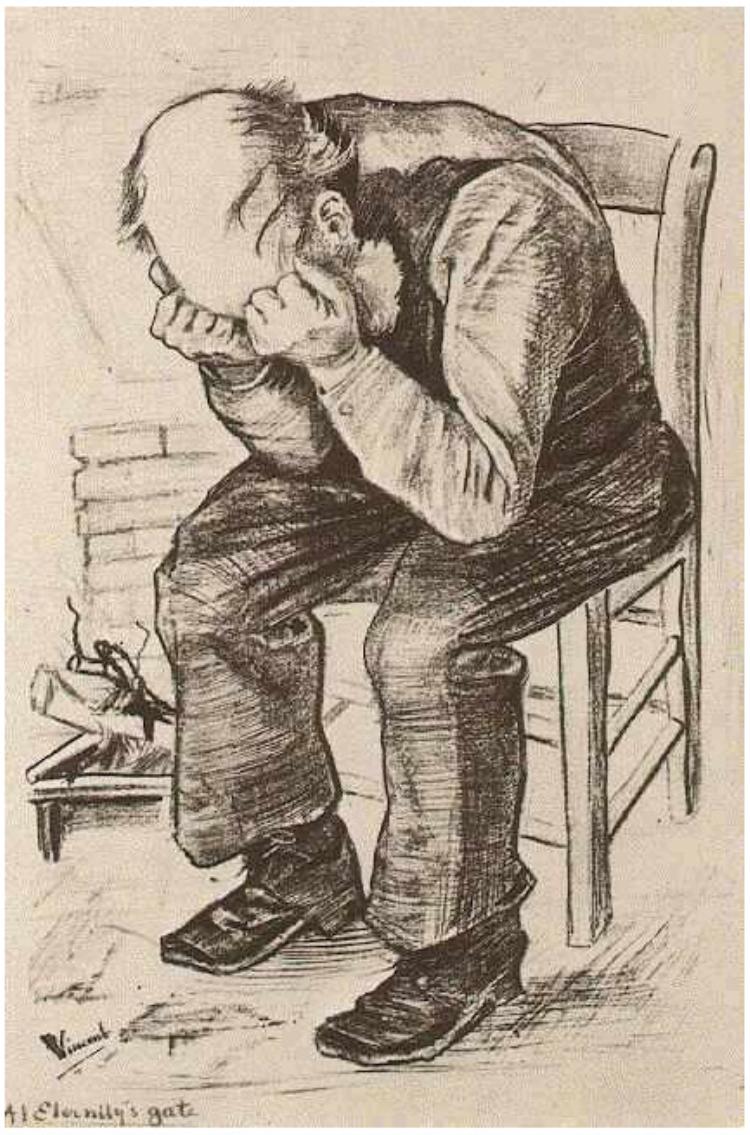
F1662 At Eternity's Gate (lithograph) 1882 -
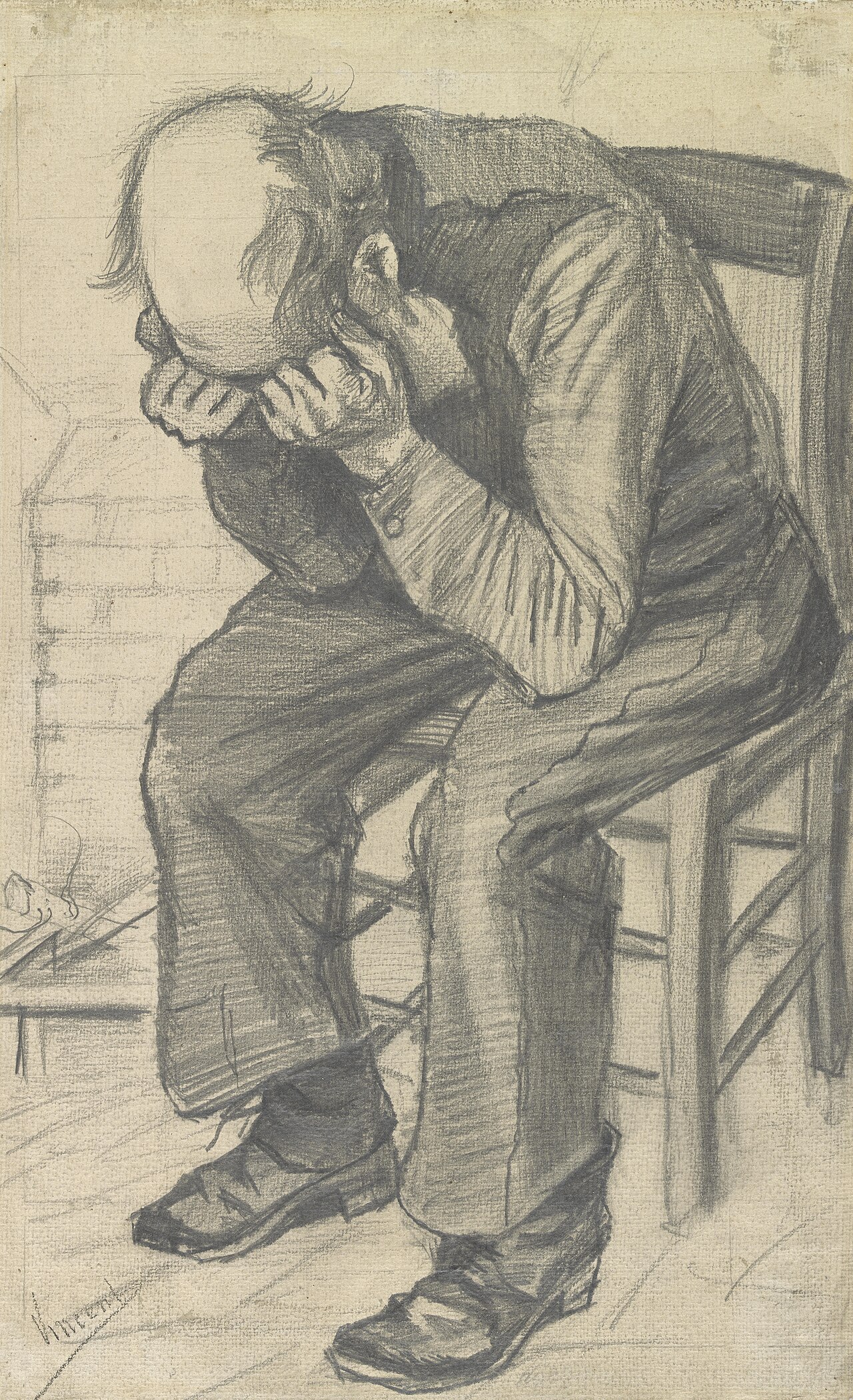
F997 Worn Out 1882
Painting
Shown side by side are the pencil drawing Worn Out (F997) and the lithograph At Eternity’s Gate (F1662). The drawing was the immediate model for the lithograph. In late November 1882 he told Rappard that he had redrawn Worn Out — a subject he had drawn in Etten a year earlier — three times with two models, and that one would become a fifth stone; a few days later he sent Theo the first impression.
Letter
November 1882, The Hague. He was reading Forster’s Life of Charles Dickens and paraphrased the criticism of painters that the book records from Dickens: the model is not the ultimate goal but a means of giving body and vigour to one’s ideas and inspiration. He drew two lessons of his own: do not become a slave to the model; but take a model and study it, or your inspiration will never take on material form.
In December he told Theo the story of Fildes: on the day Dickens died, Fildes came into his room, saw the empty chair standing there, and made of it the drawing The Empty Chair in The Graphic. Then he wrote: Empty chairs — there are many, more will come, and sooner or later instead of Herkomer, Fildes, Holl, Small there will only be empty chairs.
Place
The Hague. That autumn and winter he drew old men and workers from models in his studio, and collected the wood engravings of the English magazine The Graphic. He felt closer to its draughtsmen — Herkomer, Fildes, Holl — than to Gavarni and Daumier: the latter viewed society with mockery, the former chose subjects just as true but nobler and more serious. In November he made his first lithograph with the help of Smulders’s printer, and later followed each stage at the printer’s, from the transfer and preparation of the stone to the printing.
Events
- The Ferocious Reader · Letter 278
Rappard sent him an extract from a lecture by Herkomer on the wood engravings in The Graphic. He told Theo that he found Herkomer, Fildes, Holl and the other founders of The Graphic more sympathetic than Gavarni and Daumier: the latter seemed to view society with mockery, while the former chose subjects just as true but with something noble and a more serious sentiment.
- The Ferocious Reader · Letter 280
That week he was reading Forster’s Life of Charles Dickens, and paraphrased for Theo the criticism of painters that Forster records from Dickens: the model is not the goal but a means of giving body to one’s ideas and inspiration. From this he drew two complementary truths: do not become a slave to the model; but take a model and study it, or your inspiration will never take on material form.
- The Translator · Letter 281
With the help of Smulders’s printer he made his first lithograph, of an old man, and sent Theo the very first impression.
- The Ferocious Reader · Letter 286
He finished Zola’s Pot-bouille — the most powerful passage, he thought, was the maid giving birth in the dark attic room — and at last read Hugo’s Quatre-vingt-treize, which he said was ‘painted, I mean written’. In the same letter he said he had drawn two figures of an old man with his elbows on his knees and his head in his hands.
- The Translator · Letter 287
He asked Rappard whether he remembered the drawing Worn Out: in the last few days he had done it again three times with two models, and one would be the subject of a fifth stone — an old working man who sits and ponders, elbows on his knees, his bald head in his hands.
- The Translator · Letter 288
At the printer’s he followed the whole process — the transfer to the stone, the preparation, the printing — and sent Theo the first impression of the old man. A painter, he wrote, has a duty to try to put an idea into his work: the unutterably moving quality in the expression of an old man sitting quietly in the corner of his hearth is one of the strongest pieces of evidence for ‘something on high’.
- The Ferocious Reader · Letter 291
He brought up Doyce, the working man in Dickens’s Little Dorrit, as typical of those whose principle is ‘How to do it’.
- The Ferocious Reader · Letter 293
He told how Fildes, coming into Dickens’s room on the day of his death, saw the empty chair standing there, and so The Graphic came to have that striking drawing The Empty Chair; then he wrote: Empty chairs — there are many, more will come, and sooner or later instead of Herkomer, Fildes, Holl, Small there will only be empty chairs.
From the Letters
Wat ik in Herkomer/ in Fildes/ in Holl en de andere stichters van de Graphic op prijs stel/ waarom zij mij nog meer dan Gavarni & Daumier sympathiek zijn en blijven zullen/ is dat terwijl laatstgenoemden de maatschappij meer met malice schijnen te beschouwen/ eerstgenoemden in overeenstemming met mannen als Millet/ Breton/ de Groux/ Israels/ sujetten kiezen – even waar als Gav. of Daum. – maar die iets nobels hebben en waar een ernstiger sentiment in is. What I value in Herkomer, in Fildes, in Holl and the other founders of The Graphic, why I find and will continue to find them even more sympathetic than Gavarni and Daumier, is that, while the latter seem to view society more with mockery, the former, like such men as Millet, Breton, Degroux and Israëls, choose subjects which — while as true as those of Gav. or Daum. — have something noble and in which there’s a more serious sentiment.
Twee dingen die eeuwig waar blijven en elkaar aanvullen zijn m.i. – doof uw inspiratie en verbeeldings-kracht niet uit/ wordt geen slaaf van ’t model – en het andere/ neem model en bestudeer het want anders krijgt Uw inspiratie geen plastisch corps. Two things that remain eternally true and complement each other, in my view are: don’t snuff out your inspiration and power of imagination, don’t become a slave to the model; and, the other, take a model and study it, for otherwise your inspiration won’t take on material form.
Het is geschilderd/ ik bedoel geschreven als Decamps of Jules Dupré It’s painted, I mean written, like Decamps or Jules Dupré
Ge herinnert U die teekening Worn out/ die heb ik dezer dagen op nieuw gemaakt/ tot driemaal toe met twee modellen en zal er nog meer op sjouwen You remember that drawing Worn out? In the last few days I’ve done it again no fewer than three times with two models, and will labour on it some more.
een van de sterkste bewijzen voor ’t bestaan van “quelque chose là-haut” waarin Millet geloofde/ in ’t bestaan van een God en een eeuwigheid nl./ wel is het onuitsprekelijk roerende dat in de expressie van zoo’n oud mannetje zijn kan/ zonder dat hij zelf zich zulks bewust is misschien, als hij zoo stillekens in ’t hoekje van zijn haard zit. one of the strongest pieces of evidence for the existence of ‘something on high’ in which Millet believed, namely in the existence of a God and an eternity, is the unutterably moving quality that there can be in the expression of an old man like that, without his being aware of it perhaps, as he sits so quietly in the corner of his hearth.
Empty chairs – er zijn er velen/ er zullen er nog meer komen en vroeger of later zullen in plaats van Herkomer/ Luke Fildes/ Frank Holl/ William Small &c_ slechts blijven Empty chairs. Empty chairs — there are many, more will come, and sooner or later instead of Herkomer, Luke Fildes, Frank Holl, William Small &c. there will only be Empty chairs.
Letter Sources
Van Gogh letter records referenced on this page, linked to the Van Gogh Letters Project. vangoghletters.org
Technique Evidence
This work appears as evidence in this site’s technique-evolution axis.
- Redemptive Drawing 1880.08 – 1883.12 Open period F863 / JH34 Worn Out