Asnières landscape series: moment and letters
Here he learned to let light scatter — and then he set out to find a stronger light.
-
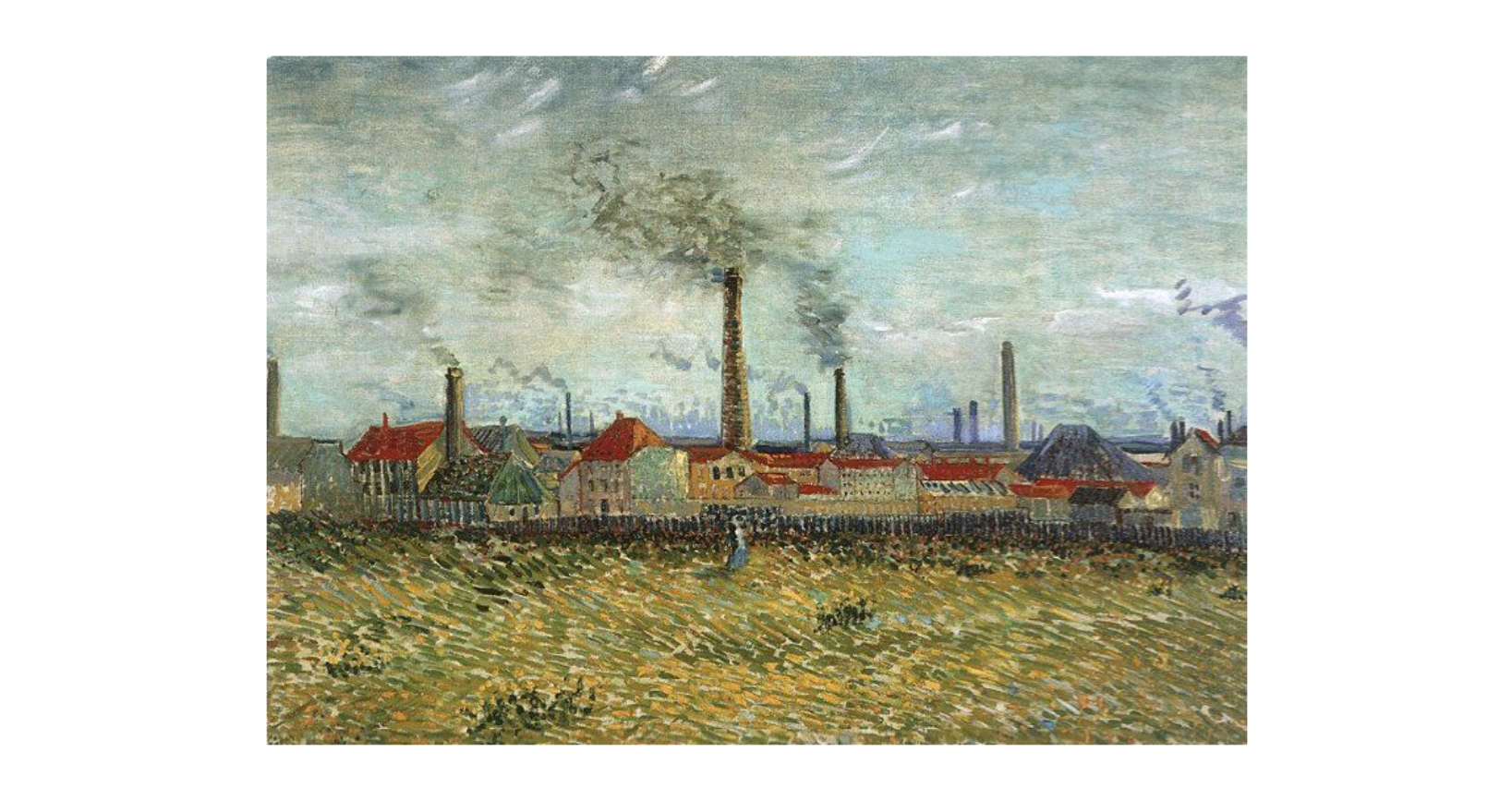
F317-F318 Asnières landscape series 1887
His indoor colour experiments in Paris needed an outdoors to test them, and the Seine, at the edge of the city, was within walking distance.
In 1887 he painted by the river at Asnières with Signac and that circle — the bridge, factory chimneys, the surface of the water. He took in divided colour and a high key, yet did not hand himself over wholly to strict Pointillism; but the way he broke colour apart began to change here.
He wanted to go somewhere farther and brighter than the outskirts of Paris. The talk of "going to Japan," of "going South," would not appear in his letters until after Arles; but the place where it began may well be here.
Events
- The Colour Experimenter
The indoor flower and still-life experiments moved outdoors. Asnières, on the Seine and close to the city, was the right place to put colour theory into bridges, riverbanks, factories and sky
- The Translator
He worked around Signac, Bernard and other young painters, absorbing divided colour and high-key light without becoming a strict Pointillist. He kept the parts that answered his own problem
- Synaesthetic Precision
The Asnières landscapes break river water, bridges, chimneys and tree shadows into short strokes. Light no longer spreads evenly; brushwork breaks it into visible vibration
- The Colour Experimenter
After discussing neo-impressionist colour with Signac, he carried the complementary relations learned in flower still lifes into landscape: blue and orange, green and red, yellow and violet began to check one another outdoors
- The Colour Experimenter
Asnières was not an endpoint but a testing ground before departure. Its high-key outdoor light helped convince him that the next step had to be farther, brighter, closer to the South he imagined as Japan
Essays
Long-form reading connected to this node.
Technique Evidence
This work appears as evidence in this site’s technique-evolution axis.