Doctor Gachet
The painted face is Gachet's; the changing judgment belongs to Vincent's letters.
-
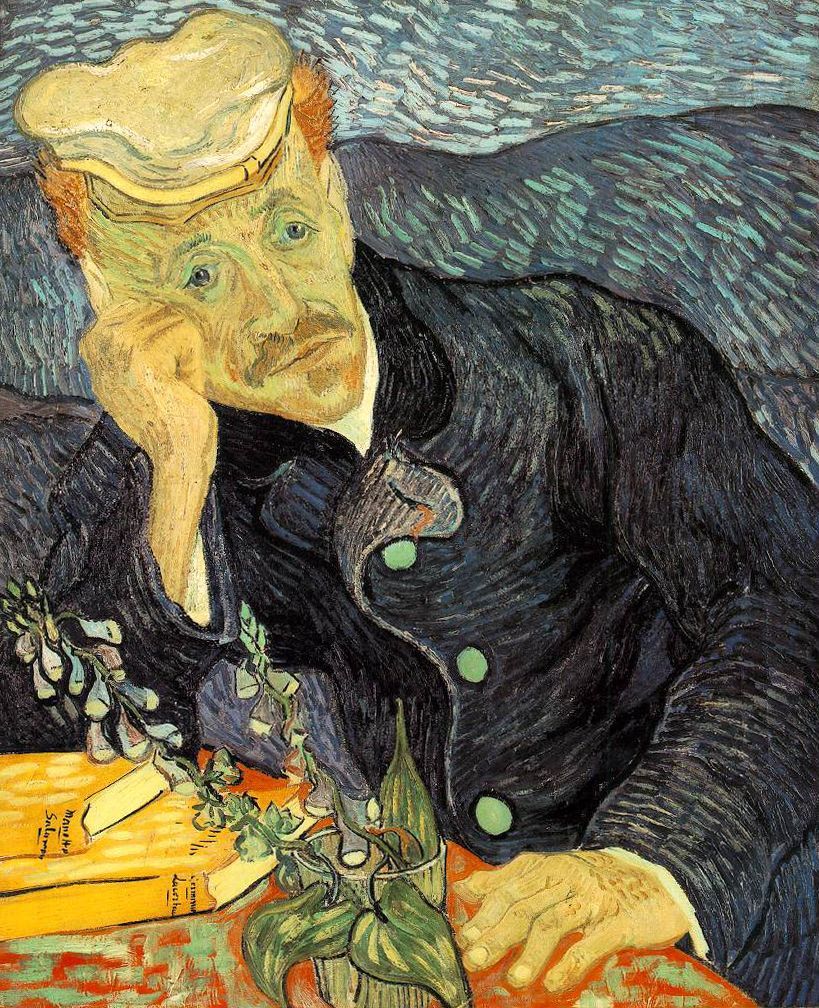
F753 Portrait of Doctor Gachet 1890 -
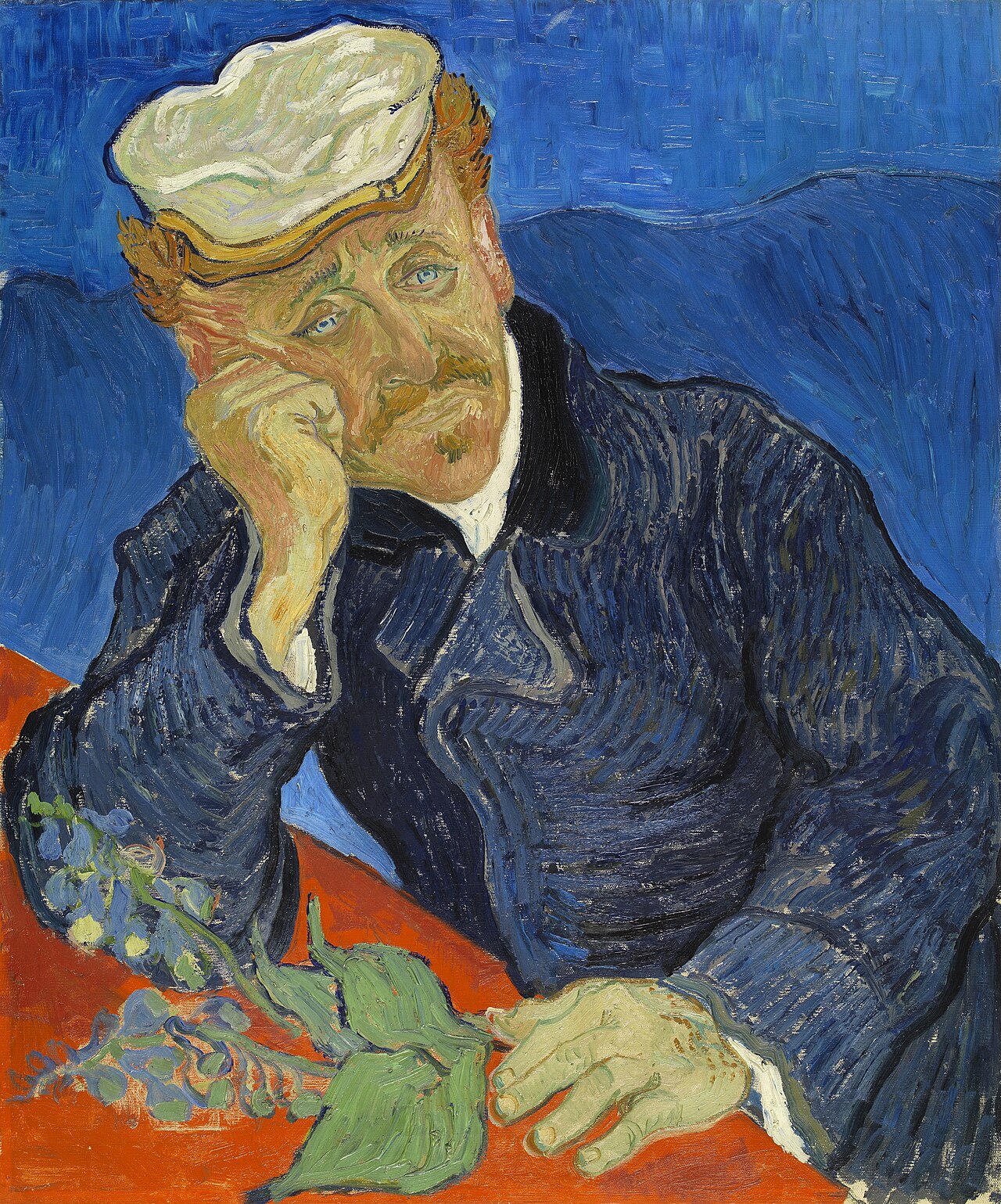
F754 Portrait of Doctor Gachet (second version) 1890
Painting
Two versions. Doctor Gachet sits at a table, leaning his head against his hand, elbow resting on the surface — the posture of someone waiting for a patient to finish speaking. He wears a dark blue coat, on the table is a sprig of foxglove (a plant used to treat heart conditions, and Gachet's own remedy), the background is cobalt — flattened, depthless, like a wall in a Japanese print. His face is sallow, his cap a soft greyish white, his hands faintly red, the whole canvas's colour pressed low, pressed flat, pressed into a melancholic frequency. He wrote: "An expression of melancholy which would often appear to be a grimace to those who look at it." The table differs between the two versions: the first also includes two yellow-covered novels, Manette Salomon and Germinie Lacerteux; the Musée d'Orsay version has no books, and the foxglove changes position. Gachet had published a study of melancholy in 1858 that described the contracted body and the head sinking into the hand; this is historical context for the portrait, not evidence that Vincent staged it from the text.
Letter
Early June 1890. "I've done the portrait of M. Gachet with an expression of melancholy which would often appear to be a grimace to those who look at it." Another letter: "Sad but gentle and clear and intelligent, that is how one ought to paint many portraits." A third gives the colour scheme: "The head with a white cap, very fair, very light, the hands also with a light flesh tint, a blue frock coat and a cobalt blue background." Three sentences, taken together, form a portrait theory — melancholy is not pathology, it is a modern face; that face deserves to be painted seriously; colour is what supports the melancholy.
Place
Auvers-sur-Oise, Doctor Gachet's house. Gachet was the man meant to keep Vincent well — a physician who collected Impressionists, painted under a pseudonym, knew Cézanne and Pissarro. But Vincent's verdict, in a letter to Theo, was colder than the portrait: "I think we must not count on Dr Gachet at all. He is sicker than I am, it seemed to me, or let's say just as much." He painted the man anyway, in the man's own house. Five weeks later he was dead, and Gachet was at the bedside.
Before Vincent arrived in Auvers, Theo had arranged for him to meet Dr. Gachet: a physician who painted in his spare time and was known to Pissarro.
In the portrait, Gachet's expression is melancholy. Writing to Willemien on 13 June, Vincent said it might look like a grimace, but that present-day faces held passion, waiting, and a shout. In an unsent draft to Gauguin a few days later, he called it "the deeply sad expression of our time." On 3 June he had written that Gachet seemed as ill and confused as himself; two days later, that Gachet was very nervous and bizarre. These were Vincent's impressions, not a diagnosis.
The change is visible in the letters. In an unsent draft of 24 May he doubted that he could rely on Gachet. By 3 and 5 June he called him a firm friend, then a ready-made friend and something like a new brother.
Events
- Synaesthetic Precision · Letter 877
Met Doctor Paul Gachet on the very first day in Auvers. A physician sympathetic to artists — in his youth he had moved among the Impressionists, was a friend of Cézanne and Pissarro
- The Colour Experimenter · Letter 879
'The head with a white cap, very fair, very light, the hands also with a light flesh tint, a blue frock coat and a cobalt blue background.' The colour scheme written into the letter
- Synaesthetic Precision · Letter 879
Completed the first Portrait of Doctor Gachet — the doctor leaning his head on his hand, elbow on the table, a sprig of foxglove on the surface. Translating 'melancholy' into a concrete bodily posture
- Synaesthetic Precision · Letter 879
'With an expression of melancholy which would often appear to be a grimace to those who look at it.' He knew the melancholy was not pretty, but insisted on painting it
- Synaesthetic Precision · Letter 881
'Sad but gentle and clear and intelligent — that is how one ought to paint many portraits.' A portrait theory: melancholy is not pathology, it is a modern face
From the Letters
J'ai fait le portrait de M. Gachet avec une expression de mélancolie qui souvent à ceux qui le regarderaient pourrait paraître une grimace. I've done the portrait of M. Gachet with an expression of melancholy which would often appear to be a grimace to those who look at it.
Triste mais doux et clair et intelligent, c'est ainsi qu'il faut faire beaucoup de portraits. Sad but gentle and clear and intelligent, that is how one ought to paint many portraits.
La tête avec une casquette blanche, très blonde, très claire, les mains aussi à carnation claire, un frac bleu et un fond bleu cobalt. The head with a white cap, very fair, very light, the hands also with a light flesh tint, a blue frock coat and a cobalt blue background.
Letter Sources
Van Gogh letter records referenced on this page, linked to the Van Gogh Letters Project. vangoghletters.org
Technique Evidence
This work appears as evidence in this site’s technique-evolution axis.
- The Burning Seventy Days 1890.05 – 1890.07 Open period F753 / JH2007 Portrait of Dr. Gachet Speed Representative work from the 70-day Auvers burst