Rain over Auvers
The angle at which those lines fall is already speaking, and needs no explanation.
-
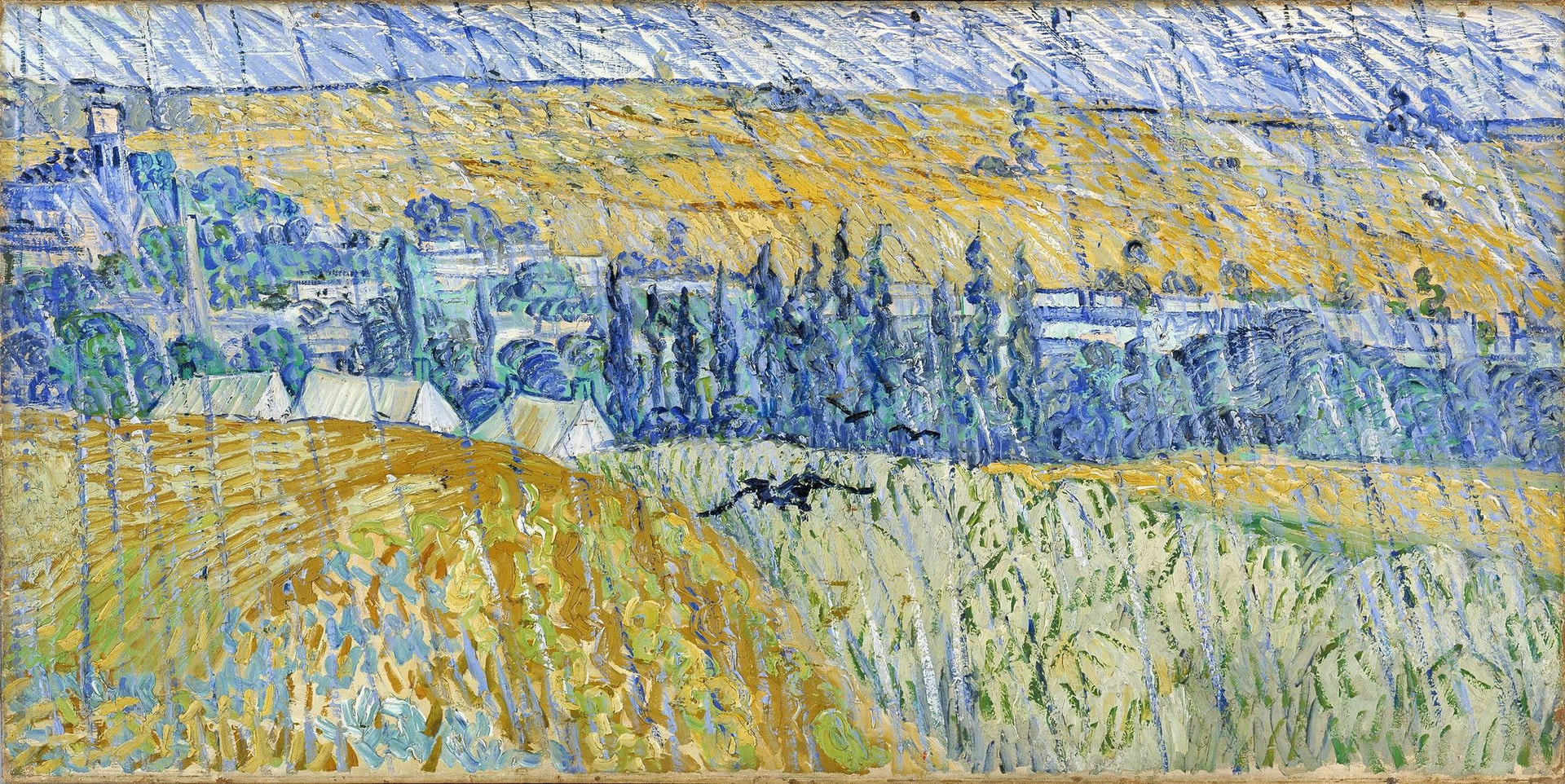
F811 Landscape at Auvers in the Rain 1890
The wheat fields of Auvers, in July; the weather changed, and he watched the rain.
Diagonal threads of rain cut the picture on a slant. He is not describing a rainfall but making emotion into a physical shape — letting the viewer feel that slant on the skin.
From here to the tree roots, language grows ever scarcer, and the paintings come to look more and more like marks left directly behind.
Events
- Synaesthetic Precision · Letter 898
In the last weeks at Auvers a northern rain came — slanted, dense; Provence does not have rain like this. The rain of his Brabant childhood, falling again
- The Colour Experimenter · Letter 898
Completed Landscape at Auvers in the Rain — a wide 50 × 100 cm canvas, deep violet sky, dark green wheat, the distant village in greyish white
- Synaesthetic Precision
Scratched in countless slanting grey-white streaks with a hard tip — pass after pass. The rain was not painted into the landscape; it was another layer placed on top of it
- Synaesthetic Precision · Letter 898
'They are vast stretches of wheat under troubled skies — and I did not need to go out of my way to express sadness and extreme loneliness.' His most direct self-statement
- The Colour Experimenter · Letter 898
The colour experimenter's last experiment — not pushing colour to the limit of saturation, but pulling it back, letting it be seen through a medium
From the Letters
Ce sont d'immenses étendues de blés sous des ciels troublés, et je ne me suis pas gêné pour chercher à exprimer de la tristesse, de la solitude extrême. They are vast stretches of wheat under troubled skies, and I did not need to go out of my way to try to express sadness and extreme loneliness.
Letter Sources
Van Gogh letter records referenced on this page, linked to the Van Gogh Letters Project. vangoghletters.org