The Sower Motif
The sower returned across the years, but never as a single unchanged image.
-
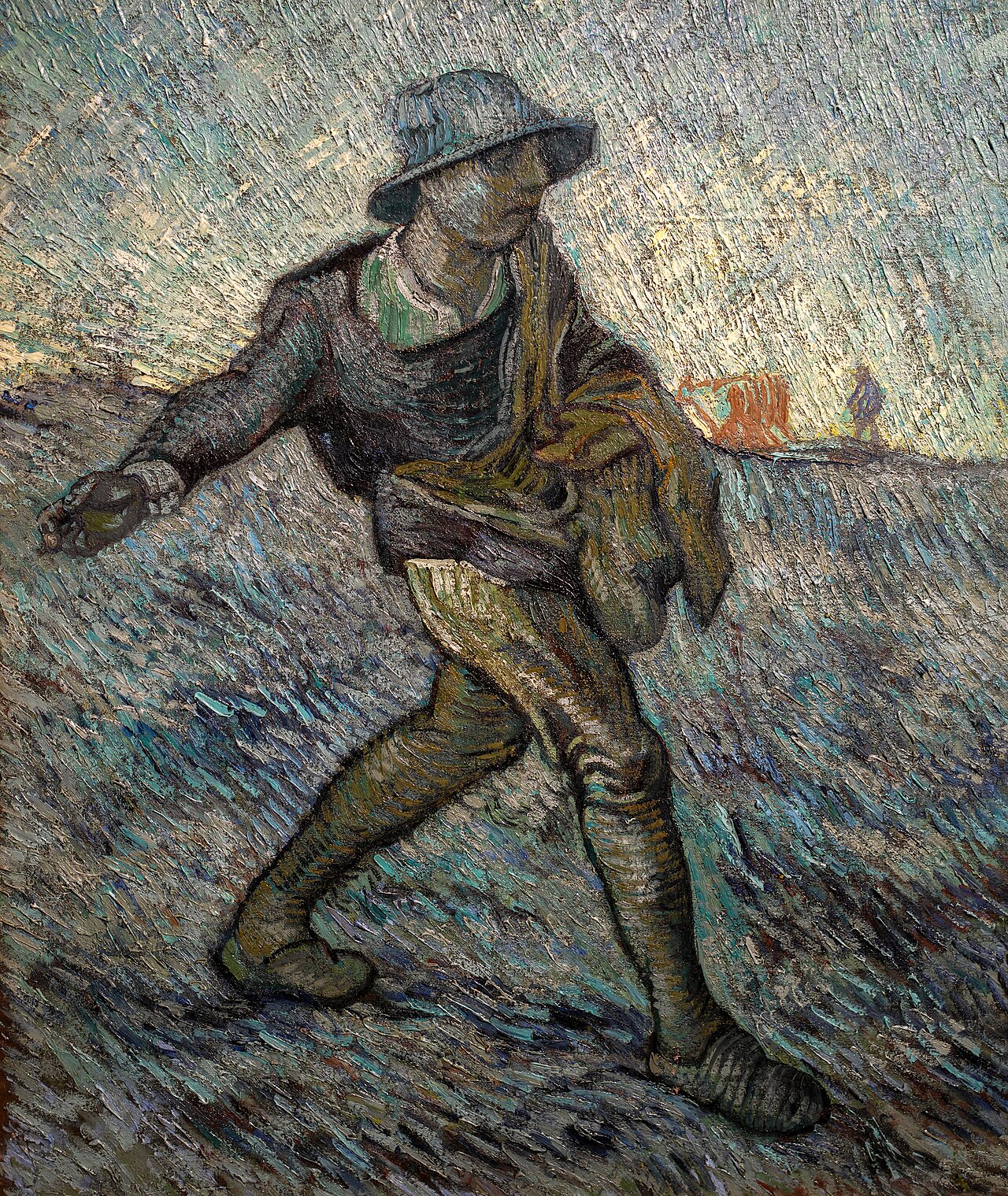
F830 Sower (after Millet) 1881 -
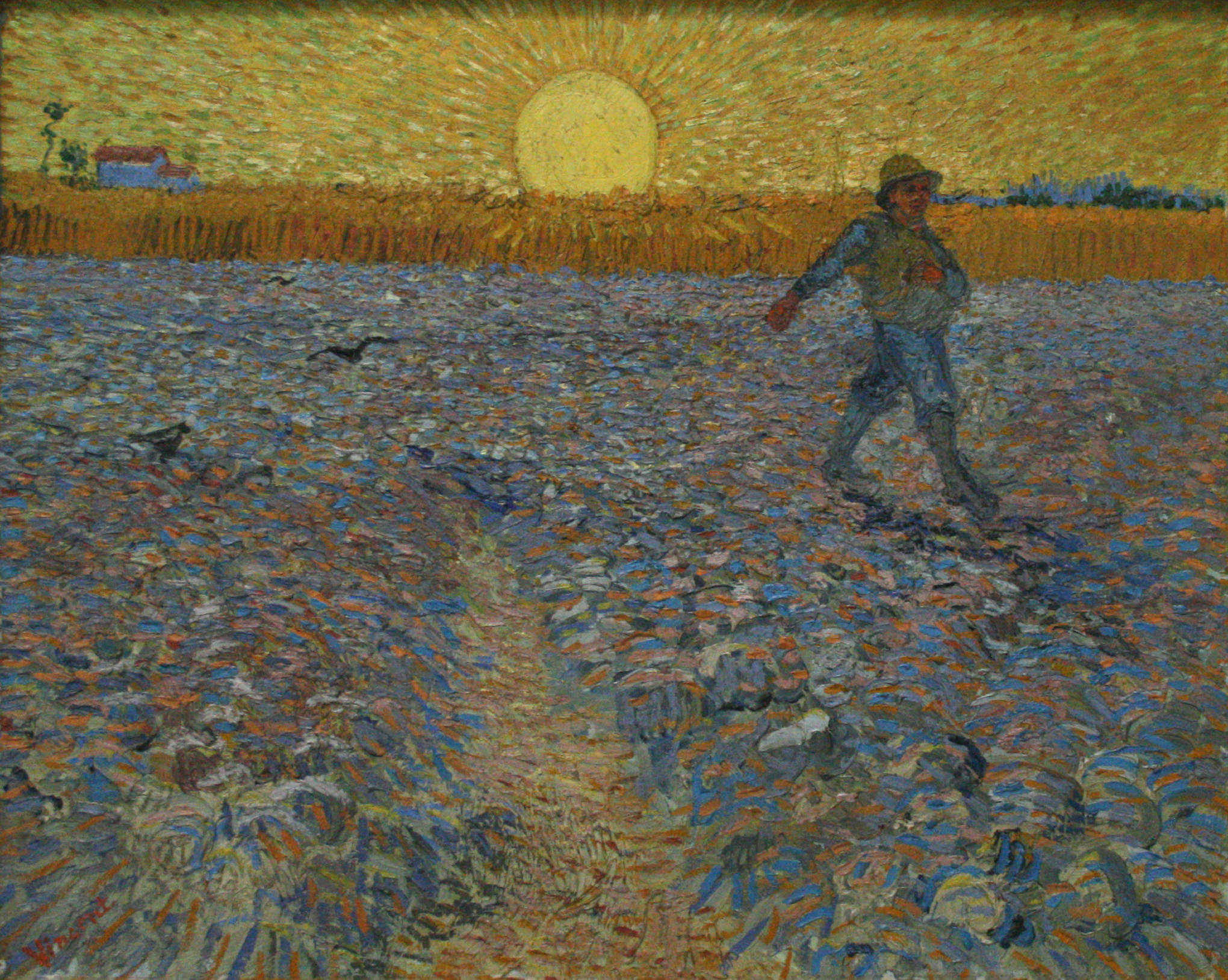
F422 The Sower 1888 -
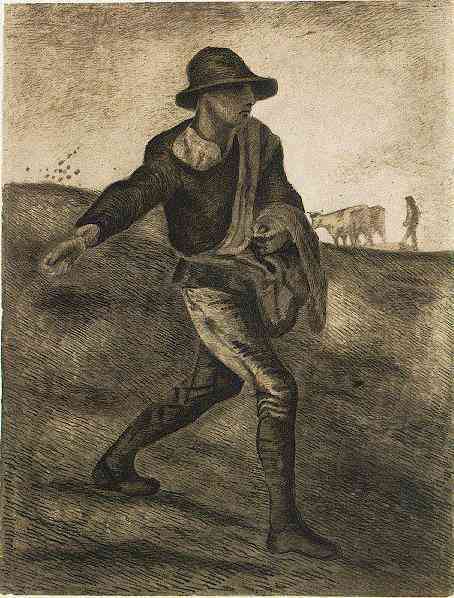
F450 The Sower (large) 1888
Painting
From 1881 to 1890, at least six versions. The earliest is a copy of Millet's black-and-white print — clumsy pencil lines. The 1888 Arles version explodes: a huge lemon-yellow sun, violet earth, Prussian blue sower. From black-and-white to colour, from another's composition to his own chromatic system — this line is his ten-year growth trajectory.
Letter
"The sower is always what I'd most like to do." He wrote this in June 1888. In the same letter he described the colours: lemon-yellow sun, yellow-green sky with pink clouds, violet ground, Prussian blue sower and tree. Later in Saint-Rémy, he called copying Millet "translating music" — black-and-white is the score, colour is the performance.
Place
This motif has no single place — it has four. Etten 1881, a clumsy pencil copy of Millet, the year of the rejected proposal. Nuenen 1884, dark, among the weavers. Arles 1888, the colour explosion, the month Gauguin was expected. Saint-Rémy 1889, behind the wall, returning to Millet with his own palette. Nine years, four rooms, one figure he could never finish with.
Millet's Sower was present from Van Gogh's earliest drawing exercises. In 1882, he listed a print of it among the images hung in his home; he would return to Millet's subjects throughout his working life.
At Arles, the motif became Sower with setting sun. The figure remains a peasant at work, but Van Gogh recast the field through colour and the large disc of the sun.
In Saint-Rémy he again worked from prints after Millet, including The sower. The recurrence is documented; a single fixed meaning is not.
Events
- The Copyist · Letter 156
Starting in Etten — copying Millet's print The Sower. These were among the first serious drawings on record
- The Copyist · Letter 156
Kept copying Millet. 'The sower is always what I'd most like to do.' A motif declared at the start of his career and held to the end
- The Colour Experimenter · Letter 558
Arles, the first independent colour Sower. 'Large lemon-yellow sun. Yellow-green sky with pink clouds. Ground violet, the sower and the tree Prussian blue.' The colour recipe written into the letter
- The Translator · Letter 634
Painted a large Sower around the time of Gauguin's arrival in Arles. Millet's subject placed onto the flat composition of a Japanese print, with extreme complementary colour — one motif, three languages stacked
- The Translator · Letter 805
Returned again to copying Millet during the Saint-Rémy asylum period. Wrote: 'Copying Millet's Labours of the Fields is rather translating into another language — that of colours — the impressions of chiaroscuro in black and white.'
- Synaesthetic Precision · Letter 805
The nine-year arc closes here. From 'breathing through someone else's body' (1881) to 'living once more by his own pulse' (1889) — the same sower, three palettes, five paintings
From the Letters
Le semeur est toujours ce que je voudrais le plus faire. The sower is always what I'd most like to do.
J'ai un semeur. Grand soleil jaune citron. Ciel jaune-vert avec nuages roses. Le terrain violet, le semeur et l'arbre bleu de Prusse. I have a sower. Large lemon-yellow sun. Yellow-green sky with pink clouds. The ground violet, the sower and the tree Prussian blue.
Copier les Travaux des champs de Millet, c'est plutôt traduire dans une autre langue — celle des couleurs — les impressions de clair-obscur en blanc et noir. Copying Millet's Labours of the Fields is rather translating into another language — that of colours — the impressions of chiaroscuro in black and white.
Letter Sources
Van Gogh letter records referenced on this page, linked to the Van Gogh Letters Project. vangoghletters.org
Technique Evidence
This work appears as evidence in this site’s technique-evolution axis.