1889 · F617 · JH1753
Wheat Field with Reaper
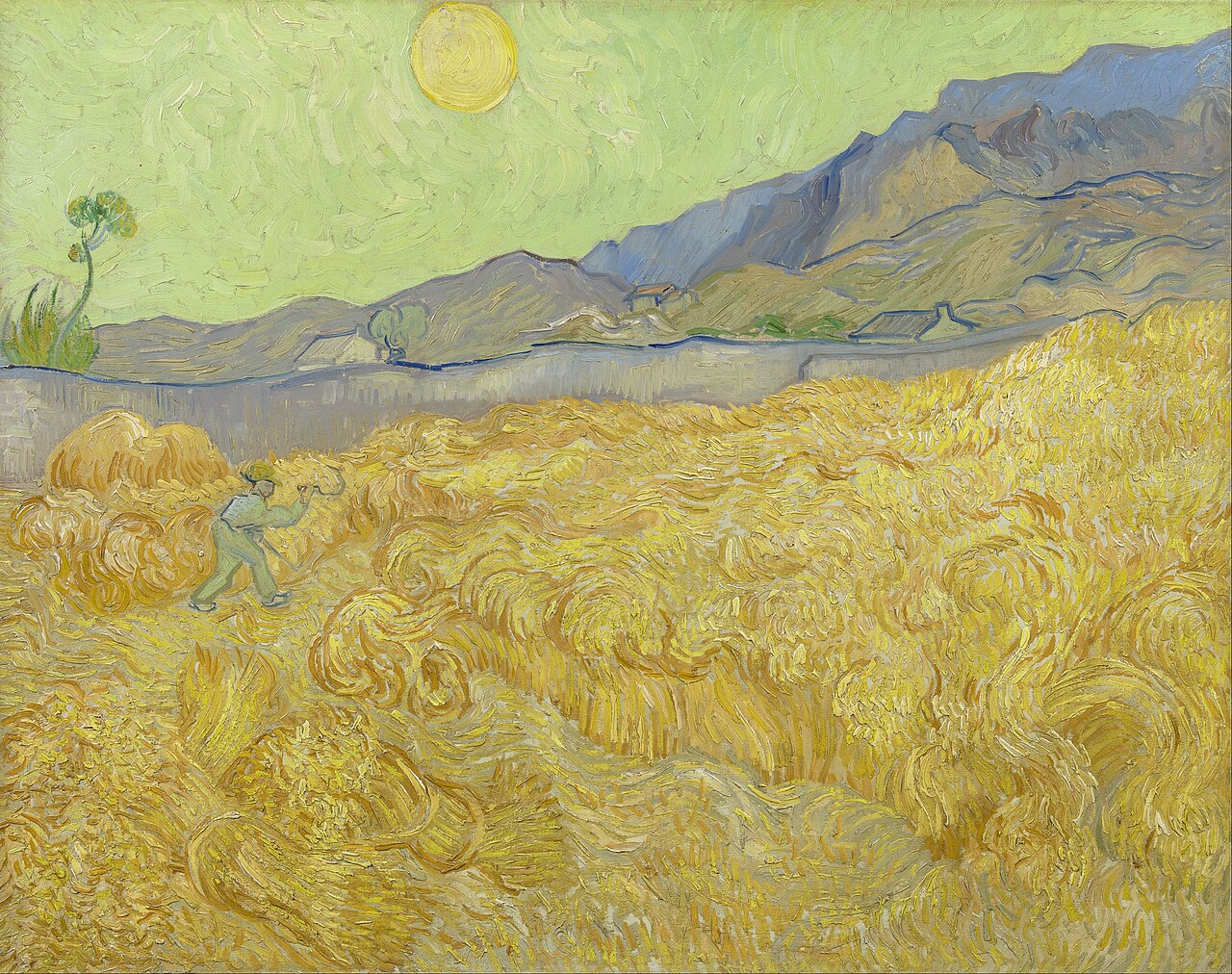
In Wheat Field with Reaper (F617), the small worker is almost lost in a field of yellow. Van Gogh's September 1889 letter lets us read the figure without treating the painting as a prediction of his own death.
Wheat Field with Reaper meaning and analysis
In Wheat Field with Reaper (F617), the small worker is almost lost in a field of yellow. Van Gogh's September 1889 letter lets us read the figure without treating the painting as a prediction of his own death.
Continue with this work in the context of The Wheat Fields.
Meaning
In letter 800, Van Gogh saw the reaper as an image of death: humanity is the wheat being cut. He immediately added that this death had nothing sad about it. The two statements belong together, rather than making the painting simply cheerful or ominous.
Visual Analysis
The field occupies nearly the whole canvas. The sun and a narrow line of violet hills hold the upper edge, while the reaper is only a small blue-green presence among the wheat. The sickle is there, but barely visible.
Symbolism
The reaper can carry Van Gogh's own comparison between harvest and mortality, but the worker remains a person at work in a real landscape. The letter speaks of an almost smiling quality, not a literal smile on the figure.
Technique
Impasto in yellow builds the wheat; a few touches of blue in the wet paint make the figure's outline greenish. The surface lets the person emerge from the crop without pulling the eye away from the field.
Period Context
In Saint-Rémy, letter 800, dated 5-6 September 1889, says this canvas was finished. In letter 806, Van Gogh distinguished this version, painted from life, from a large studio repetition (F618). The two should not be merged into one artwork.
Related Letters
Letter 800 supplies the death comparison, the insistence that it is not sad, and the description of yellow with violet hills. Letter 806 identifies the version painted from life and the later repetition.
FAQ
- What does the reaper mean in this painting?
- Van Gogh compared the reaper to death and humanity to harvested wheat, but expressly said there was nothing sad in this death.
- When was F617 finished?
- Van Gogh said it was finished in a letter dated 5-6 September 1889. A second large version, F618, was painted in the studio.
Sources
Wheat Field with Reaper, Saint-Rémy, 1889. In an early September letter, Van Gogh called the reaper an 'image of death' but said there was nothing sad in it. The field is flooded with golden daylight; the sickle is barely visible.