Cypresses
He did not find the tree first in his letters; he caught up to it, in the letters, as he painted.
-
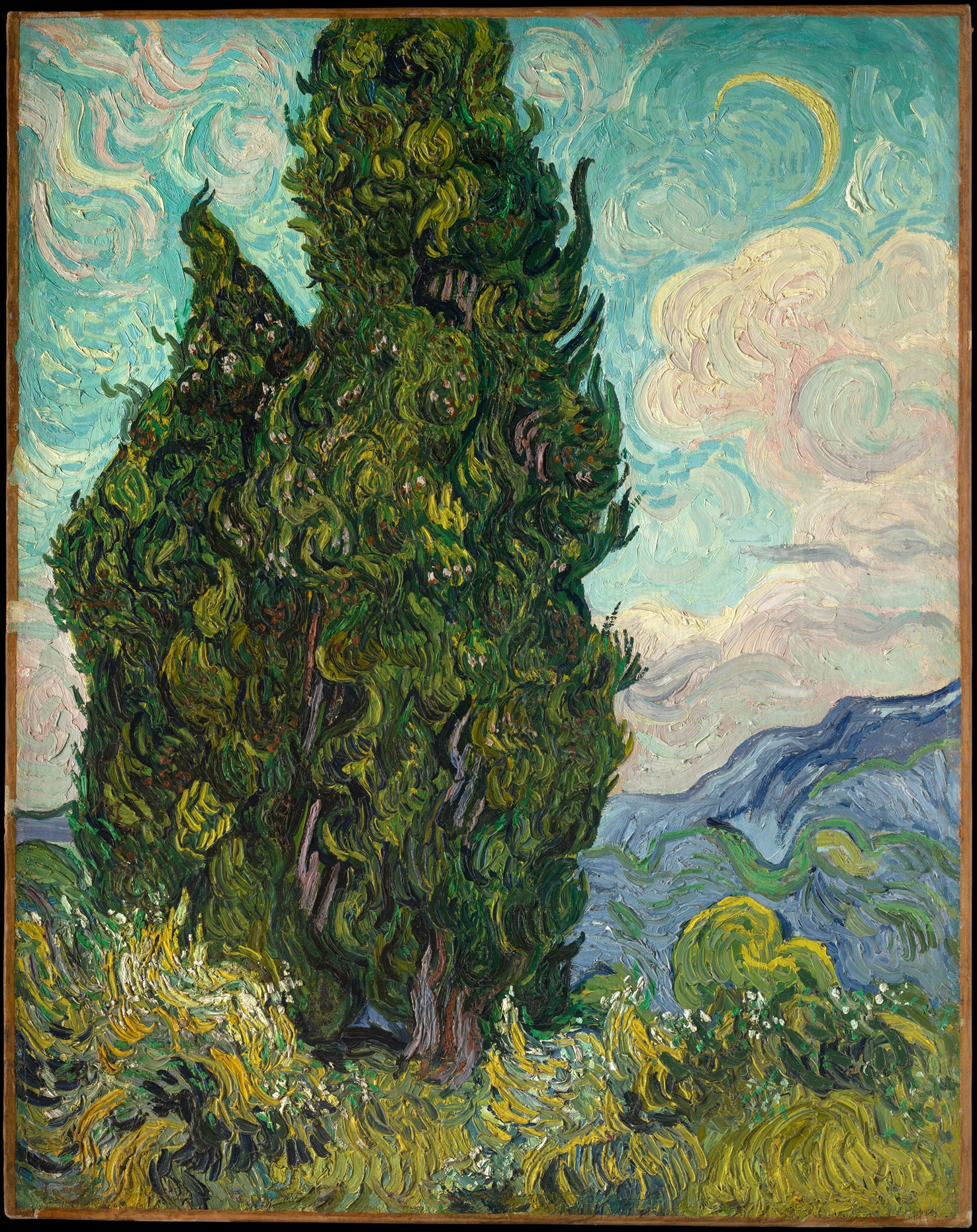
F613 Cypresses 1889 -
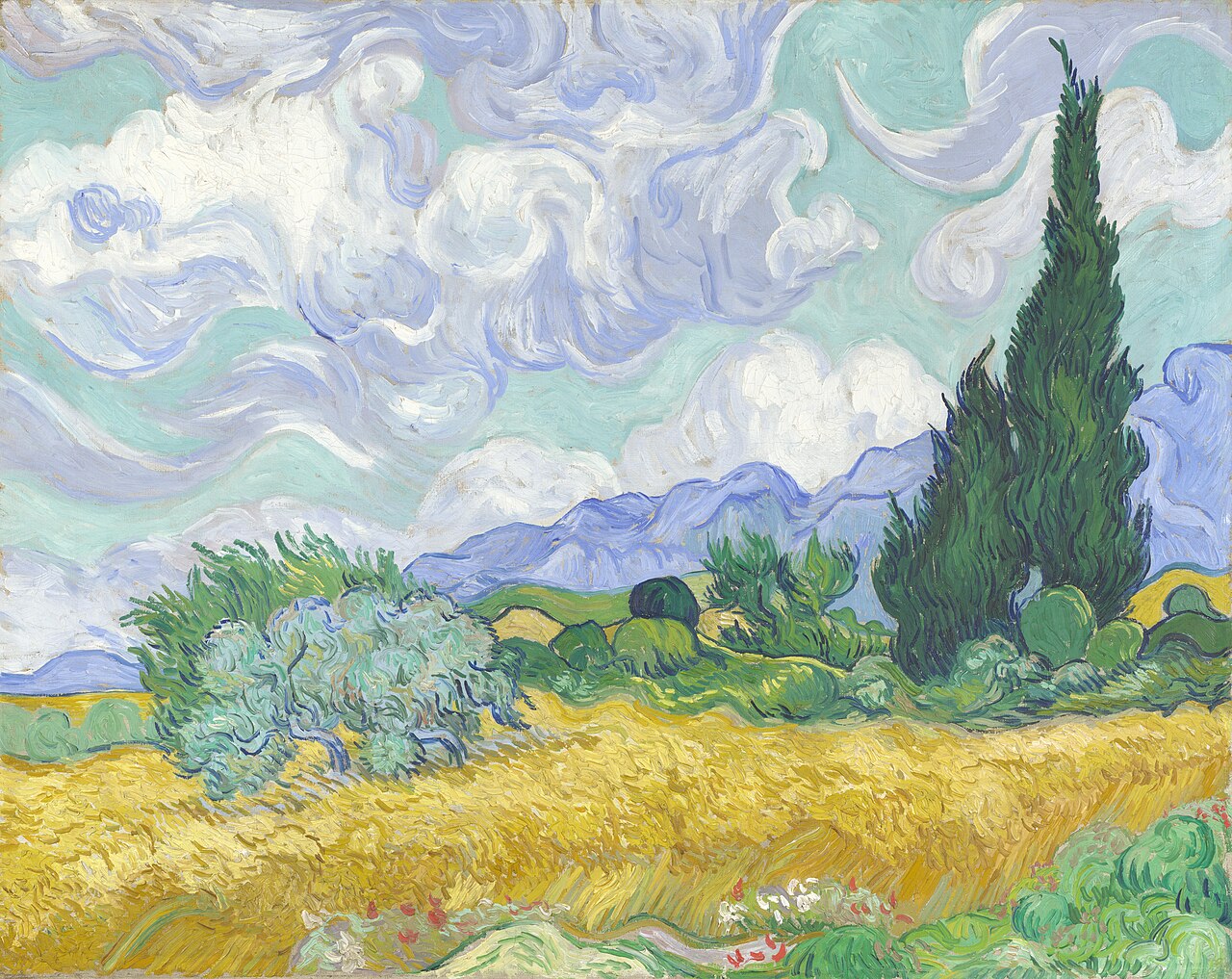
F717 Wheat Field with Cypresses 1889 -
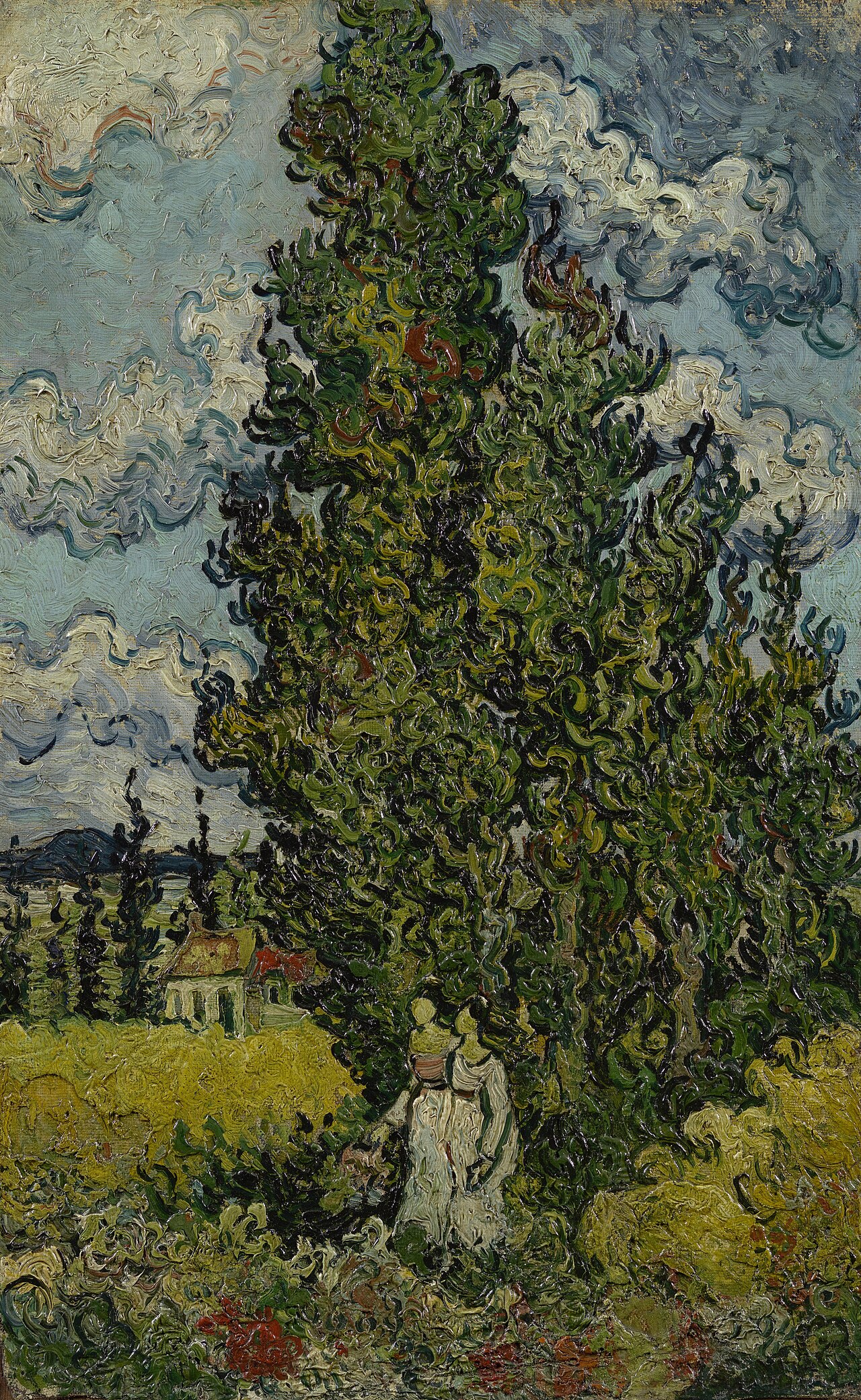
F620 Cypresses with Two Women 1889
Painting
From June 1889 onward, for several months, he returned to the same subject — cypresses. Three representative paintings: pure cypresses (two trees almost filling the canvas), Wheat Field with Cypresses (a single dark spear standing in a sea of gold), Cypresses with Two Women. The colour ranges from deep green to ink black — he himself called it "the dark patch in a landscape." But he made the dark glow with twisting, ascending, fire-licked brushwork — every stroke goes upward, every stroke has direction, the whole tree both burning and silent.
Letter
June 1889. "The cypresses still preoccupy me. I'd like to do something with them like the Sunflowers, because it astonishes me that no one has yet done them as I see them." Another line: "It is beautiful in line and proportion, like an Egyptian obelisk." A third: "It is the dark patch in a sunlit landscape, but it is one of the most interesting dark notes — the most difficult to hit off exactly that I know of." Three sentences place the cypress: motif, geometry, colour problem. He wanted the cypress to occupy in painting history the position an obelisk occupies in architecture.
Place
Outside the wall of the Saint-Paul Hospital — and everywhere else in Provence. He could see them from the second-floor window of his room. Mediterranean wind made them sway violently — green flames. From May onward he was allowed out of the ward, walking to the field's edge, the wheat's edge, the wall's edge to paint cypresses. These were the last months before he was permitted to leave; each cypress carries the mark of being looked at by someone counting.
After a round of the garden and the fields, he began to notice the cypresses at the garden's edge.
He wrote (letter 783): "The cypresses still preoccupy me. I’d like to do something with them like the canvases of the sunflowers, because it astonishes me that no one has yet done them as I see them. It’s beautiful as regards lines and proportions, like an Egyptian obelisk." He painted several versions, searching for that sense of the vertical in motion.
He did not think for months in language before lifting the brush; rather, language and canvas appeared almost together. As he painted he tried, in sentences, to explain why this black-green tree deserved to be worked over and over, like the Sunflowers.
Events
- Synaesthetic Precision · Letter 783
'The cypresses still preoccupy me — I'd like to do something with them like the Sunflower canvases. It astonishes me that no one has yet done them as I see them.'
- Synaesthetic Precision · Letter 783
'It is beautiful in line and proportion, like an Egyptian obelisk.' Synaesthetic precision at its furthest reach — naming a Mediterranean tree with the stone column of an Egyptian temple
- The Colour Experimenter · Letter 783
'It is the dark patch in a sunlit landscape — and the most difficult dark note I know to hit off exactly.' Treating the cypress as a colour-theory problem
- The Colour Experimenter · Letter 784
Completed Cypresses — two trees almost filling the canvas. Deep green to ink black split into multiple layers, keeping the 'black' breathing internally
- Synaesthetic Precision · Letter 785
Completed Wheat Field with Cypresses — a single cypress standing like a spear in a sea of gold. Obelisk geometry stacked onto wheat-field motion
- The Translator · Letter 785
Painted Cypresses with Two Women. The same tree appears across three paintings in three roles: architecture, monument, living being
From the Letters
Les cyprès me préoccupent toujours, je voudrais en faire une chose comme les toiles des tournesols, parce que cela m'étonne qu'on ne les ait pas encore faits comme je les vois. The cypresses still preoccupy me, I'd like to do something with them like the sunflower canvases, because it astonishes me that no one has yet done them as I see them.
C'est beau comme lignes et comme proportions, comme un obélisque égyptien. It is beautiful in line and proportion, like an Egyptian obelisk.
C'est la tache noire dans un paysage ensoleillé mais c'est une des notes les plus intéressantes, la plus difficile à toucher juste que je connaisse. It is the dark patch in a sunlit landscape, but it is one of the most interesting dark notes, the most difficult to hit off exactly that I know of.
Letter Sources
Van Gogh letter records referenced on this page, linked to the Van Gogh Letters Project. vangoghletters.org
Technique Evidence
This work appears as evidence in this site’s technique-evolution axis.
- The World in Motion 1889.05 – 1890.05 Open period F615 / JH1755 Wheatfield with Cypresses Impasto Visible impasto and thick brushwork Brushstroke Representative of swirling brushwork