The Hospital Garden
After his range became smaller, he looked at that small place more thoroughly.
-
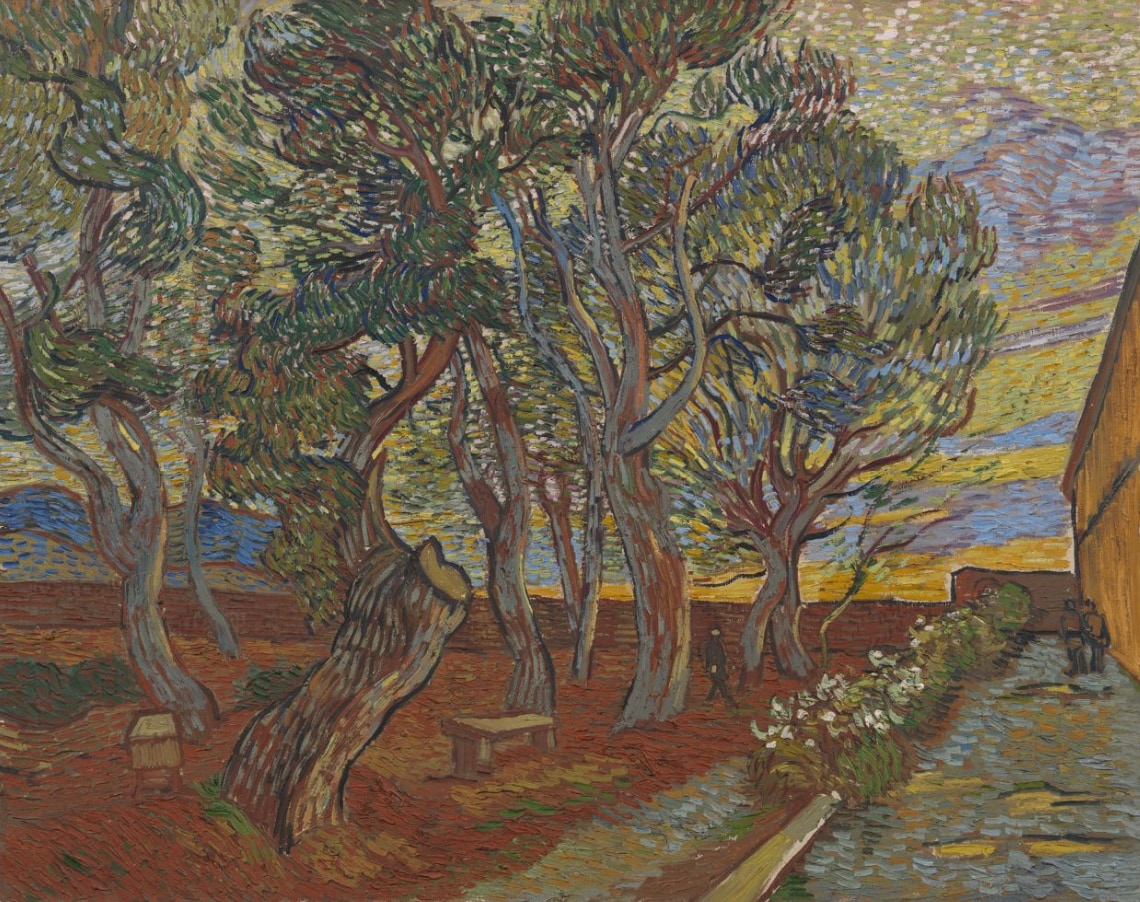
F659 The Garden of Saint-Paul Hospital 1889 -
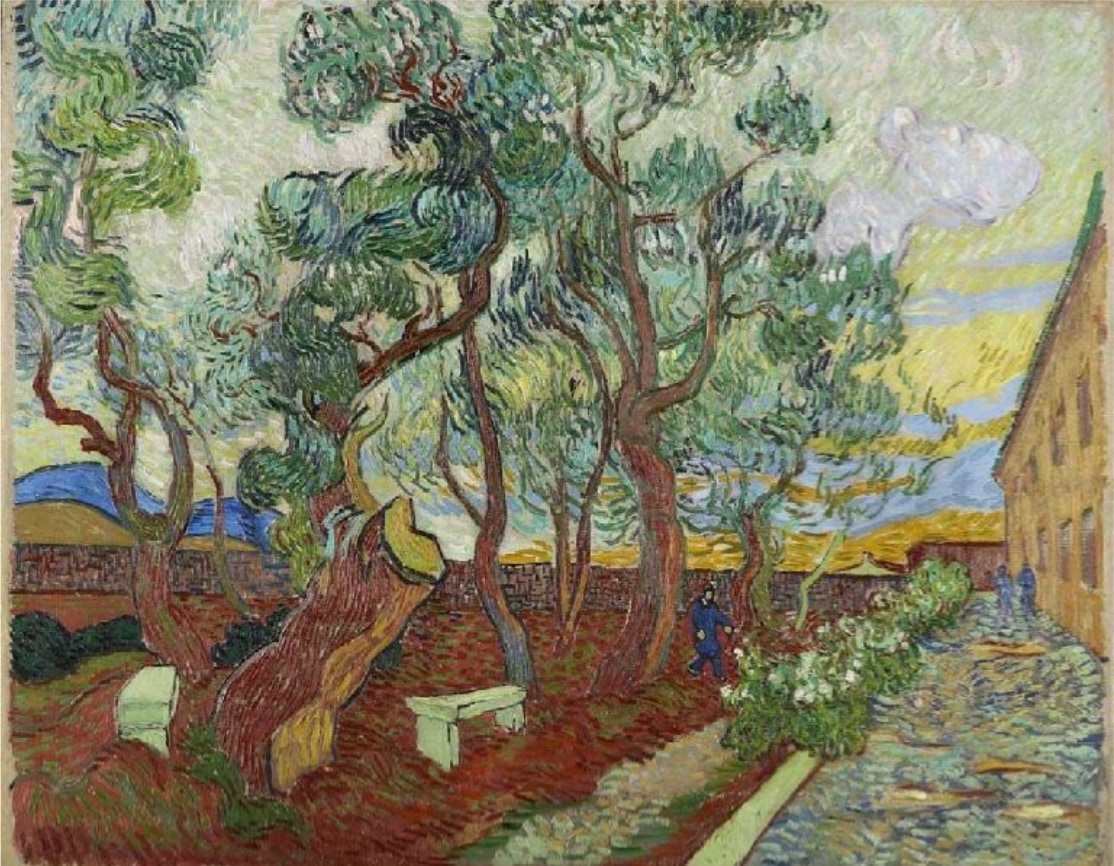
F660 The Garden of Saint-Paul Hospital (Essen) 1889 -
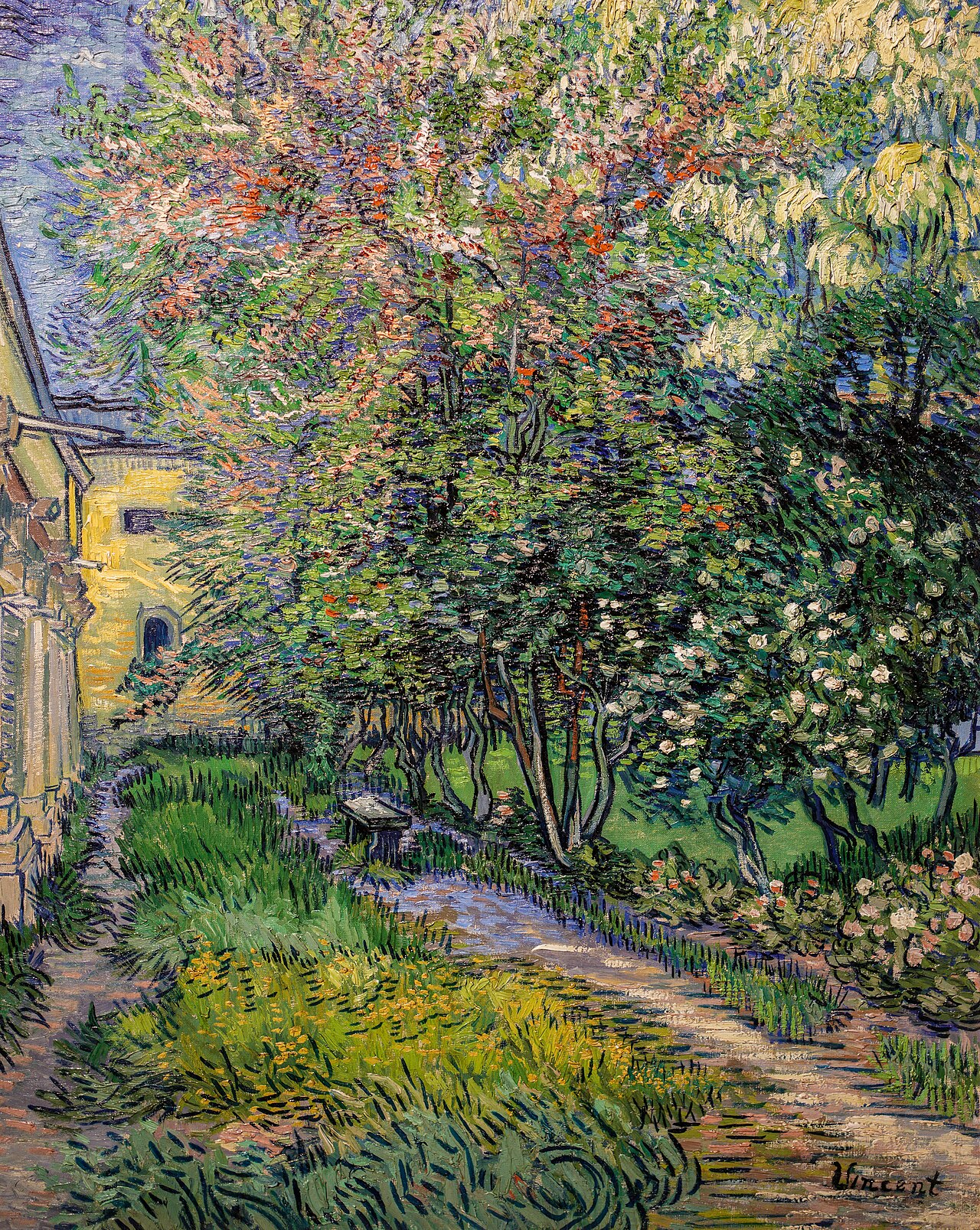
F734 The Garden of Saint-Paul Hospital (May) 1889
Painting
These three paintings show different views of the same hospital garden, not three details of one canvas. In F734 a path curves from the building at left into flowering trees. F660 and F659 are horizontal views: bent pines fill the foreground, while paths, benches and figures appear between the trunks. Their compositions and colours differ, but those differences alone do not establish the painter's mental state.
One less noticed work on paper, *Corridor in the Asylum* (F1529), writes constraint into its material. Long taken for gouache, technical examination identifies diluted oil paint; oil seepage on the verso fluoresces yellow under ultraviolet light. With supplies greatly depleted, he used the oil paint at hand to keep working on paper. Its pink Ingres paper absorbed excess oil, helping the paint take on the matte appearance of gouache.
Letter
1889. "The garden of the asylum is very beautiful — there are magnificent trees." Another: "I see the gardens of the asylum through the iron window of my room." A third: "The garden is planted with large pines beneath which grows tall and unkempt grass, mixed with various weeds." The three sentences map his three positions inside the asylum: distant view (the iron window), entry (allowed out of the ward), close view (sitting under the trees, looking carefully).
Place
Saint-Paul-de-Mausole, a former monastery outside Saint-Rémy. He committed himself voluntarily — no one sent him; he signed the register in his own hand. Dr. Peyron ran it; half the rooms stood empty. Twice a week he was let out as far as the wheat and the olives; the rest of the week the garden was the entire reachable world. He stayed exactly twelve months. After leaving here, he went to Auvers.
He committed himself to Saint-Rémy of his own will, knowing his range would be restricted, but feeling this was better than staying in Arles under everyone's watch.
The range he could move in was the garden and the nearby fields. He accepted the restriction as a condition, and then began to paint every corner of the garden, painting whatever he saw.
He stayed here a year and a week, suffered several attacks, and also kept working between the attacks. He did not explain how those two things could coexist.
Events
- Synaesthetic Precision · Letter 777
'I see the gardens of the asylum through the iron window of my room.' Observation phase one: distant view
- The Colour Experimenter · Letter 776
'The garden of the asylum is very beautiful — there are magnificent trees.' Observation phase two: granted entry
- The Colour Experimenter
The May hospital-garden painting F734: a path beside the building leads into flowering trees.
- Synaesthetic Precision · Letter 784
'The garden is planted with large pines beneath which grows tall and unkempt grass, mixed with various weeds.' Observation phase three: sitting close, looking carefully
- The Colour Experimenter · Letter 816
By 3 November at the latest, Van Gogh had mentioned the horizontal garden painting F660 in a letter. Pines, benches, figures and the building at right take a new arrangement.
From the Letters
Le jardin de l'asile est très beau — il y a des arbres magnifiques. The garden of the asylum is very beautiful — there are magnificent trees.
Je vois les jardins de l'asile à travers la fenêtre de fer de ma chambre. I see the gardens of the asylum through the iron window of my room.
Le jardin est planté de grands pins sous lesquels pousse de l'herbe haute et mal soignée, mêlée de diverses mauvaises herbes. The garden is planted with large pines beneath which grows tall and unkempt grass, mixed with various weeds.
Letter Sources
Van Gogh letter records referenced on this page, linked to the Van Gogh Letters Project. vangoghletters.org