Irises: moment and letters
In his first letter from Saint-Rémy, two garden paintings were already under way.
-
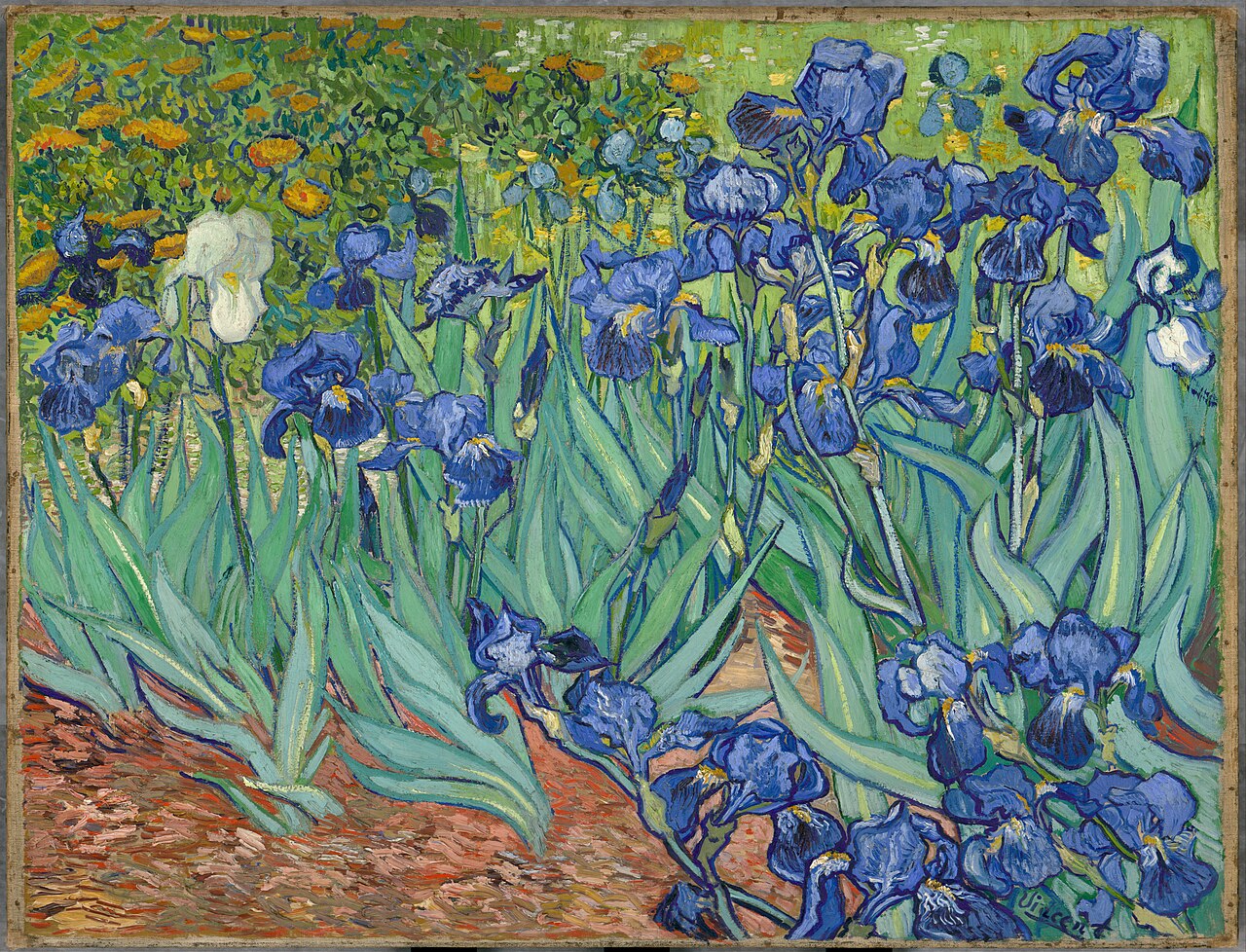
F608 Irises 1889 -
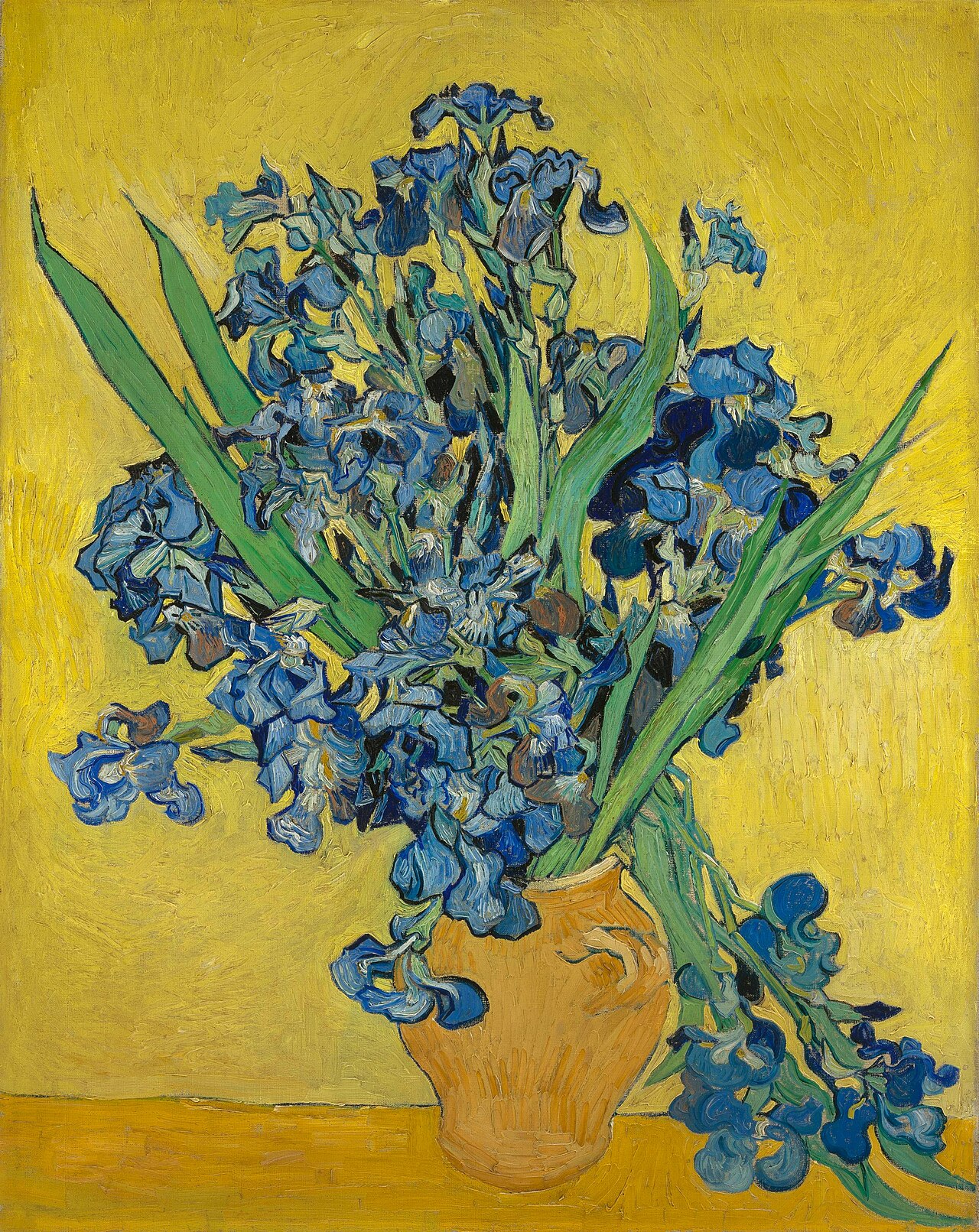
F678 Irises (in vase) 1890 -
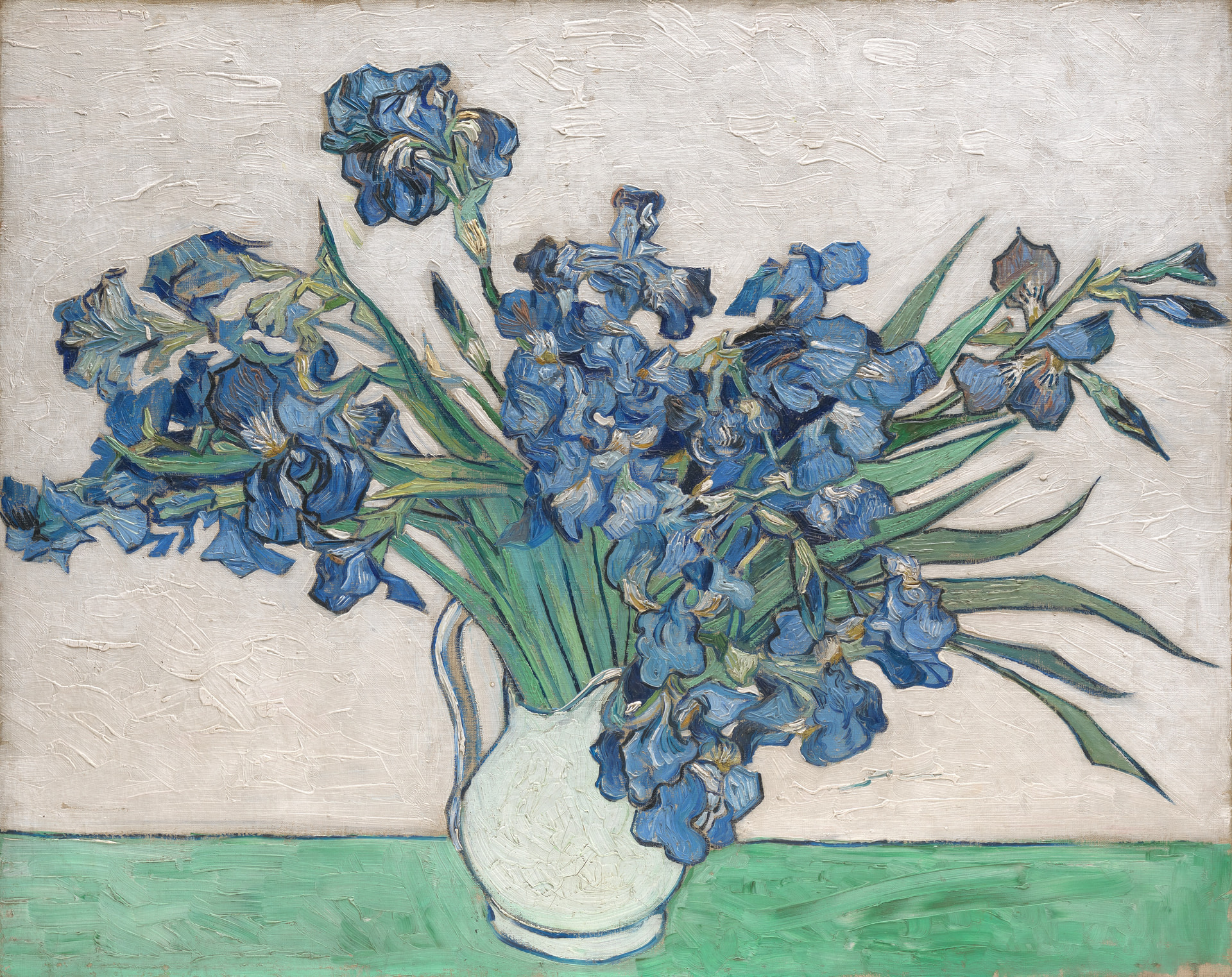
F680 Irises (pink background) 1890
Painting
One of the earliest canvases was painted in May 1889. In his first Saint-Rémy letter, he reported that Irises and a lilac bush were already under way. Violet irises crowd diagonally into the lower half of the frame, the leaves stand crossed like swords, the soil orange-red. A year later he painted two more — vases of violet irises against yellow, then violet irises against pink, the colours pushed even purer. Set the three together: the garden subject later returns as a room-bound still life.
Letter
May 1889. He wrote to Theo: "I'm working on two others — bouquets of violet flowers against a yellow background, with an effect of terribly disparate complementary colours that reinforce each other by their opposition." Another letter: "The garden is full of violet irises." After the Arles crisis, leaving the Yellow House, and voluntarily entering the asylum, the first things he could write were still about colour and work, not about handing himself over to rumour.
Place
Saint-Paul Hospital, the walled garden. He had checked himself in voluntarily a few days before; in his first surviving letter from there, he told Theo that Irises and a lilac bush were already under way. This was the opening week of the twelve months he would spend here. Within the walls, he returned first to the garden subjects nearest at hand.
He entered Saint-Paul in May 1889, and soon after admission began to paint the irises in the garden.
In his first letter from Saint-Rémy, he told Theo that Irises and a lilac bush were already under way. Later letters continued to report work, materials, and the garden. The irises mark a return to painting, not proof of a cure.
That autumn Theo showed Irises at the Indépendants exhibition and wrote that it was one of Vincent's good things. The pictures' travels and reception remained part of their exchange.
Events
- The Colour Experimenter · Letter 776
Within days he was allowed to step into the walled garden. The first thing he did was set up an easel before the irises — using painting to save himself
- The Translator · Letter 777
Completed the first Irises — flat violet-blue, sharp black contour, large empty space across the upper half. Japanese visual grammar transferred onto a Provençal flowerbed
- The Colour Experimenter · Letter 777
'The garden is full of violet irises.' Just after disaster, the first sentence he could write was about colour, not about himself
- Synaesthetic Precision · Letter 776
Admitted to the Saint-Paul-de-Mausole asylum. At first kept in a second-floor room, watching the irises in the garden through the iron window
- The Colour Experimenter · Letter 776
A year later, painted two more bouquets indoors — violet irises against yellow, against pink. 'Terribly disparate complementary colours that reinforce each other by their opposition.'
- Synaesthetic Precision · Letter 778
The three placed side by side trace the slow displacement from 'I can go outside' to 'I can only stay in the room'
From the Letters
Je travaille à deux autres — des bouquets de fleurs violettes sur fond jaune, avec un effet de couleurs complémentaires terriblement disparates qui se renforcent par leur opposition. I'm working on two others — bouquets of violet flowers against a yellow background, with an effect of terribly disparate complementary colours that reinforce each other by their opposition.
Le jardin est plein d'iris violets. The garden is full of violet irises.
Letter Sources
Van Gogh letter records referenced on this page, linked to the Van Gogh Letters Project. vangoghletters.org
Technique Evidence
This work appears as evidence in this site’s technique-evolution axis.