Japanese Print Translations
He went to Arles not to arrive in Japan, but to look for a place where he could paint out the method of Japanese prints.
-
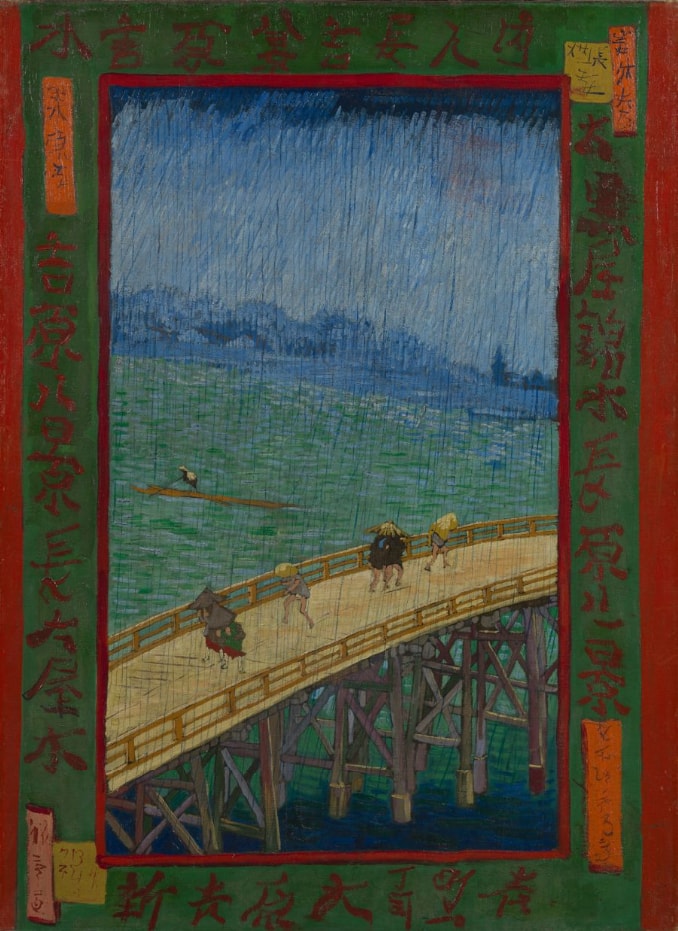
F372 Bridge in the Rain (after Hiroshige) 1887 -
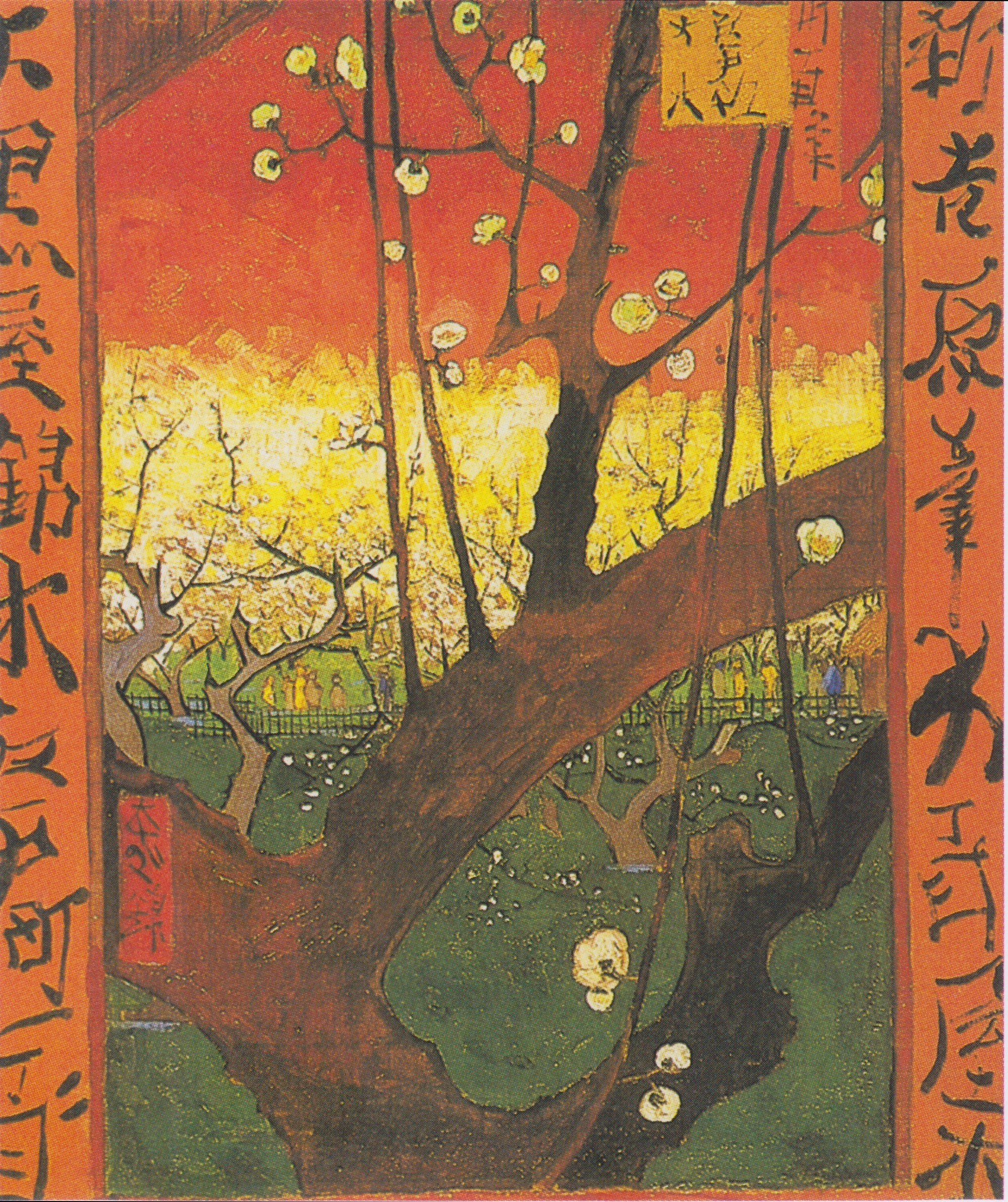
F371 Flowering Plum Tree (after Hiroshige) 1887 -
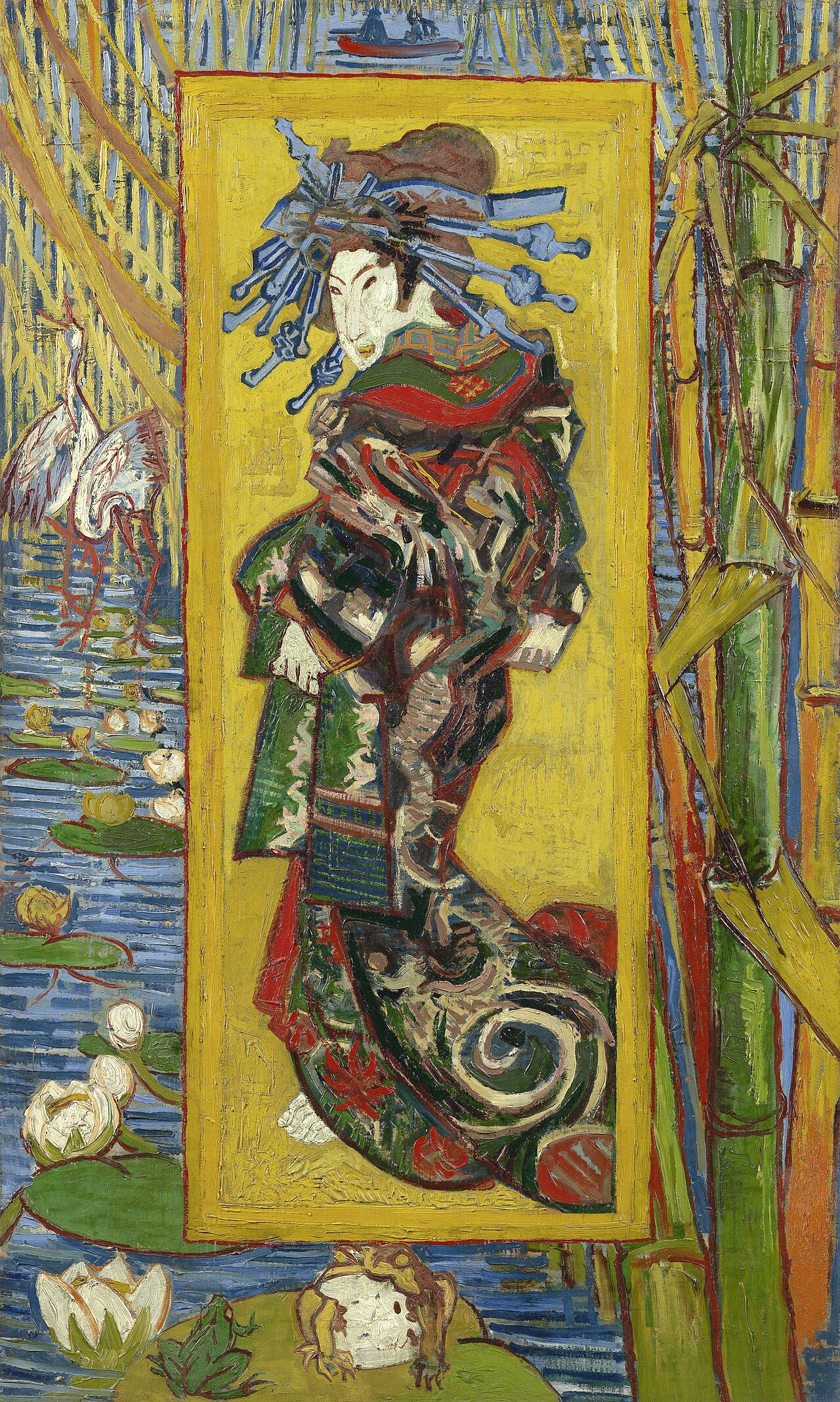
F373 Oiran (after Kesai Eisen) 1887
Painting
Three oil paintings — Bridge in the Rain, Flowering Plum Tree, Oiran. The first two copy directly from Hiroshige's woodblock prints; the third from Kesai Eisen. He did not hide the act of copying: he kept the calligraphic border like an Eastern signature, painting Chinese characters around the edge as decoration. But the medium had changed — ukiyo-e is water-printed on wood, thin and flat; oil paint is thick, heaped, bright. He was attempting something difficult: translating a lightness into a weight, while keeping its clarity.
What this work changed: Japanese prints did not supply a style to copy, but a way to reorganize the picture. Flatness, cropped views, decorative contours and strong colour areas were translated into the language of oil painting.
The catalogue also connects the exotic motifs in Japonaiserie: Oiran (1887) with Van Gogh's copy of Hokusai's One Hundred Views of Mount Fuji. The book was working material, not an ornament: another way a printed page entered his painted image.
Letter
1887 to 1888, Japan returns again and again in his letters. To his sister Wil: "If we study Japanese art, we see a man who is undoubtedly wise, philosophic and intelligent, who spends his time doing what? Studying the distance between the earth and the moon? No. Studying a single blade of grass." Another letter: "Do you envy the Japanese? Their work is as simple as breathing." From copying a bridge and a plum tree in Paris, the position grew, in Arles, into: "All my work is based to some extent on Japanese art."
Place
Two places, two years. Paris 1887 — he bought ukiyo-e at Bing's, copied them at home, hung them on Tanguy's shop wall. Arles 1888 — his first letter from Provence: "It is like Japan here." He never went to Japan. With a stack of prints, several books, and his own need, he built a working Japan. This imagined Japan was productive, and also limited: it helped him open the picture, but it cannot be treated as real Japan.
Paris also gave this interest a public moment: in 1887, he organized an exhibition of Japanese colour woodcuts at the Café le Tambourin. Collecting, copying and exhibiting formed a continuous way of working with these images, not merely an exotic background for them.
He began collecting prints in Antwerp; by Paris they numbered in the hundreds. Over the Paris years he and Theo collected and displayed these Japanese prints in quantity.
He chose two Hiroshiges and copied them in oil, stroke by stroke. Not to hand to anyone — he wanted to move into his own hands that way of reorganizing the world through line and flat colour.
Later, in Arles, he imagined the South as his own "Japan." This was not a geographical judgement, but a working hypothesis with a misreading built into it: perhaps the light of Provence would let him truly paint the flatness, brightness, and simplification of the prints.
Events
- The Translator · Letter 510
In Paris, bought a batch of ukiyo-e from Bing's gallery. Began pinning them to the wall with Bernard, studying one after another
- The Copyist · Letter 540
Completed Bridge in the Rain (after Hiroshige). Scaled the woodblock print up on grid paper, drew a pencil sketch, then painted in oil
- The Copyist · Letter 540
Painted Flowering Plum Tree and Oiran (after Eisen). Added Chinese characters around the border, keeping the eastern signature-style as decoration
- The Translator · Letter 620
Just after arriving in Arles, wrote: 'It is like Japan here.' He was living in southern France as if it were a geographical Japan
- The Ferocious Reader · Letter 640
Reading Loti's Madame Chrysanthème. Wrote to his sister Wil: 'If we study Japanese art, we see a man undoubtedly wise, philosophic and intelligent. What does he spend his time doing? Studying a single blade of grass.'
- The Translator · Letter 686
Wrote the most complete self-statement: 'All my work is based, to some extent, on Japanese art.' From copying specific prints to absorbing a whole visual grammar
From the Letters
Tout mon travail est un peu basé sur la japonaiserie. All my work is based to some extent on Japanese art.
Envie-tu les Japonais? Leur travail est aussi simple que de respirer. Do you envy the Japanese? Their work is as simple as breathing.
Si on étudie l'art japonais, on voit un homme incontestablement sage, philosophe et intelligent, qui passe son temps à quoi? À étudier la distance de la terre à la lune? Non. À étudier un seul brin d'herbe. If we study Japanese art, we see a man who is undoubtedly wise, philosophic and intelligent, who spends his time doing what? Studying the distance between the earth and the moon? No. Studying a single blade of grass.
Material Evidence
Facts that can be verified in the material and surface of the work.
-
Both oils after Hiroshige were made by tracing first and then transferring the tracing onto the canvas. Copying here is not a metaphor but a documented step of procedure.
Letter Sources
Van Gogh letter records referenced on this page, linked to the Van Gogh Letters Project. vangoghletters.org
Essays
Long-form reading connected to this node.
- Painting for Painting With almost no cash market in Paris, Van Gogh's work circulated by barter: a self-portrait for a portrait of Bernard's grandmother, two sunflower still lifes for one landscape, oil studies for about a hundred Japanese prints, herring still lifes for a carpet. The rates were recorded, so his standing can be measured. Open essay
- How Paris Paintings Are Dated Paris works are dated by converging clues: letters, seasons, locations, supports, pigments and continuity of touch. Open essay
- From Realism to Modernism Van Gogh's turn was not a sudden change of style, but a continuous chain from peasant subjects and Antwerp training to Rubens, Japanese prints and Parisian colour. Open essay
- A Single Reed In 1881 a drawing manual noted that the best reed pens grew in the South of France. Seven years later he actually went south, cut himself a reed — and in two months drew the finest sheets of his life. Materials analysis adds a quiet revelation: he drew with the same kind of commercial ink used for letters and document copies. Open essay
Technique Evidence
This work appears as evidence in this site’s technique-evolution axis.
- Colour as Practice 1886.03 – 1888.02 Open period F372 / JH1297 Japanese-print translations Brushstroke Representative of Paris short, adjacent brushwork