The Back of Beyond
He was not short of inspiration. He was short of four or five colours.
-
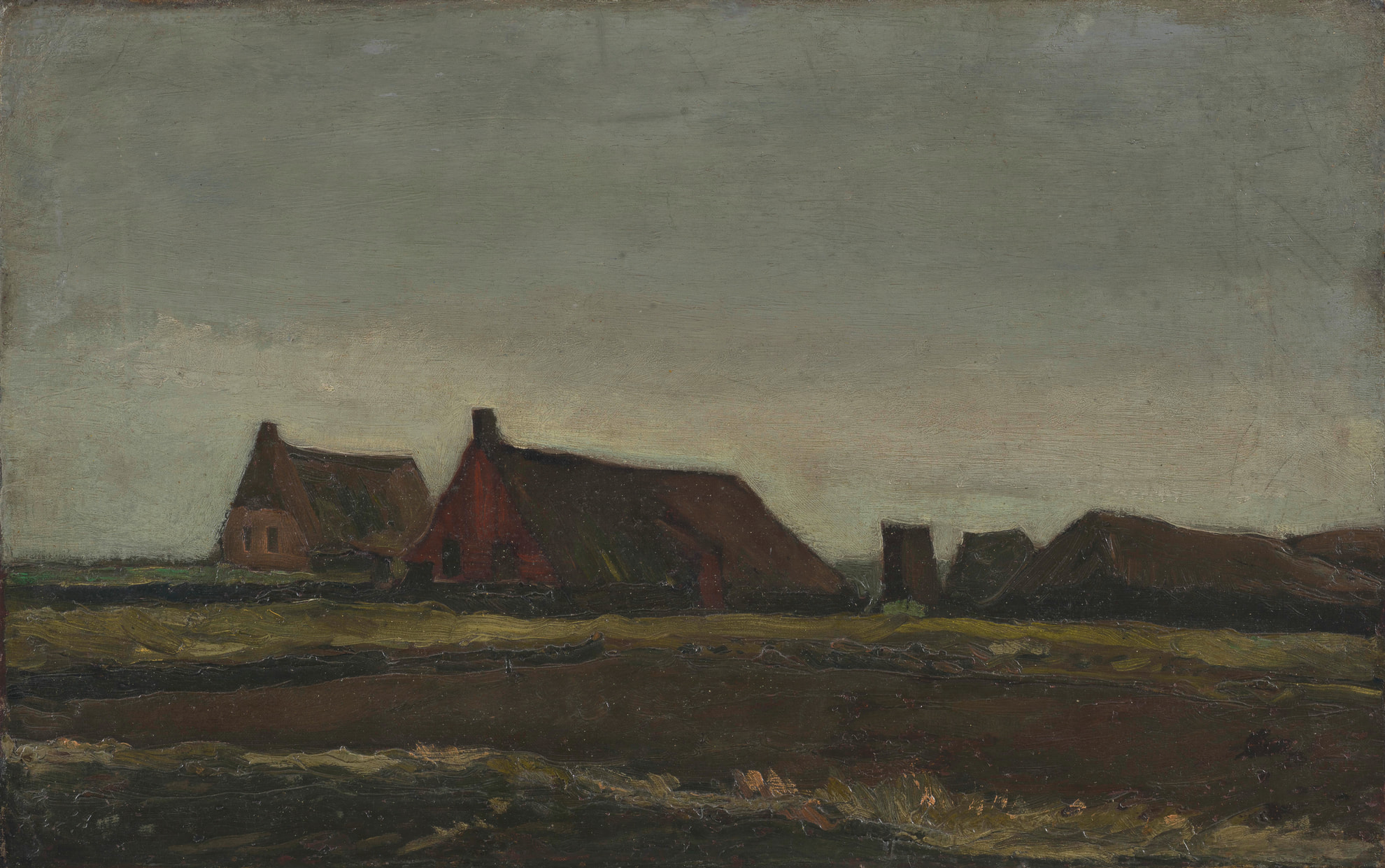
F17 Cottages 1883 -
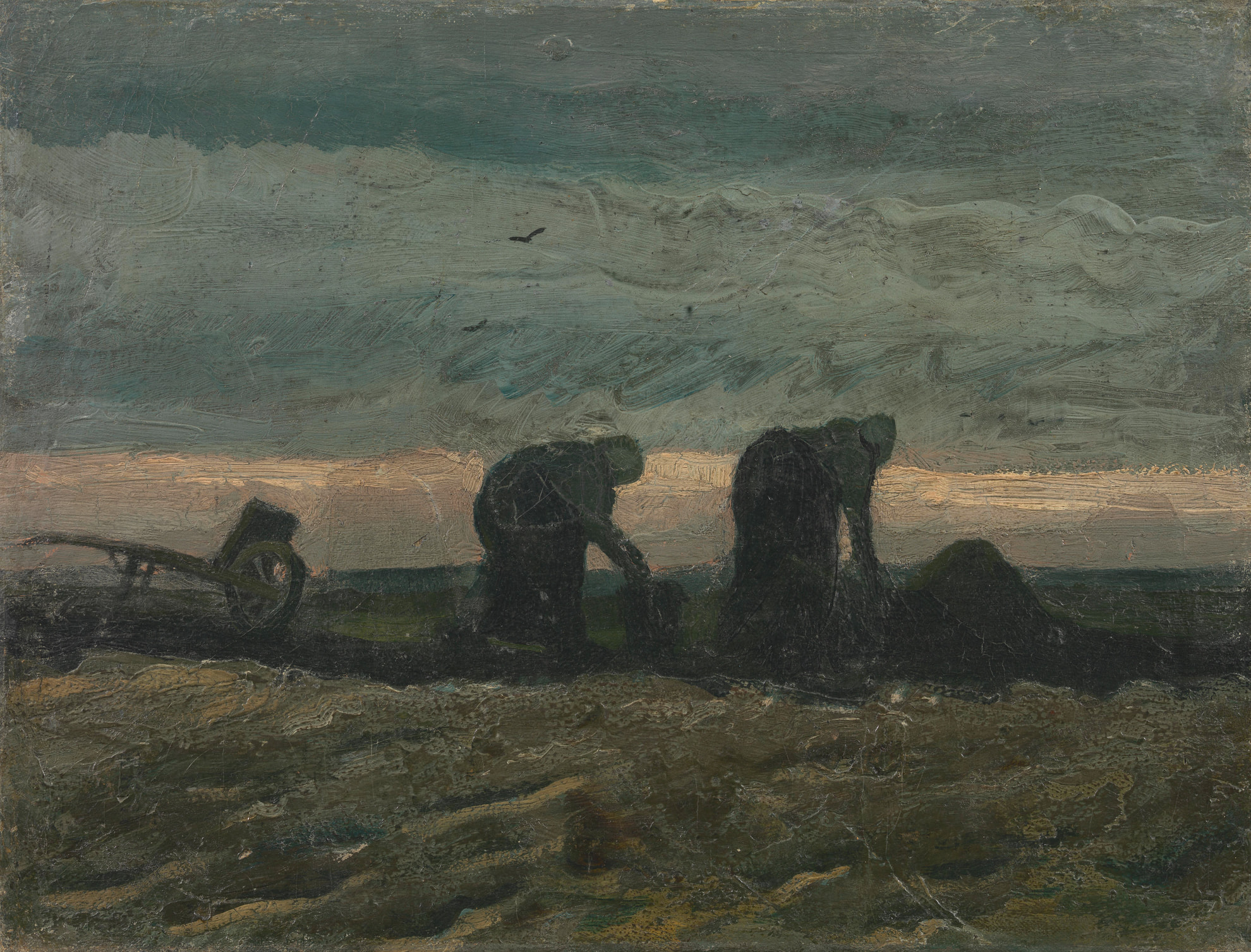
F19 Women on the Peat Moor 1883 -
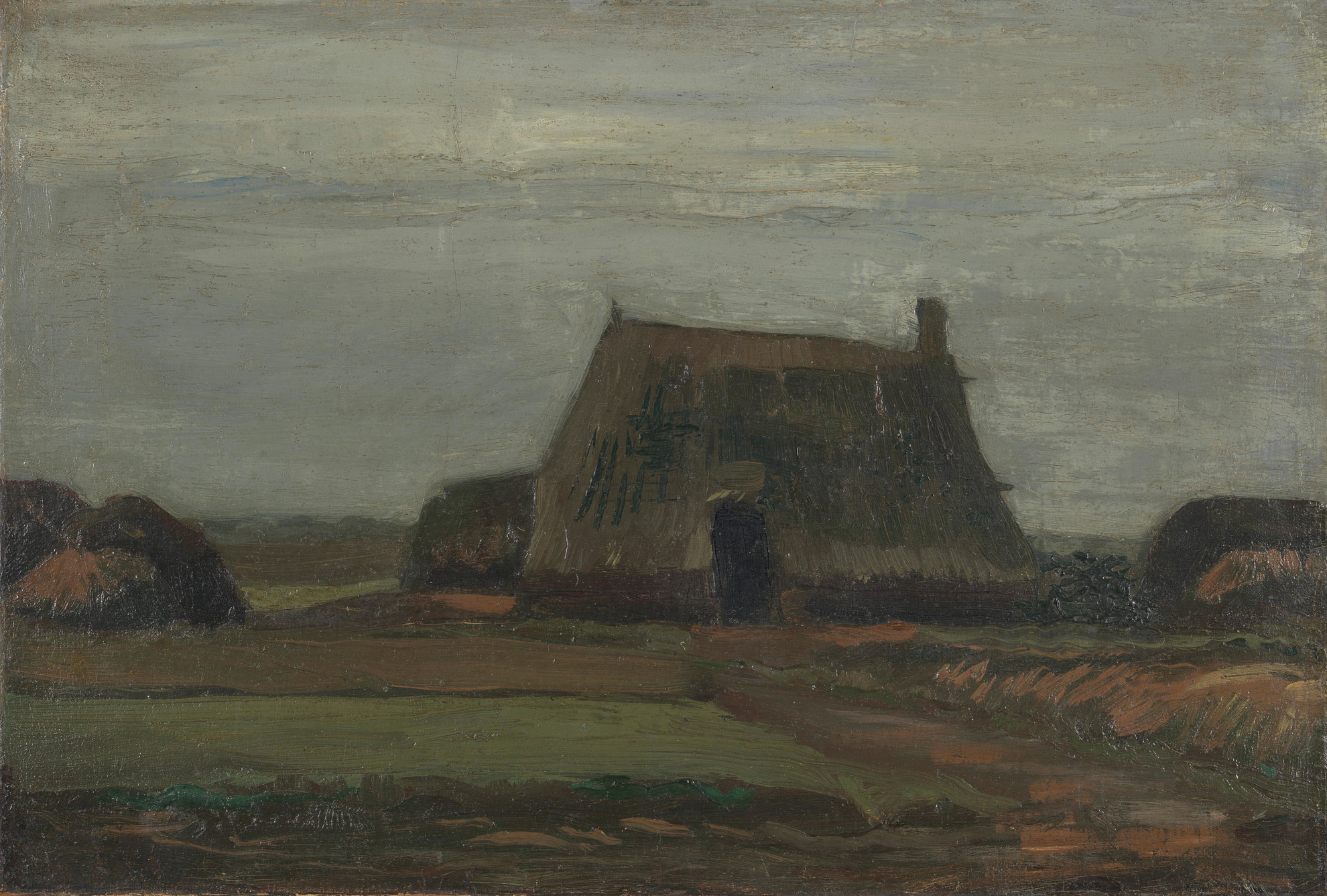
F22 Farm with Stacks of Peat 1883
Painting
All three are recorded at Nieuw-Amsterdam: Cottages, Women on the Peat Moor, Farm with Stacks of Peat. There is almost no bright colour in them — grey-green sky, brown-black ground, a single note of red on a roof. In Women on the Peat Moor the two bending figures are nearly solid black, cut out only by a streak of orange-red along the horizon; that streak is the brightest thing in the picture and no wider than a finger. The date recorded for Cottages spans two months (mid-September to mid-November), so where it falls inside these three months cannot be fixed.
The darkness of Cottages is not a matter of using less paint. He set out a specific rule: a grey sky can be so luminous that even pure white cannot reach it; once the sky has to remain grey, the browns and yellow-greys of the landscape must be pushed several degrees darker if their relation is to hold. Dark foreground and luminous sky are not painted separately; they correct one another from the start. The paint of this work contains abundant sand, evidence that he began it on site; above the ground he also laid a red-brown underpaint, which let the picture start from a middle tone. It is not visible in the finished work, and it must not be collapsed into the technical record's “ground impossible to determine”: that refers to the lower ground layer, while this is a working layer above it.
All three use a fine, medium-weave canvas; the thread counts on record are 20 × 17 for each. Their grounds have not been reliably identified in the existing technical records — not for want of looking, but because after looking the answer is still not there. Worth remembering: what can be stated is the canvas, not the layer underneath it.
Letter
Twenty-four letters survive from Drenthe, 11 September to 1 December, all to Theo apart from one to his parents. The arc can be read straight off them, without inference — and what it describes is not solitude on the moor but a supply line that keeps breaking.
The night he reached Hoogeveen he wrote: "I've brought very little paint with me, but some anyway," and said he would wait for more before going deeper. On 24 September he sent off three studies that were not yet dry, with instructions for Theo: if they stick to the paper laid over them, soak them off with lukewarm water; the smallest has sunk in badly, brush it with egg white in a week to lift the colour back up — a letter that is all procedure. Four days later, on 28 September: "This morning the weather was better again and I went out to paint, regardless. Only it wasn't possible, I was missing 4 or 5 colours." He does not write this as a mood; he attaches it to the Borinage — the time he walked three days and three nights in the rain with less than two francs. Without supplies he would not go further in.
Before leaving Hoogeveen he had paint sent from Furnée and painted several more studies there; on 3 October he arrived by barge at Nieuw-Amsterdam. By late November his letters had to travel to Hoogeveen and back, and the money came later each time — the equivalent of losing a delivery outright. On 1 December: "at present I cannot go on." Within days he was back in Nuenen.
(The identity of the three studies posted on 24 September is unknown. They cannot be used as evidence for these three paintings.)
Place
Nieuw-Amsterdam, in Drenthe, is not a city but a village at the end of a canal. He wrote that he could see no way of describing the country as it ought to be described, because words failed him: imagine the banks of the canal as miles and miles of Michel, Rousseau, van Goyen; flat bands of colour narrowing toward the horizon, punctuated here and there by a sod hut, a small farm, a few scrawny birches. Stacks of peat everywhere, and barges always passing with peat or bulrushes.
The remoteness here is measurable: his letters went first to Hoogeveen, then back out again.
September 1883. He left The Hague, and left Sien and the children too. There was very little paint in his luggage — his own words: "but some anyway."
On the morning the weather turned, he went out to paint and came back with nothing — four or five colours short. He did not write it up as a mood. He wrote it up as a failure of supply.
On 1 December he wrote "at present I cannot go on," and within days he was back in Nuenen, living in his father's vicarage. The next time colour became a problem, it was inside the Nuenen dark.
Events
- The Colour Experimenter · Letter 385
Arrives at Hoogeveen. That evening he writes: "I've brought very little paint with me, but some anyway, and I hope to be able to get more soon," and says he will wait for more paint before going deeper into the heath — the condition governing this whole stretch is stated in the first letter
- The Colour Experimenter · Letter 389
Sends off three studies that are not yet dry, with instructions: if they stick to the paper laid over them, soak them off with lukewarm water; the smallest has sunk in badly, brush it with egg white in a week to lift the colour. The letter is procedure, not reflection (the identity of these three studies is unknown and cannot serve as evidence for the three paintings of this node)
- The Colour Experimenter · Letter 391
The weather turns; he goes out to paint and cannot — four or five colours missing, and he comes back empty-handed. He immediately attaches this to the precedent of the Borinage: without supplies he will not venture further in
- The Colour Experimenter · Letter 392
Before leaving Hoogeveen he has paint sent from Furnée and paints several more studies there; then arrives by barge at Nieuw-Amsterdam. Once the supply lands, the work resumes at once
- The Translator · Letter 392
He says he can see no way of describing the country as it should be described, because words fail him — so he translates it into painters' names instead: imagine the canal banks as miles and miles of Michel, Rousseau, van Goyen; for that evening's effect, he says, there is a Daubigny that puts it exactly
- The Colour Experimenter · Letter 407
Letters now travel to Hoogeveen and back, and the money arrives later each time. He works it out for Theo: at this rate it amounts to losing a remittance outright — the length of the supply line can now be counted in days
- The Ferocious Reader · Letter 408
The last letter from Drenthe. He first dismantles the misunderstanding with a figure taken from reading — that Theo had read his letter as an ultimatum of the kind nihilists might send the Tsar — and then writes: "at present I cannot go on." Within days he is writing from Nuenen
From the Letters
Van morgen was het wederom beter weer & ben ik uitgegaan om toch te schilderen. Alleen het was niet mogelijk, 4 of 5 kleuren ontbraken me, en ik ben toch zoo beroerd weer terug gekomen. This morning the weather was better again and I went out to paint, regardless. Only it wasn't possible, I was missing 4 or 5 colours, and so I came back again very wretched.
Ditmaal schrijf ik U heel uit den achterhoek v. Drenthe, waar ik gekomen ben na een eeuwig lange vaart in de trekschuit door de heide. This time I'm writing to you from the very back of beyond in Drenthe, where I arrived after an endless trip through the heath on the barge.
Heden verzend ik als postpakket 3 studies welke ik hoop droog genoeg zijn. Indien ze evenwel aan 't vel papier dat ik er uit voorzorg opleg vastkleven, zoo week ze af met laauw water. De kleinste vooral is erg ingeschoten, doe er over een dag of 8 een eiwitje op om ze uit te halen. Today I'm sending a package of 3 studies which I hope are dry enough. However, if they stick to the sheet of paper I laid on them as a precaution, soak them off with lukewarm water. The smallest one, in particular, has sunk in a lot; go over it with the white of an egg in about a week to lift them.
Wij zijn nu op een punt dat ik zeg: momenteel kan ik niet voort. We're now at a point where I say: at present I cannot go on.
Material Evidence
Facts that can be verified in the material and surface of the work.
-
All three use a canvas of the same specification — fine, medium weave, with a recorded thread count of 20 × 17.
-
The ground of all three is undeterminable. The darkness of this stretch can therefore be credited neither to the ground nor to the missing paint: the canvas is all that is certain.
Letter Sources
Van Gogh letter records referenced on this page, linked to the Van Gogh Letters Project. vangoghletters.org