The Olive Groves
Rather than reconstruct a historical Garden of Olives, he returned to the ones in front of him.
-
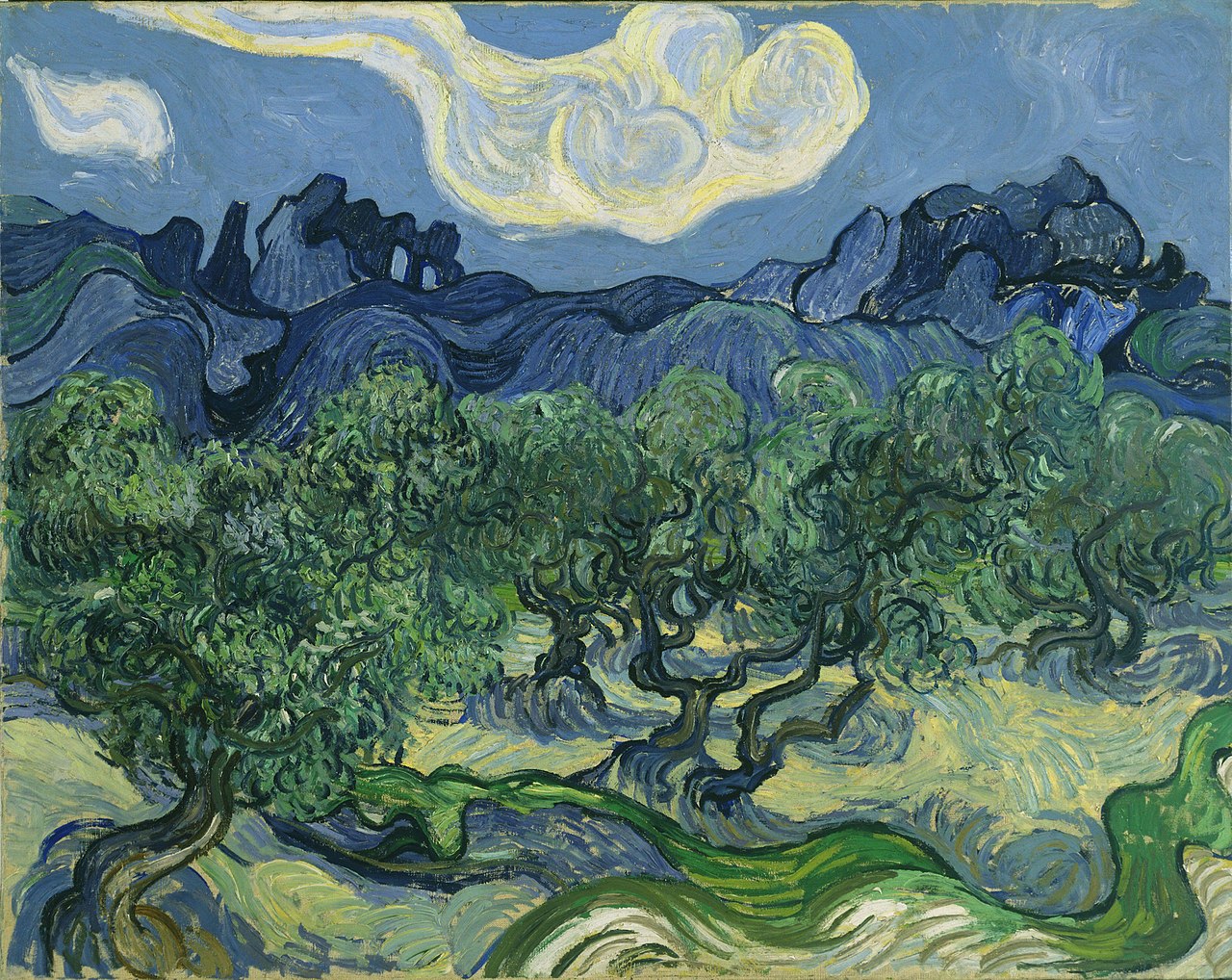
F712 Olive Trees with the Alpilles in the Background 1889 -
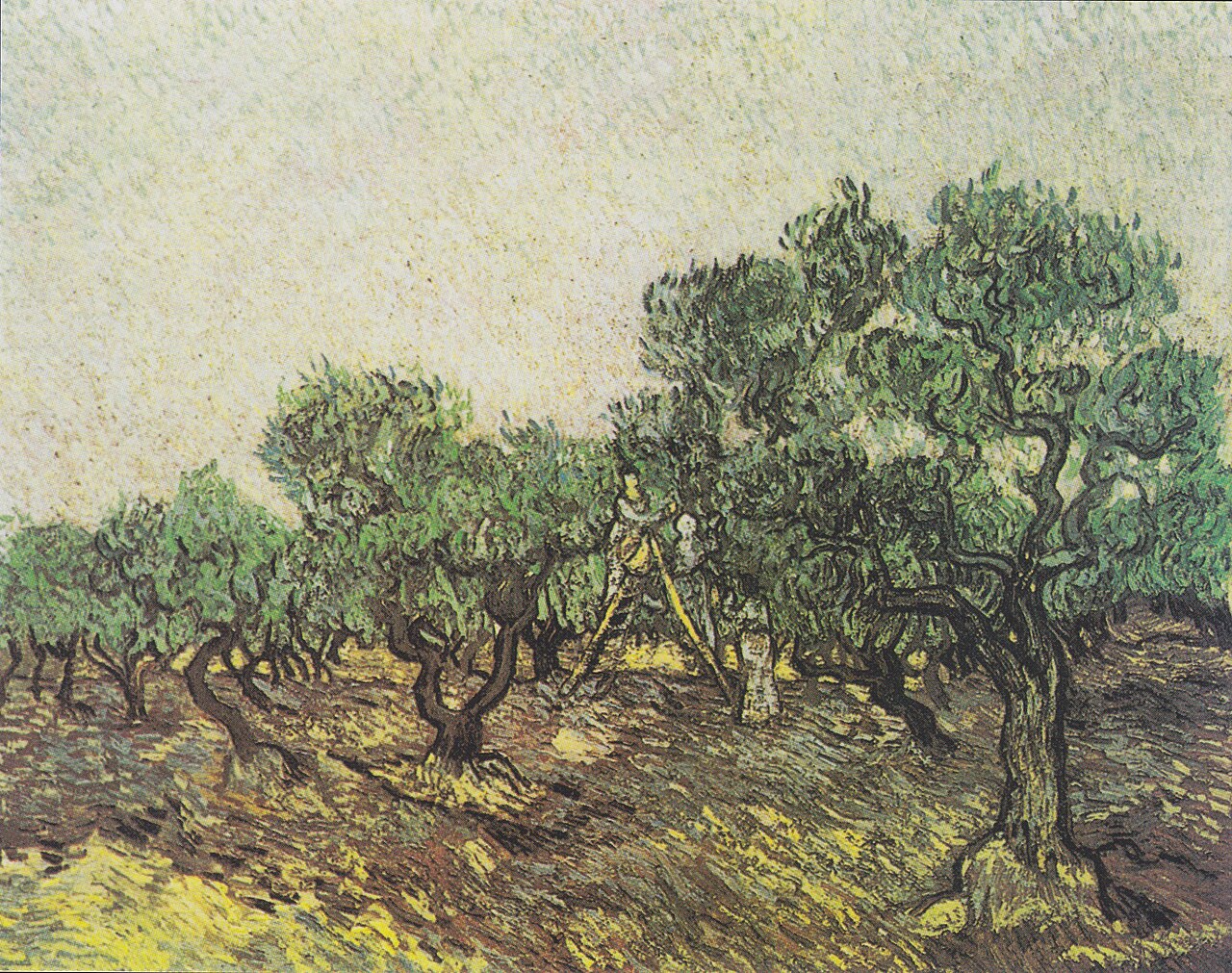
F654 Olive Picking 1889 -
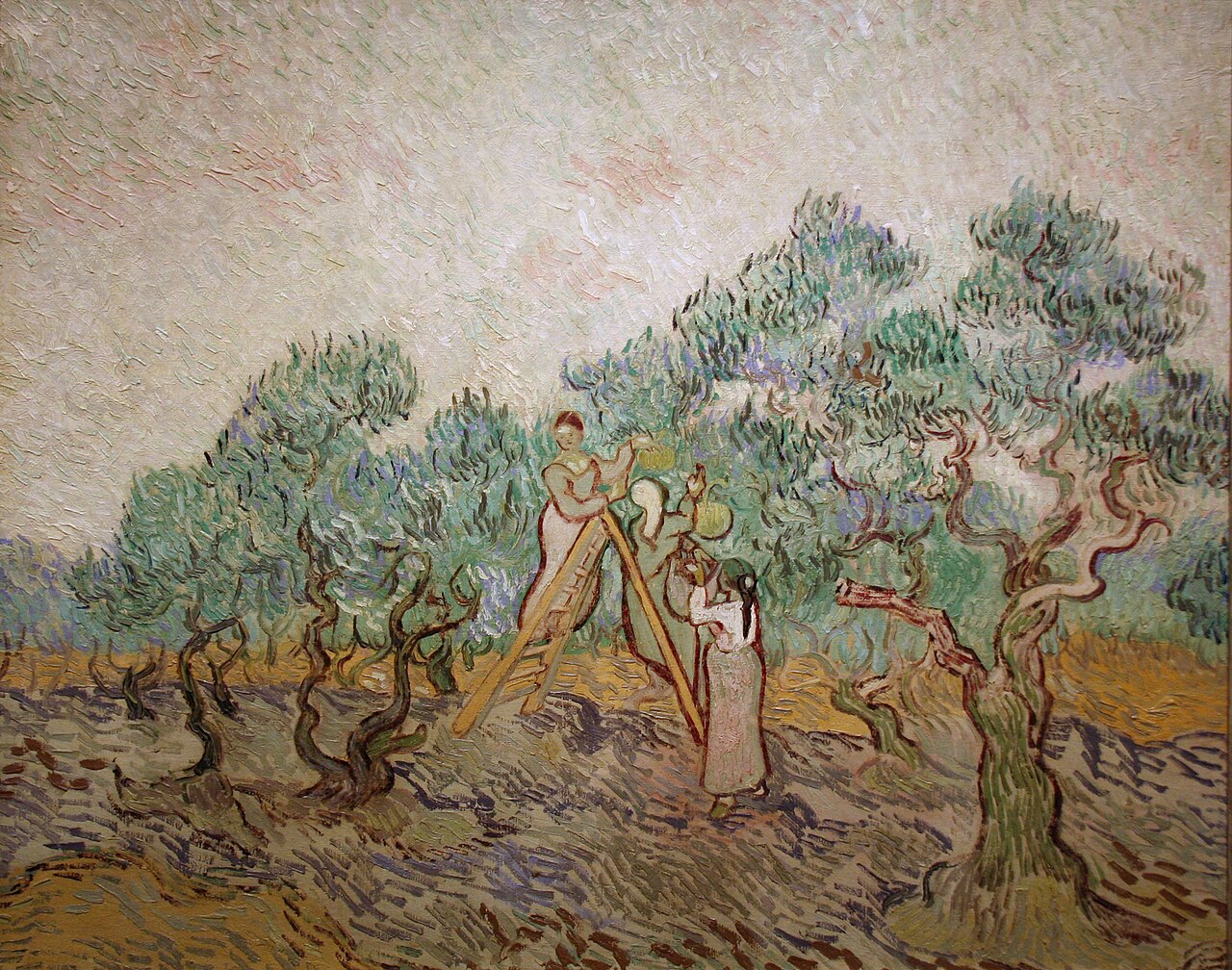
F656 The Olive Orchard 1889
Painting
From summer into winter, Van Gogh returned to the olive trees. Three works here take different approaches: Olive Trees with the Alpilles in the Background joins curved trunks, mountain ridges and a white cloud in a web of lines; Olive Picking places a ladder and workers beneath grey-green foliage; The Olive Orchard again shows a ladder and three pickers, with pale pink in the sky and figures, and violet and yellow ochre on the ground. In November 1889 he wrote that he had painted five large canvases that month, in addition to three earlier olive-tree studies already with Theo.
Letter
1889. He wrote to Theo: "Gauguin and Bernard now talk of painting Christs in the Garden of Olives. I don't want to paint imaginary things. The olive trees are too beautiful for me to dare to invent them." Another: "The olive trees with the white sky and the white and green ground, with a little violet and pink in the trunks." A third: "What I have done is a rather harsh realism beside what they do." The three sentences, taken together, are an artistic manifesto: not gods, what is seen; not invention, but looking; harsh realism.
Place
The olive groves around Saint-Rémy. They surround the Saint-Paul Hospital. The olive trees of Provence carry hundreds of years — trunks wrung, fissured, like the bones of an old hand. Through summer and autumn he went daily to the same grove, watching the same tree change colour under different light. Gauguin was in Pont-Aven painting an imagined Christ at the same time. Vincent was outside the asylum painting a real olive tree. This was his clearest refusal of symbolism.
In late 1889, Gauguin sent him a sketch of a Christ in the Garden of Olives, and Bernard sent photographs of recent biblical compositions. They reopened a question about religious subjects and painting from imagination.
He rejected their biblical Garden of Olives. If he remained there, he wrote, he would paint the olive picking as it could still be seen, with the human figure in correct proportion; before entering that subject, he needed more serious studies. He then worked among the olive trees, testing grey skies against yellow earth, and purple ground and foliage against yellow sky.
He wrote that he had completed five large olive-tree canvases, while also calling the year unsatisfactory. The letter records a continuing search, not a final answer.
Events
- The Colour Experimenter · Letter 783
Stepped beyond the asylum wall to paint the first olives. 'The olive trees with the white sky and the white and green ground, with a little violet and pink in the trunks.' The smallest-scale sentence the colour experimenter ever wrote
- Synaesthetic Precision · Letter 805
End of summer — twisted olive trunks turning into twisting brushstrokes under his hand. Not 'emotional' but 'harsh realism' — the trees actually grow that way
- Synaesthetic Precision · Letter 822
Heard that Gauguin and Bernard had both painted imagined Christs in the Garden of Olives. Vincent refused: 'I don't want to paint imaginary things. The olive trees are too beautiful for me to dare to invent them.'
- Synaesthetic Precision · Letter 822
'What I have done is a rather harsh realism beside what they do.' An artistic manifesto: not gods, what is seen; not invention, but looking
- The Colour Experimenter · Letter 823
Painted five large olive-grove canvases in November; with the three earlier studies already with Theo, he kept testing the trees' forms and colours in changing light
- The Colour Experimenter · Letter 823
Completed Olive Picking — peasant women bending to gather fruit. The same name and shape as Millet's peasants, but the colour is Provençal silver and violet
From the Letters
Gauguin et Bernard parlent maintenant de peindre des Christ au jardin des oliviers. Moi je ne veux pas peindre de choses imaginaires. Les oliviers sont trop beaux pour que j'ose les inventer. Gauguin and Bernard now talk of painting Christs in the Garden of Olives. I don't want to paint imaginary things. The olive trees are too beautiful for me to dare to invent them.
Les oliviers avec le ciel blanc et le terrain blanc et vert, avec un peu de violet et de rose dans les troncs. The olive trees with the white sky and the white and green ground, with a little violet and pink in the trunks.
Ce que j'ai fait c'est un réalisme plutôt dur à côté de ce qu'ils font. What I have done is a rather harsh realism beside what they do.
Letter Sources
Van Gogh letter records referenced on this page, linked to the Van Gogh Letters Project. vangoghletters.org