Pere Tanguy: moment and letters
Those who helped the painters usually vanish, afterward, into the backgrounds of the pictures.
-
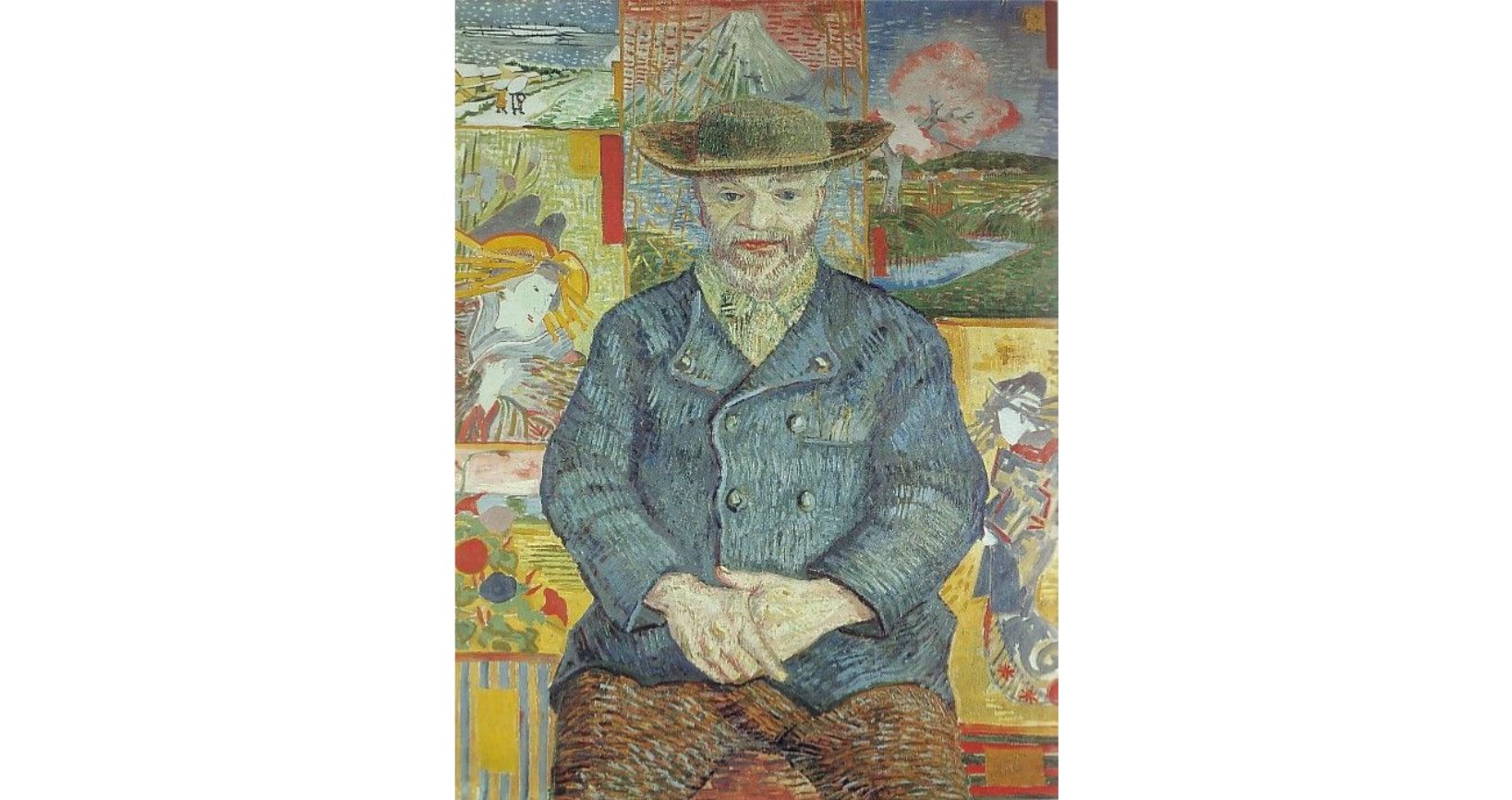
F363 Pere Tanguy 1887
Prints covered the apartment, but he needed to paint them into a person who actually existed.
Tanguy sold paint, and was also a go-between who lent out young painters' work for exhibition. He had little money, and would lend paint, more or less, to painters who could not pay. He sits before a background of prints, quiet and generous.
This is one of the most fully realized portraits of his Paris years, yet Tanguy himself is rarely remembered.
Events
- The Ferocious Reader
In Paris he entered an urban network of dealers, colour shops, independent painters and Japanese prints. Pere Tanguy stood at one of its crossings
- The Translator
Tanguy sold paint and often supported young painters who could not pay. He placed this real intermediary before Japanese prints, letting person and visual culture translate one another
- The Colour Experimenter
The background of Pere Tanguy is not decorative wallpaper but a new colour grammar: flat zones, clear outlines, juxtaposed blues, reds and yellows, pulling the Paris portrait away from brown tradition
- The Translator
He did not copy Japanese prints as exotic taste. He carried their flatness and contour into the portrait of a French shopkeeper. That is the translator talent of the Paris period
- The Colour Experimenter
After Paris, the background logic of Japanese prints continued into Arles: larger colour fields, stronger contours, bolder complementaries. Pere Tanguy is the complete Paris sample of that conversion
Essays
Long-form reading connected to this node.
- Painting for Painting With almost no cash market in Paris, Van Gogh's work circulated by barter: a self-portrait for a portrait of Bernard's grandmother, two sunflower still lifes for one landscape, oil studies for about a hundred Japanese prints, herring still lifes for a carpet. The rates were recorded, so his standing can be measured. Open essay
- From Realism to Modernism Van Gogh's turn was not a sudden change of style, but a continuous chain from peasant subjects and Antwerp training to Rubens, Japanese prints and Parisian colour. Open essay
Technique Evidence
This work appears as evidence in this site’s technique-evolution axis.