Starry Night over the Rhône: moment and letters
At night, by gaslight, before the night sky, he painted the night. That alone should not be left out.
-
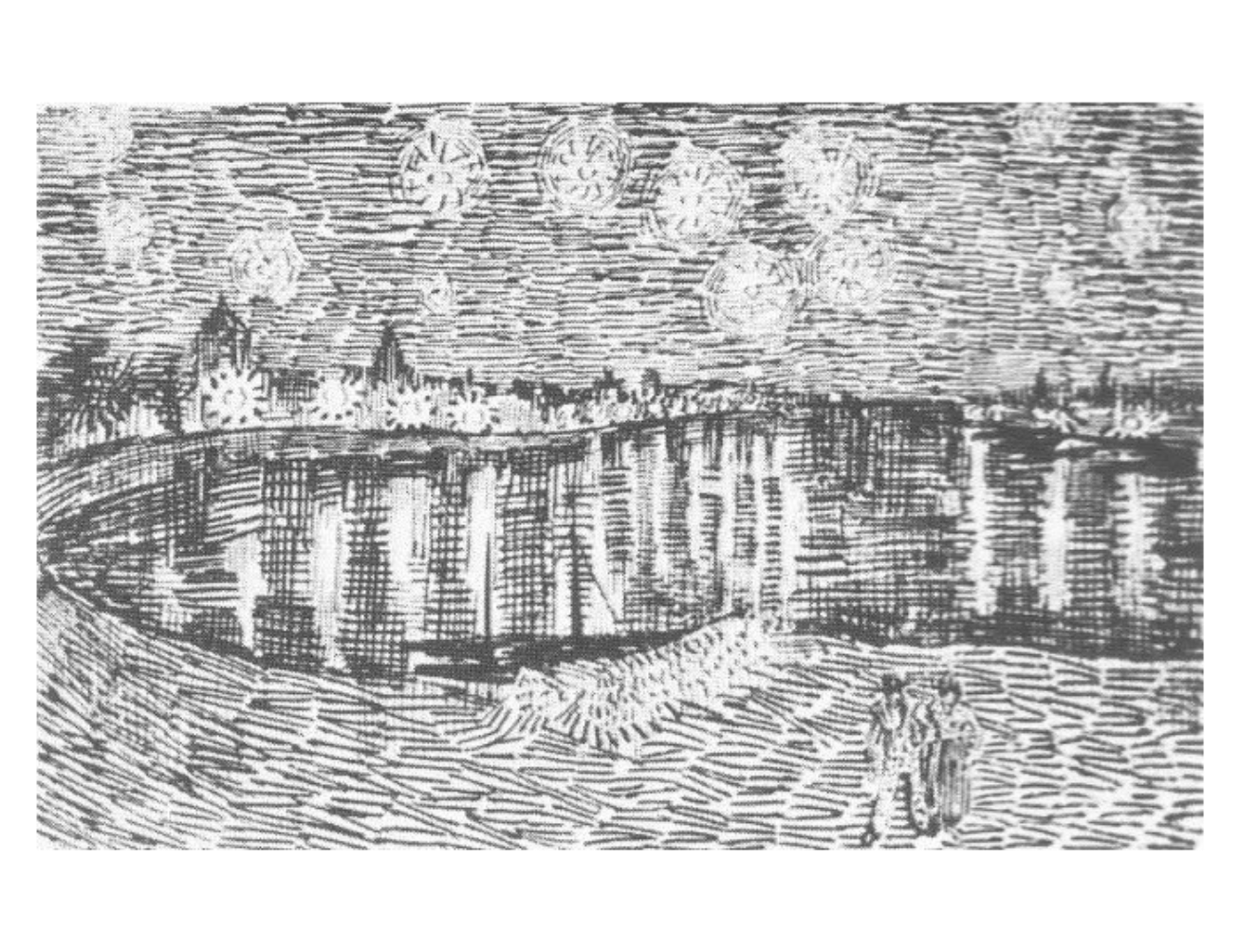
F474-sketch Letter sketch (let691, sketch enclosed) 1888 -
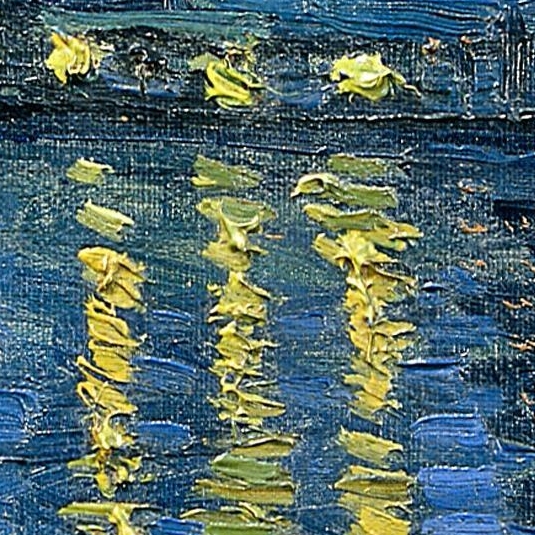
F474-crop Starry Night over the Rhône — impasto detail 1888 -
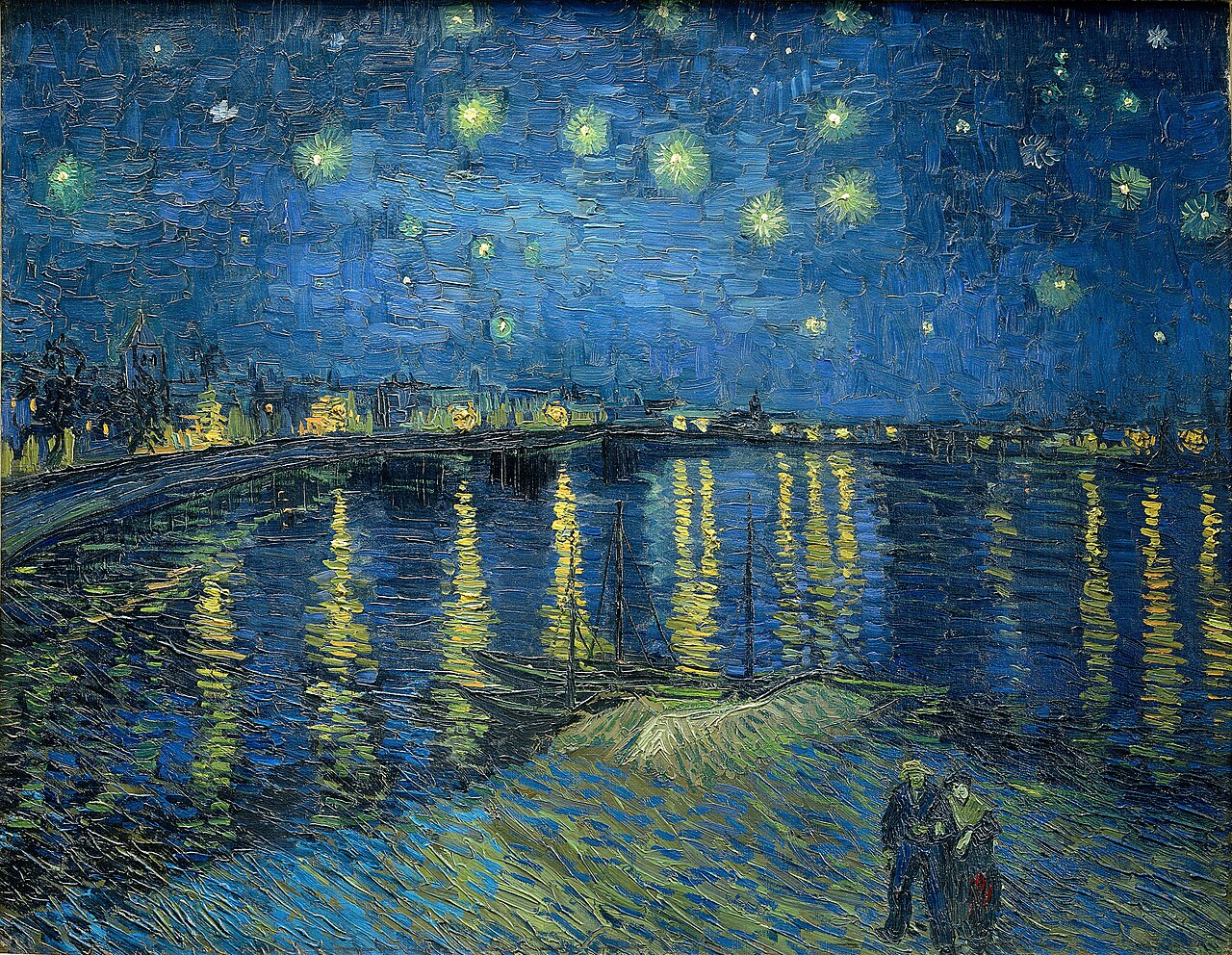
F474 Starry Night over the Rhône 1888
Painting
Oil on canvas, 72.5 × 92 cm. The sky opens in ultramarine and cobalt blue; the lamps press chrome yellow and lead white into the river. Those yellows still glow today, though they are slowly oxidizing — time leaving its own thin haze. The position of Ursa Major is not quite accurate. This is not an astronomical record. It is the trace of a man pulling the night out of himself.
Letter
September 1888, Arles. In a letter to Theo, he wrote the sentence like a command given inward: I absolutely must paint a starry sky. Not a choice of subject — a physical need. In the same letter he described the colours: sky blue-green, water royal blue, ground mauve. He painted the night scene under a gas lamp — using artificial light to catch starlight.
Place
The Rhône darkens at the edge of Arles. Gas lamps on the far bank fell onto the water in long streaks; across it, a railway bridge and factory chimneys he chose to leave half in shadow. He stood in the sand to paint at night, candles fixed to his hat brim for light. This was eight months into the south, three weeks before Gauguin — the night sky rehearsed here, a year before the one at Saint-Rémy that he could not explain.
Daytime Arles was already enough, but he began to believe the night had a colour system of its own — not black, but another set entirely.
In September he sat by the Rhône and painted at night by the light of a gas lamp. He reported this picture as a true experiment in painting at night, before the night sky itself — blue, yellow, green, orange; the riverbank, the lamps, the backs of two figures.
Here there are still people, still a riverbank, still the scale of a city. At that time he still believed he was standing in a definite place.
Events
- The Ferocious Reader · Letter 672
Reading Daudet's Tartarin de Tarascon and Maupassant's Bel-Ami
- The Translator · Letter 673
Discussing Japanese prints and the southern studio plan with Belgian painter Boch
- The Colour Experimenter · Letter 676
Stayed up three nights painting The Night Café — using red-green complementaries to express 'terrible human passions'
- Synaesthetic Precision · Letter 678
Wrote that 'the night is even more richly coloured than the day' — began conceiving the starry sky painting
- The Copyist · Letter 681
Mentioned Delacroix's colour theory in a letter — the law of complementary contrast
- The Translator · Letter 682
Discussed how Japanese prints handle 'night scenes' — flattened black and stars
- The Colour Experimenter · Letter 681
Went to the Rhône at night to paint under gas lamps — using artificial light to capture the colour of starlight
- Synaesthetic Precision · Letter 691
Completed Starry Night over the Rhône — listed exact colour formula in letter: sky blue-green, water royal blue, ground mauve
- Synaesthetic Precision · Letter 691
Wrote 'I absolutely must paint a starry sky' — not a choice of subject, a physical need
From the Letters
J'ai un besoin absolu de peindre un ciel étoilé. I absolutely must paint a starry sky.
Le ciel étoilé peint la nuit, en fait, sous un bec de gaz. Le ciel est bleu-vert, l'eau est bleu de roi, les terrains sont mauves. The starry sky painted at night, actually under a gas lamp. The sky is blue-green, the water is royal blue, the ground is mauve.
La nuit est encore plus richement colorée que le jour. The night is even more richly coloured than the day.
Cela ne me gêne pas de travailler dans la nuit sur place, si je peux voir suffisamment sur ma toile. It doesn't bother me to work at night on the spot, if I can see well enough on my canvas.
Letter Sources
Van Gogh letter records referenced on this page, linked to the Van Gogh Letters Project. vangoghletters.org
Technique Evidence
This work appears as evidence in this site’s technique-evolution axis.
- The Shattering Stroke 1888.02 – 1889.05 Open period F474 / JH1592 Starry Night Over the Rhône Colour Representative of the changed colour system Impasto Visible impasto and thick brushwork Brushstroke Representative of directional brushwork
- The World in Motion 1889.05 – 1890.05 Open period F612 / JH1731 The Starry Night Colour Representative of the changed colour system Impasto Visible impasto and thick brushwork Brushstroke Representative of swirling brushwork