1889 · F613 · JH1746
Cypresses
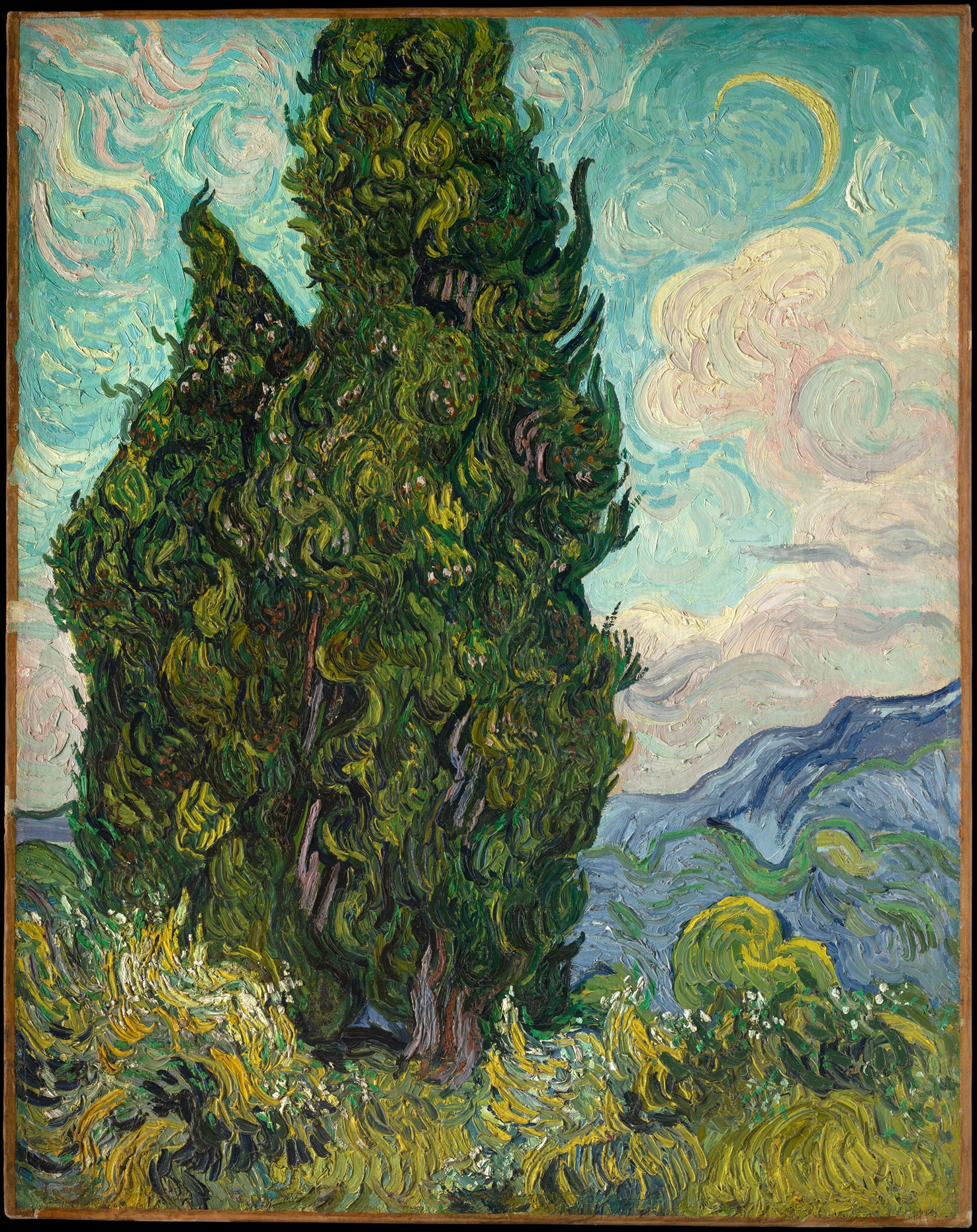
Cypresses makes the tree a living vertical force. In Saint-Remy, Van Gogh did not treat cypresses as background; he made them protagonists.
Cypresses meaning and analysis
Cypresses makes the tree a living vertical force. In Saint-Remy, Van Gogh did not treat cypresses as background; he made them protagonists.
Continue with this work in the context of Cypresses.
Meaning
The painting turns the cypress into a figure of upward pressure. It is tree, flame and dark monument at once.
Its meaning lies in the tension between rootedness and movement. The tree is fixed in the earth, yet every stroke climbs.
Visual Analysis
The cypresses fill the canvas with vertical movement. Their dark mass dominates the lighter landscape around them.
The sky, ground and tree all move, so the entire painting refuses stillness.
Symbolism
Cypresses traditionally carry associations with death and cemeteries, but Van Gogh also makes them intensely alive.
The tree becomes a mediator between earth and sky, stillness and fire.
Technique
The brushwork is ascending and twisted. Dark greens and near-black tones stay active because the strokes keep moving.
Colour contrast sets the heavy tree against a brighter, more open landscape.
Period Context
The work belongs to the Saint-Remy period, when cypresses became one of Van Gogh's major motifs.
It is closely linked to The Starry Night and Wheat Field with Cypresses as part of the same visual problem.
Related Letters
Van Gogh wrote about the difficulty and beauty of cypresses. Those letters should later be connected to this page.
FAQ
- What do cypresses mean in Van Gogh's paintings?
- They often connect earth, sky, death and vitality, becoming more than ordinary landscape trees.
- Why did Van Gogh paint cypresses?
- He was fascinated by their dark shape and vertical movement during the Saint-Remy period.
- How are Cypresses and The Starry Night related?
- Both belong to the Saint-Remy visual world where cypress forms connect landscape, night and inner intensity.
The single tree. He wrote that cypresses are 'beautiful as an Egyptian obelisk,' yet no one had painted them. A near-black flame shape, brushstrokes spiralling upward. He wanted cypresses as the counterpoint to sunflowers — one is yellow life, the other dark-green death.