Gauguin Leaves
After that night, the Yellow House's plan for a shared community was over. Soon after leaving the hospital he picked up the brush again.
-
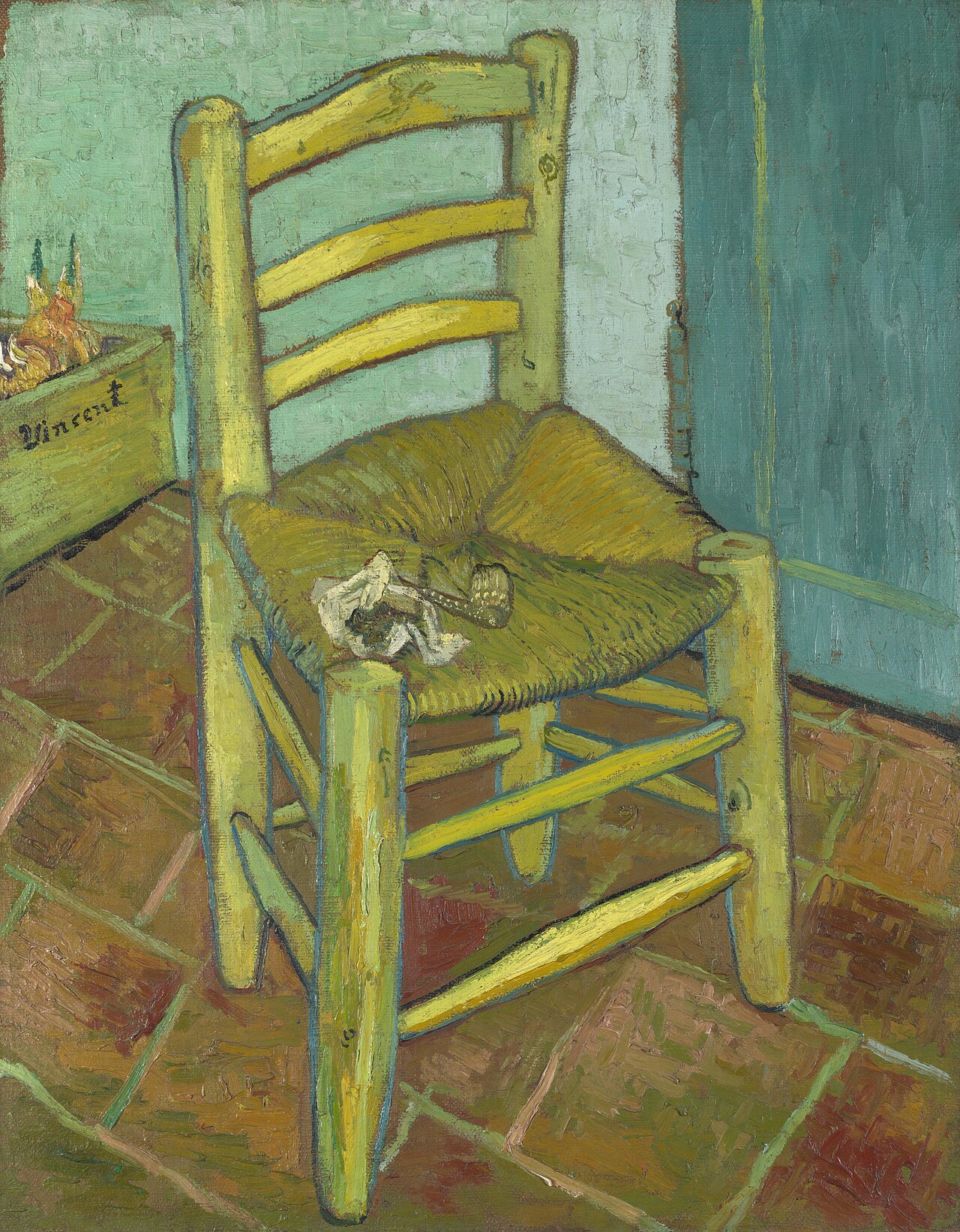
F498 Vincent's Chair with His Pipe 1888 -
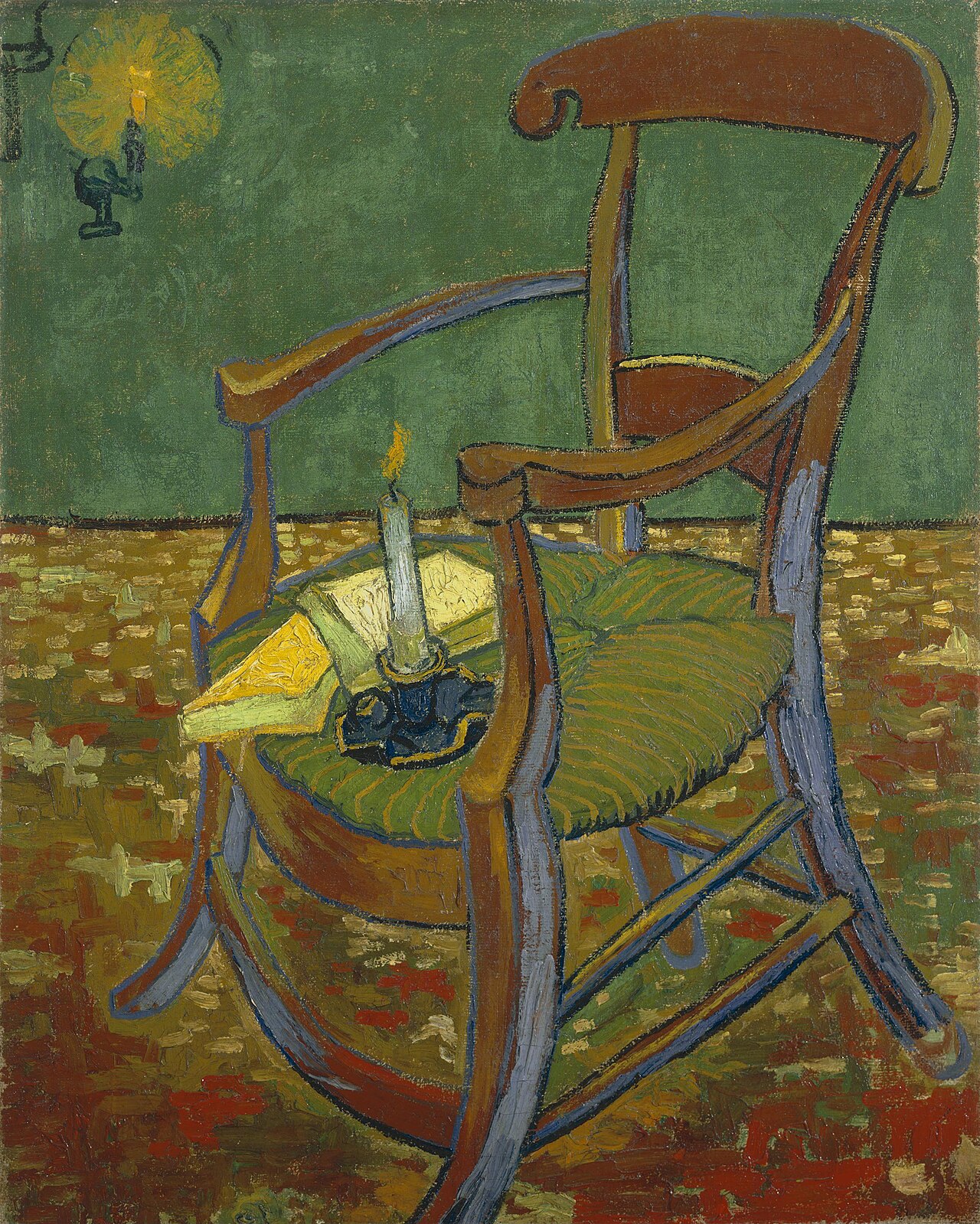
F499 Gauguin's Chair 1888 -
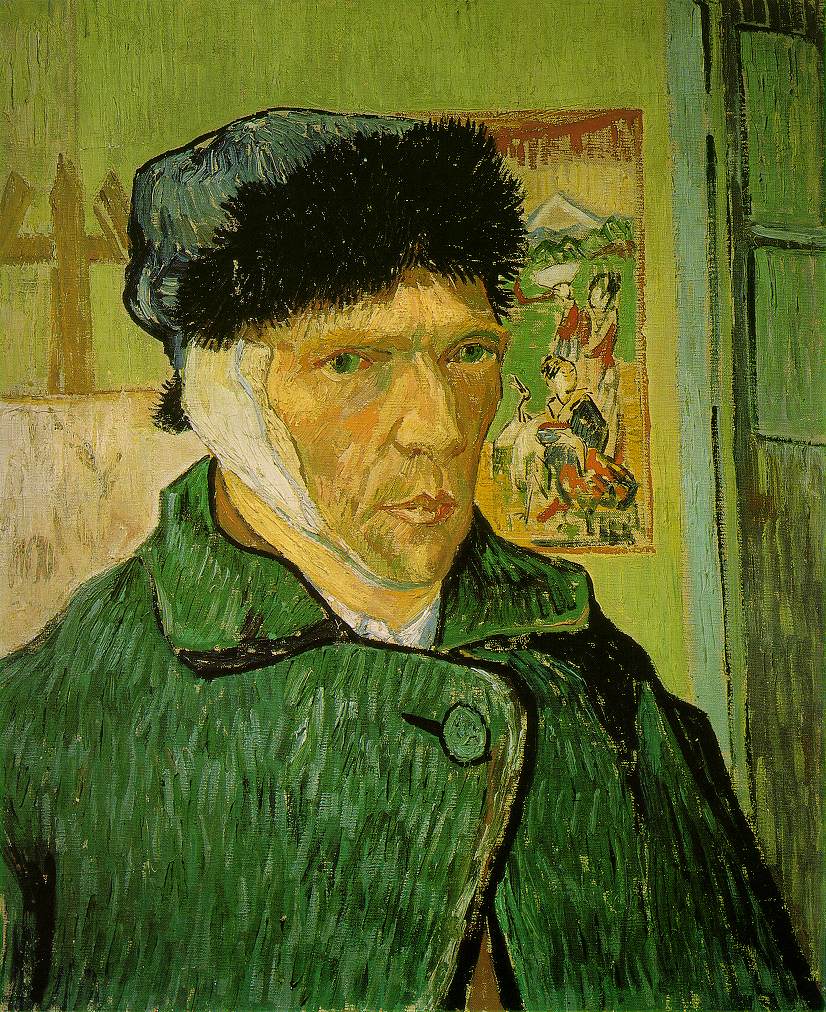
F527 Self-Portrait with Bandaged Ear 1889 -
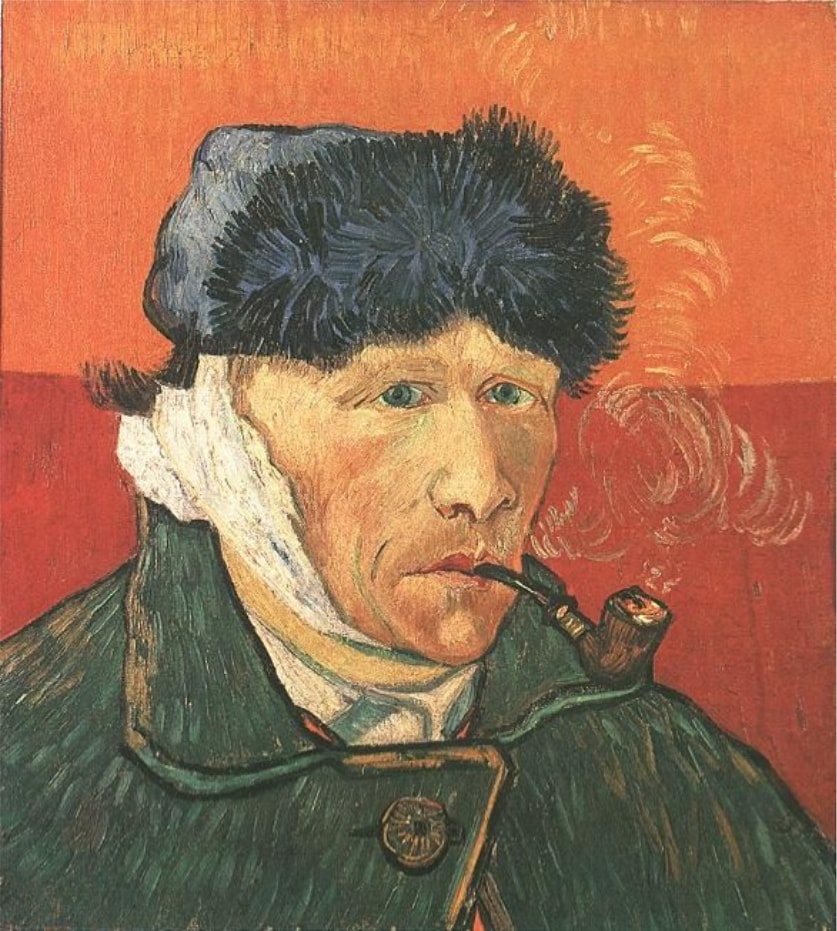
F529 Self-Portrait with Bandaged Ear and Pipe 1889
Painting
Four paintings, in two acts —
**December, absence.** Vincent's chair — wood and straw, the whole canvas yellow, red tiles on the floor, white wall, a pipe and a packet of tobacco on the seat. Daylight, frontal. Gauguin's chair — dark red-brown wood, greenish straw seat, red and green floor and red and green wall pressing against each other, two modern novels and a lit candle on the seat. Night light, oblique. Set the two side by side and the picture becomes clear — one daytime, one nighttime; one plain, one ornate; one his place, one Gauguin's.
**January, back to work.** First self-portrait: a bandage covering the right ear and jaw, green coat, red background, a Japanese print on the wall. Second: the same pose, a pipe added, smoke a thin grey-blue line in front of his lip. The face is flat, the lines dry, the eyes no longer carry the brightness of the Arles summer — as if he was using the brush to confirm that he could still hold steady. The red of the wall is the same red as the Night Café, but it has stopped roaring. In the mirror, he was doing one thing: paint what just happened, confirm that his hand was still working.
Letter
December 1888. He wrote to Theo: "I've done the two chairs — mine in wood and straw, all yellow on red tiles against a wall (daytime). Then Gauguin's chair, red and green, night effect, wall and floor red and green too, on the seat two novels and a candle." Another letter: "It's a study of his empty chair, in dark red-brown wood, the seat of greenish straw, and in the place of the absent one a lit candle and modern novels."
The night of 23 December, it happened. Roulin carried him to the hospital. Gauguin packed and went to Paris without saying goodbye.
Early January 1889, his first letter to Theo after leaving the hospital: "I'm writing to tell you that I've come home and that I'm well for the moment." Another: "I hope it was just a simple artist's bout of madness and then a lot of fever following the very considerable loss of blood." He did not explain what had happened — instead: "I've got back to work — I have three studies on the go — one of the berceuse, one of myself, and a still life." A list of work in answer to disaster. After silence, work.
Place
Arles, the Yellow House.
When the chairs were painted in December, Vincent wanted Gauguin to stay; Gauguin was already thinking of leaving. The two chairs were painted before the break, but the picture had already separated the two men into two positions, two systems of light, two kinds of night.
When the self-portraits were painted in January, one room was already empty — Gauguin's. Young Dr. Rey would come over from the hospital from time to time. These were the last four months of the Yellow House: Vincent himself would soon leave it for the asylum at Saint-Rémy.
Nine weeks of living together pushed them to the edge — the disagreements about painting turned from discussion into quarrel; about art, and about how one ought to live. The Yellow House's plan for a shared community was losing its load-bearing structure.
On the night of 23 December, in a state of total confusion, he cut off a part of his left ear and was then taken to hospital. Accounts say he gave the severed part to a woman in Arles; older accounts place her at a brothel, but studies disagree about her identity. Here the detail is not turned into legend, nor handed first to the medical file. What matters is this: in that moment, there was not a wide enough place to receive a person's loss of control.
He stayed in the hospital until 7 January, and after his discharge soon began painting again, making the self-portrait with the bandaged ear. But the neighbours of Arles petitioned to have him expelled from his home, citing his wandering in a state of confusion. In the end he committed himself, voluntarily, to the asylum at Saint-Rémy.
Events
- Synaesthetic Precision · Letter 726
Gauguin had begun preparing to leave. Vincent started painting two chairs — not the two men, but the seats they had sat in
- The Colour Experimenter · Letter 727
Completed his own chair — wood and straw, the whole canvas yellow, red tiles, white wall, a pipe on the seat. Daylight, frontal, plain saturation
- The Colour Experimenter · Letter 727
Completed Gauguin's chair — dark red-brown wood, greenish straw seat, red and green floor and wall pressing against each other, two modern novels and a lit candle on the seat
- Synaesthetic Precision · Letter 728
Wrote: 'It's a study of his empty chair — in the place of the absent one, a lit candle and modern novels.'
- Synaesthetic Precision
Three weeks later, Gauguin had gone and Vincent had fallen. The two chairs became their last shared seating in the Yellow House
- Synaesthetic Precision · Letter 728
'I hope that it was just a simple artist's bout of madness and then a lot of fever following the very considerable loss of blood.' Applying a doctor's calm to his own condition
- The Colour Experimenter · Letter 730
Returned home and began painting at once. Completed the first Self-Portrait with Bandaged Ear — white bandage, dark-green coat, red ground, a Japanese print on the wall
- The Copyist · Letter 732
'I've got back to work — I have three studies on the go: one of the berceuse, one of myself, and a still life.' A work-list as response to disaster
- Synaesthetic Precision · Letter 728
Discharged from hospital. His first letter to Theo: 'I'm writing to tell you that I've come home and that I'm well for the moment.' No explanation of what had happened
- The Copyist · Letter 735
Repainted two Sunflowers — versions two of the first set. Repetition as self-repair
- Synaesthetic Precision · Letter 736
A second attack. Hospitalised, released, attacked again — three episodes that year. The tone of his letters grew tighter and tighter
- Synaesthetic Precision · Letter 736
Decided to voluntarily enter the Saint-Rémy asylum. 'Let people take care of me — so that I don't hurt myself or anyone else again.'
From the Letters
J'ai fait les deux chaises — la mienne en bois et paille, toute jaune sur des carreaux rouges contre un mur (le jour). Puis la chaise de Gauguin, rouge et verte, effet de nuit, mur et plancher rouges et verts aussi, sur le siège deux romans et une bougie. I've done the two chairs — mine in wood and straw, all yellow on red tiles against a wall (daytime). Then Gauguin's chair, red and green, night effect, wall and floor red and green too, on the seat two novels and a candle.
C'est une étude de sa chaise vide, en bois sombre rouge-brun, le siège en paille verdâtre, et à la place de l'absent un flambeau allumé et des romans modernes. It's a study of his empty chair, in dark red-brown wood, the seat of greenish straw, and in the place of the absent one a lit candle and modern novels.
Je t'écris pour te dire que je suis rentré chez moi et que je me porte bien pour le moment. I'm writing to tell you that I've come home and that I'm well for the moment.
J'espère que ce n'a été qu'un simple coup de folie d'artiste et puis beaucoup de fièvre à la suite de la perte de sang très considérable. I hope that it was just a simple artist's bout of madness and then a lot of fever following the very considerable loss of blood.
Je me suis remis au travail — j'ai trois études en train — une de la berceuse, une de moi-même, et une nature morte. I've got back to work — I have three studies on the go — one of the berceuse, one of myself, and a still life.
Letter Sources
Van Gogh letter records referenced on this page, linked to the Van Gogh Letters Project. vangoghletters.org
Technique Evidence
This work appears as evidence in this site’s technique-evolution axis.
- The World in Motion 1889.05 – 1890.05 Open period F627 / JH1772 Self-Portrait Brushstroke Representative of swirling brushwork