The Night Café
"It is one of the ugliest pictures I have done." Those are his own words, from the letter.
-
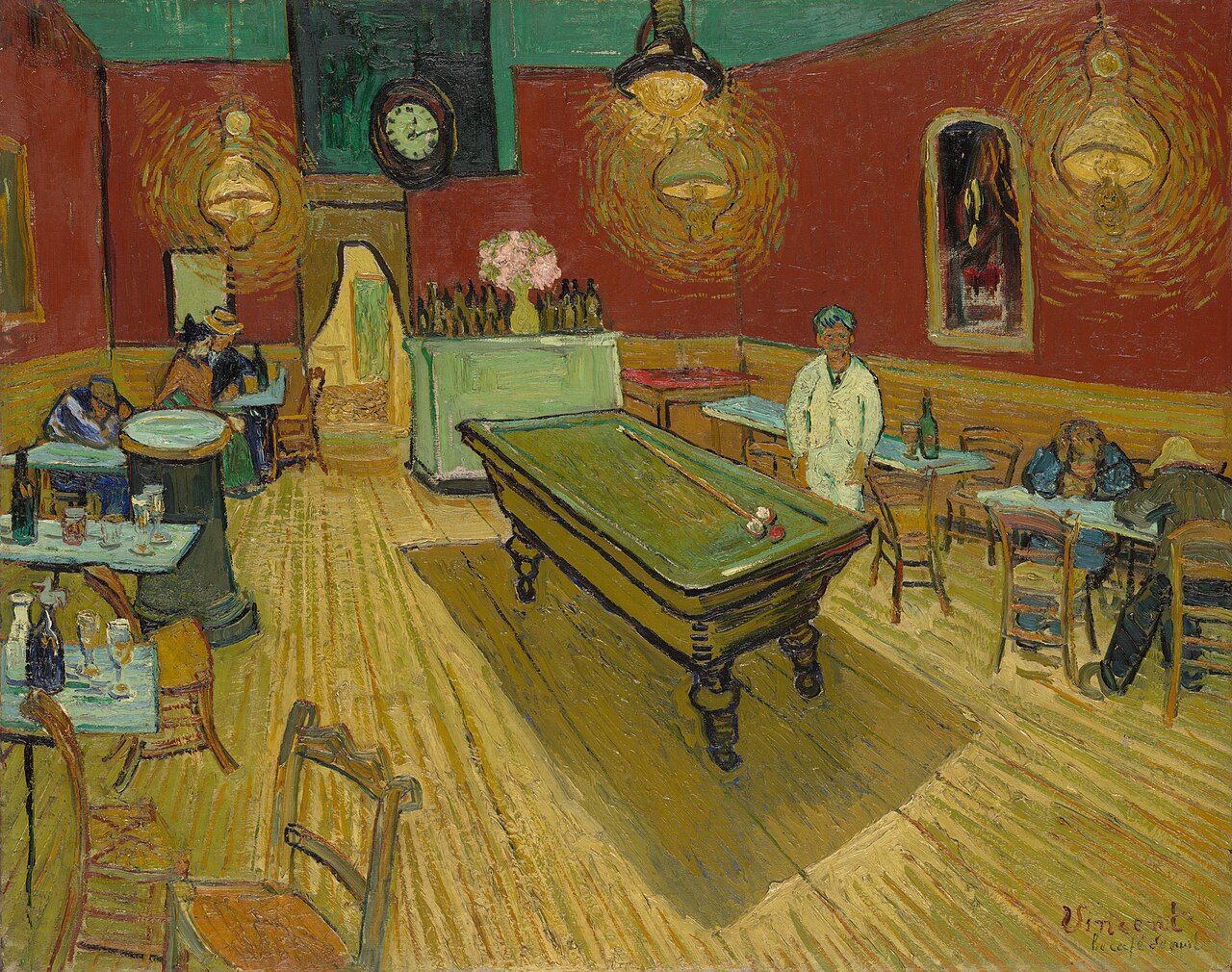
F463 The Night Café 1888 -
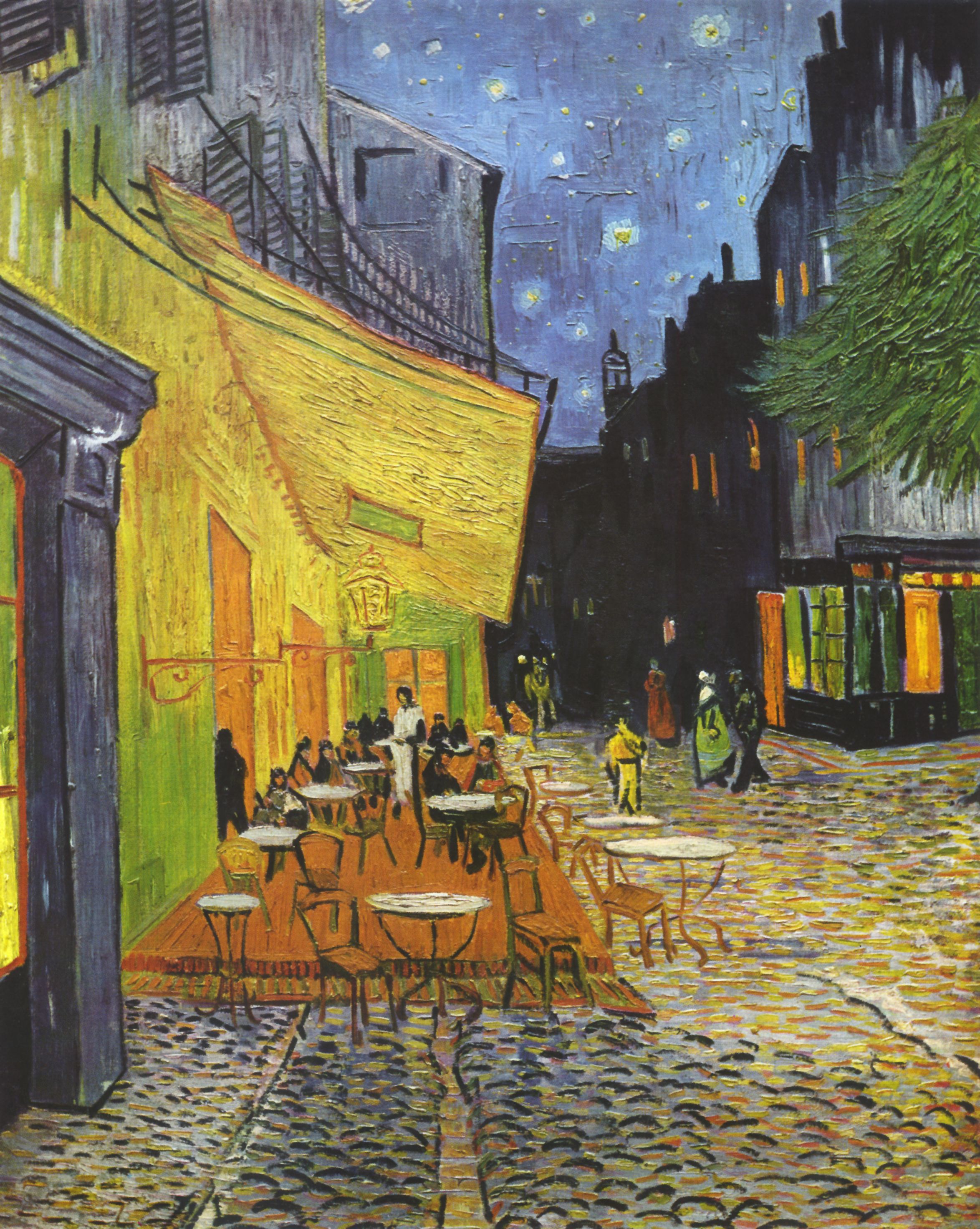
F467 Café Terrace at Night 1888
Painting
The Night Café, oil on canvas, 72.4 × 92.1 cm. An ordinary all-night café — red walls, a green billiard table, four yellow lamps floating like haloes beneath the ceiling. The floor tilts. At the back, a bar mirror; the owner stands at centre in white. This painting breaks every rule of colour harmony: red and green are not led to agree, they are deliberately pressed to the point of combat. The light is not warm. The light is toxic.
Letter
September 1888. He wrote: "I have tried to express the terrible human passions with red and green." Another letter: "The café is a place where one can ruin oneself, go mad, or commit a crime." A third: "I have tried to express, as it were, the powers of darkness in a low public house." Then his own verdict: "It is one of the ugliest paintings I have done. It is the equivalent, though different, of the Potato Eaters."
Place
Arles, Place Lamartine — the Café de la Gare, next door to the Yellow House he was about to move into. All-night place: stranded sailors, drifters, anyone who could not pay for a bed. He later made the distinction explicit: the night café was not a brothel but a place where night prowlers collapsed over tables until morning; a sex worker might occasionally bring a client inside. He painted there three nights running, slept by day, owed the owner rent. This was September 1888 — five weeks before Gauguin, three months before the ear. He painted the room that ruins people while living one wall away from it.
Arles was not only orchards and starry nights; there were also his solitary nights — the café was where he went when he could not sleep.
He wrote (letter 676): "I have tried to express the terrible passions of humanity by means of red and green." And also: "It is one of the ugliest pictures I have done." These are his own words, not anyone else's.
Treating colour as a danger signal — that approach never wholly disappeared from the later pictures; it only changed form.
Events
- Synaesthetic Precision · Letter 677
Decided to paint the Café de la Gare next door to the Yellow House. 'The café is a place where one can ruin oneself, go mad, or commit a crime.'
- The Colour Experimenter · Letter 676
Stayed up three nights in the café painting The Night Café. Slept at home during the day
- The Colour Experimenter · Letter 676
'I have tried to express the terrible human passions with red and green.' Complementaries used for the first time as a tool to manufacture unease
- Synaesthetic Precision · Letter 677
Wrote: 'I have tried to express, as it were, the powers of darkness in a low public house.' Translating the abstract 'powers of darkness' into the concrete physical structure of an image
- The Translator · Letter 678
Completed Café Terrace at Night — the other side of the same city: blue sky, stars, warm-toned terrace. The two paintings together hold his two vocabularies for night
- The Ferocious Reader · Letter 677
Self-judgement after completion: 'It is one of the ugliest paintings I have done. It is the equivalent, though different, of the Potato Eaters.' He placed the Night Café beside the masterpiece of his Dutch years
From the Letters
J'ai cherché à exprimer avec le rouge et le vert les terribles passions humaines. I have tried to express the terrible human passions with red and green.
Le café est un endroit où l'on peut se ruiner, devenir fou, commettre des crimes. The café is a place where one can ruin oneself, go mad, or commit a crime.
J'ai cherché à exprimer en quelque sorte les puissances des ténèbres dans un assommoir. I have tried to express, as it were, the powers of darkness in a low public house.
C'est un des tableaux les plus laids que j'aie faits. C'est l'équivalent, quoique différent, des mangeurs de pommes de terre. It is one of the ugliest paintings I have done. It is the equivalent, though different, of the Potato Eaters.
Letter Sources
Van Gogh letter records referenced on this page, linked to the Van Gogh Letters Project. vangoghletters.org
Technique Evidence
This work appears as evidence in this site’s technique-evolution axis.
- The Shattering Stroke 1888.02 – 1889.05 Open period F467 / JH1580 Café Terrace at Night Brushstroke Representative of directional brushwork
- The Shattering Stroke 1888.02 – 1889.05 Open period F463 / JH1575 The Night Café Colour Representative of the changed colour system Brushstroke Representative of directional brushwork