1890 · F751 · JH1992
Chestnut trees in flower: pink and white blossoms
Blossoming Chestnut Trees (F751 / JH1992) belongs to Van Gogh's first days in Auvers-sur-Oise. Long known through poor reproductions and absent from public view since 1964, it is scheduled for sale at Sotheby's New York on 18 November 2026 with an estimate around $180 million before fees.
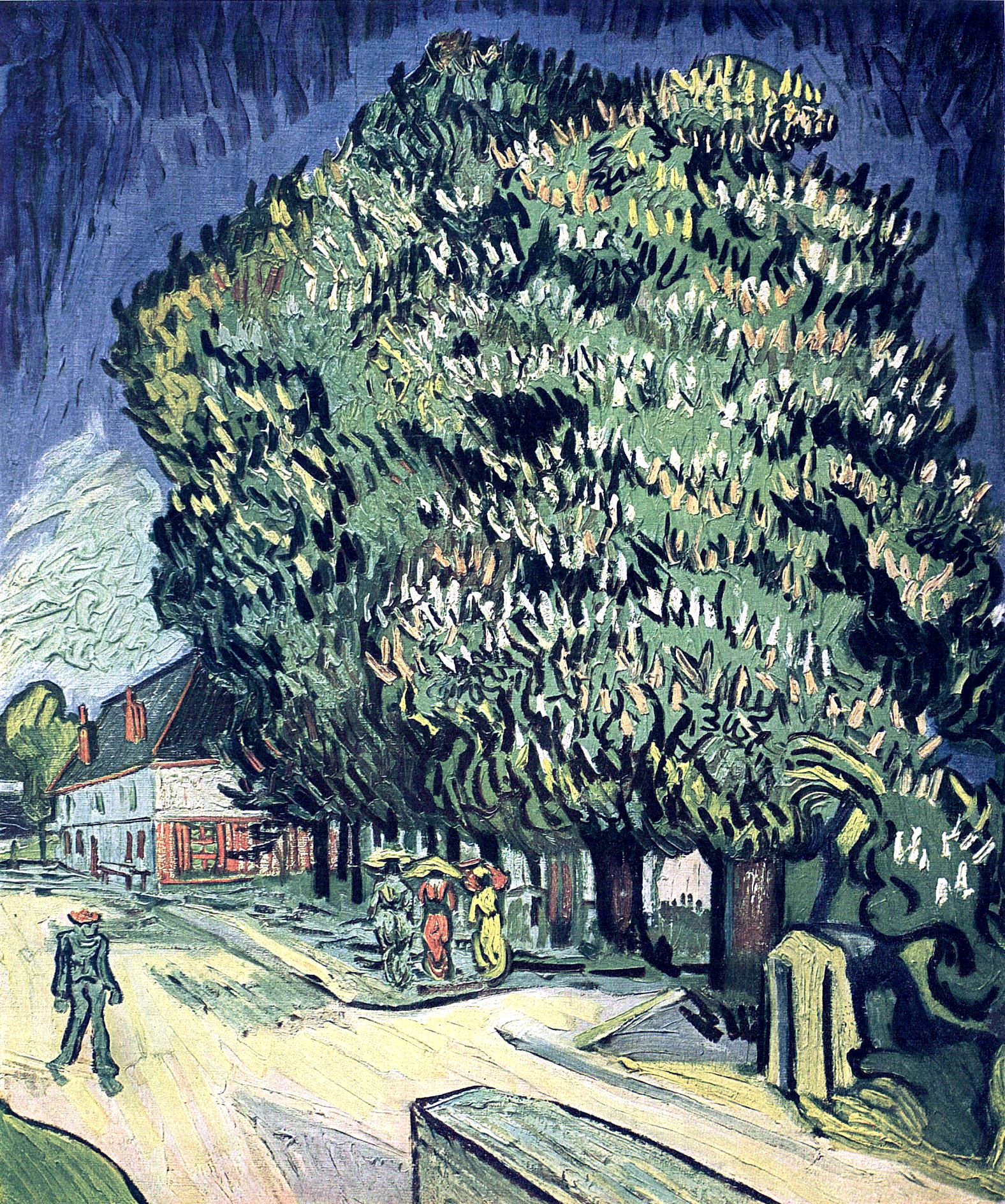
Chestnut trees in flower: pink and white blossoms meaning and analysis
Blossoming Chestnut Trees (F751 / JH1992) belongs to Van Gogh's first days in Auvers-sur-Oise. Long known through poor reproductions and absent from public view since 1964, it is scheduled for sale at Sotheby's New York on 18 November 2026 with an estimate around $180 million before fees.
Continue with this work in the context of The Seventy Days of Auvers.
Meaning
The painting belongs to the hopeful beginning of Van Gogh's Auvers period, not to the darker mythology often attached to his final weeks. He had just left Saint-Rémy and described the countryside around Auvers as full of well-being and abundant greenery.
A village street, a working bar and people passing beneath flowering trees make this a picture of ordinary life newly recovered. Its intensity comes from colour and brushwork rather than from a tragic subject.
Visual Analysis
A vast chestnut canopy fills most of the canvas. Short strokes of green, white, yellow and pink press against a deep blue sky, while the road and buildings are compressed into the lower edge.
Three women carrying Japanese-style parasols gather under the trees. A solitary figure at left, dressed in blue and wearing a straw hat, has been read as a possible echo of Van Gogh himself, but this remains an interpretation rather than an identification.
The building at the far left included a bar. The site still operates as a bar-tabac, now called Le Balto, close to the Auberge Ravoux where Van Gogh was staying.
Symbolism
The parasols and costume-like colour recall Van Gogh's continuing interest in Japanese prints, but the figures also anchor the scene in a real street at Auvers.
Blossoming trees can suggest renewal, yet the strongest evidence is immediate: Van Gogh had arrived in a new place and began painting its spring vegetation almost at once.
Technique
Dense impasto gives the flowering canopy physical weight. Dark, calligraphic strokes run through lighter clusters of blossom, producing movement without dissolving the structure of the tree.
The contrast between the dark blue sky, pale road and saturated foliage makes the painting read at a distance, while the loaded brushwork rewards close viewing.
Period Context
Sotheby's dates the work to 24 May 1890, only days after Van Gogh arrived in Auvers-sur-Oise. It measures 70 by 58 centimetres and is catalogued as F751 / JH1992.
Of roughly fifty Auvers landscapes, Sotheby's identifies only eight as remaining in private hands. This rarity, the painting's scale and its long absence from view underpin the expectation that it could exceed Van Gogh's public-auction record.
Provenance and Exhibition History
After Vincent's death, the painting passed to Theo van Gogh, then to Johanna van Gogh-Bonger and their son Vincent Willem. In 1905 Jo sold it through a dealer to Alexandre Berthier, the fourth Prince de Wagram.
The Berlin publisher Samuel Fischer acquired it in 1909. It passed to his daughter Brigitte in 1934 and was bought in 1936 by Henriette and Marcel Kapferer in Paris. Sotheby's has stated that its research found the Fischer family remained free to dispose of the work despite their persecution under the Nazi regime.
By 1945 it belonged to the American songwriter and film producer George 'Buddy' De Sylva. Harriet Harris-Jonas acquired it in 1953, and the Blaquier family bought it from Wildenstein in 1975. Last publicly exhibited at the Solomon R. Guggenheim Museum in 1964, it is being offered in 2026 by the Blaquier heirs.
Related Letters
In Letter 875, written from Auvers on 25 May 1890, Van Gogh mentioned 'a study of pink chestnut trees and one of white chestnut trees.' The passage places F751 within his first burst of work in the village while also reminding us that he made more than one chestnut-tree painting that week.
F751 should not be confused with F752 / JH1991, the separate white-blossom chestnut painting now in the Kröller-Müller Museum.
FAQ
- When will Blossoming Chestnut Trees be auctioned?
- Sotheby's has scheduled the painting for its New York evening sale on 18 November 2026.
- What is the estimate?
- Sotheby's gives an estimate in the region of $180 million before fees. The Art Newspaper calculates roughly $207 million after the buyer's premium.
- What is Van Gogh's current public-auction record?
- Verger avec cyprès sold at Christie's New York in 2022 for $117.18 million including fees.
- Is this the same painting as F752?
- No. The Sotheby's painting is F751 / JH1992, a 70 by 58 centimetre work in private hands. F752 / JH1991 is a different painting in the Kröller-Müller Museum.
- When was the painting last exhibited?
- It was last publicly exhibited in 1964 at the Solomon R. Guggenheim Museum in New York.
Sources
Chestnut trees in flower. Pink-white blossoms — Auvers spring is gentler than Arles.