1883.12 – 1886.02
Obsessive Dark
His palette began with bitumen.
Technique
He placed farmers, weavers and interior objects inside earth colours and deep shadows. Heavy marks gave figures weight; in Antwerp, cobalt blue, vermilion and crimson entered the paint box, while Rubens and Japanese prints made cracks in the darkness.
Causes
From 1884 he lived with his parents at the Nuenen parsonage; his father's sudden death in March 1885 deepened both the emotional weight and the compositional gravity of the work. That year he first encountered Charles Blanc's *Grammaire des arts du dessin* and *Les artistes de mon temps*, learning the theory of complementary colour for the first time — but it remained theory, not yet practice. He was reading Eugène Fromentin's *Les Maîtres d'autrefois* at the same time, deepening his understanding of Dutch Golden Age technique. His studio was in the sexton's house beside the church: physically dark. Zola's *Germinal* entered his reading, translating his concern for workers from theological into social language.
Representative works
- *The Potato Eaters* (F82 / JH764, April 1885): the period's total statement; he called it "the real peasant painting" - *Head of a Peasant Woman* (F388 / JH724, 1885): one of many head studies made for *The Potato Eaters* - *Still Life with Bible* (F117 / JH946, October 1885): his father's Bible set beside Zola's *La Joie de vivre* — painted after the father's death - *Weavers series* (F24, F26, F30, 1884): the loom as compositional frame - *Skull of a Skeleton with Burning Cigarette* (F212 / JH999, January 1886): an anatomy-class work from Antwerp
Letter evidence
- Letter 497 (April 30, 1885): the famous defence of *The Potato Eaters* — "I wanted to convey that these people, eating their potatoes in the lamplight, dug the earth with those self-same hands" - Letter 539 (June 1885): reply to colleagues who called *The Potato Eaters* too ugly - Letters 372–400: early colour theory discussions with Theo — he was reading Blanc, but practice had not yet caught up - Letters 545–553 (November 1885 – February 1886): Rubens, Japanese prints and the Academy conflict
Transition
In November 1885 he left Nuenen for Antwerp. Complementary colour began to reach the canvas; at the end of February 1886 he left for Paris, making Antwerp the short internal turn within this dark period.
Curve Landing Points
Obsessive Dark: smudged_modeled_to_transitional
Obsessive Dark: oil, watercolor, pencil
Obsessive Dark: bitumen, raw_umber, burnt_sienna, yellow_ochre, lead_white, prussian_blue
Obsessive Dark: 114
Obsessive Dark: 8
Representative Works
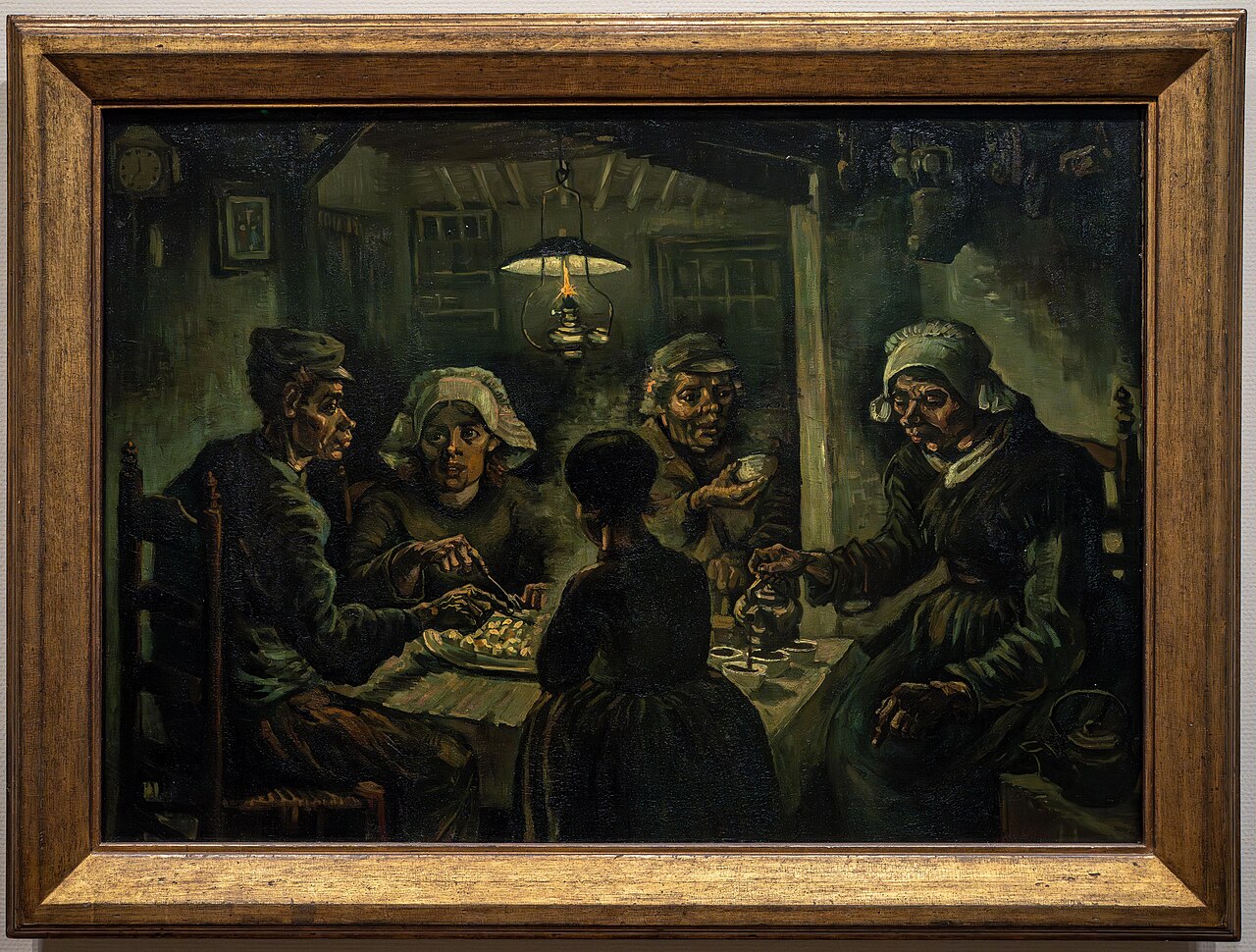 The Potato Eaters Period culmination — Vincent called it 'the real peasant painting' Open node · The Potato Eaters
 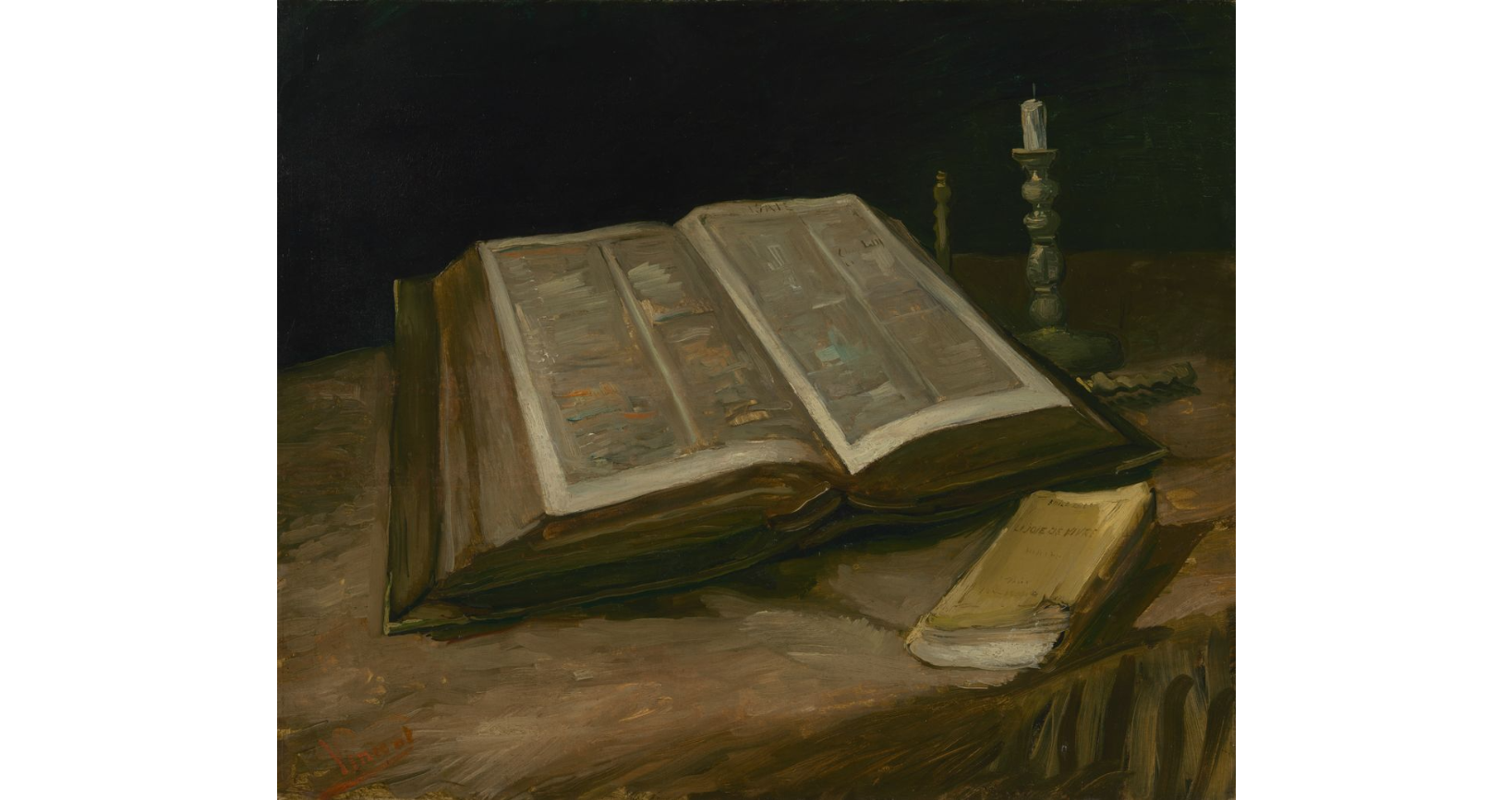 Still Life with Bible Father's Bible with Zola's La Joie de vivre — after father's death Open node · Still Life with Bible
 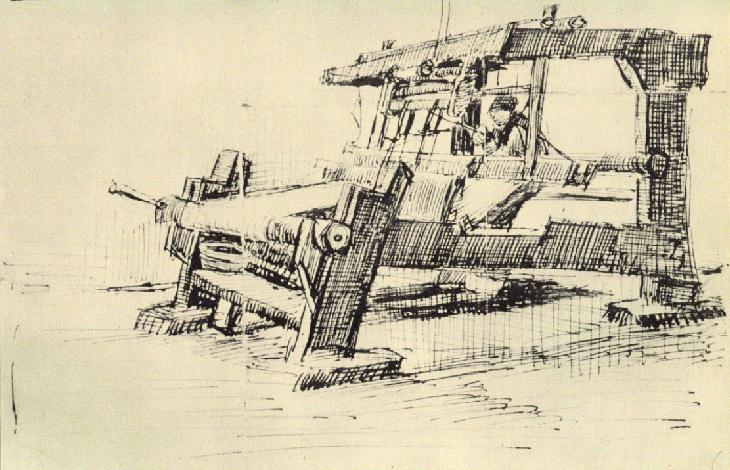 Weavers series Loom as compositional frame Open node · The Weavers
 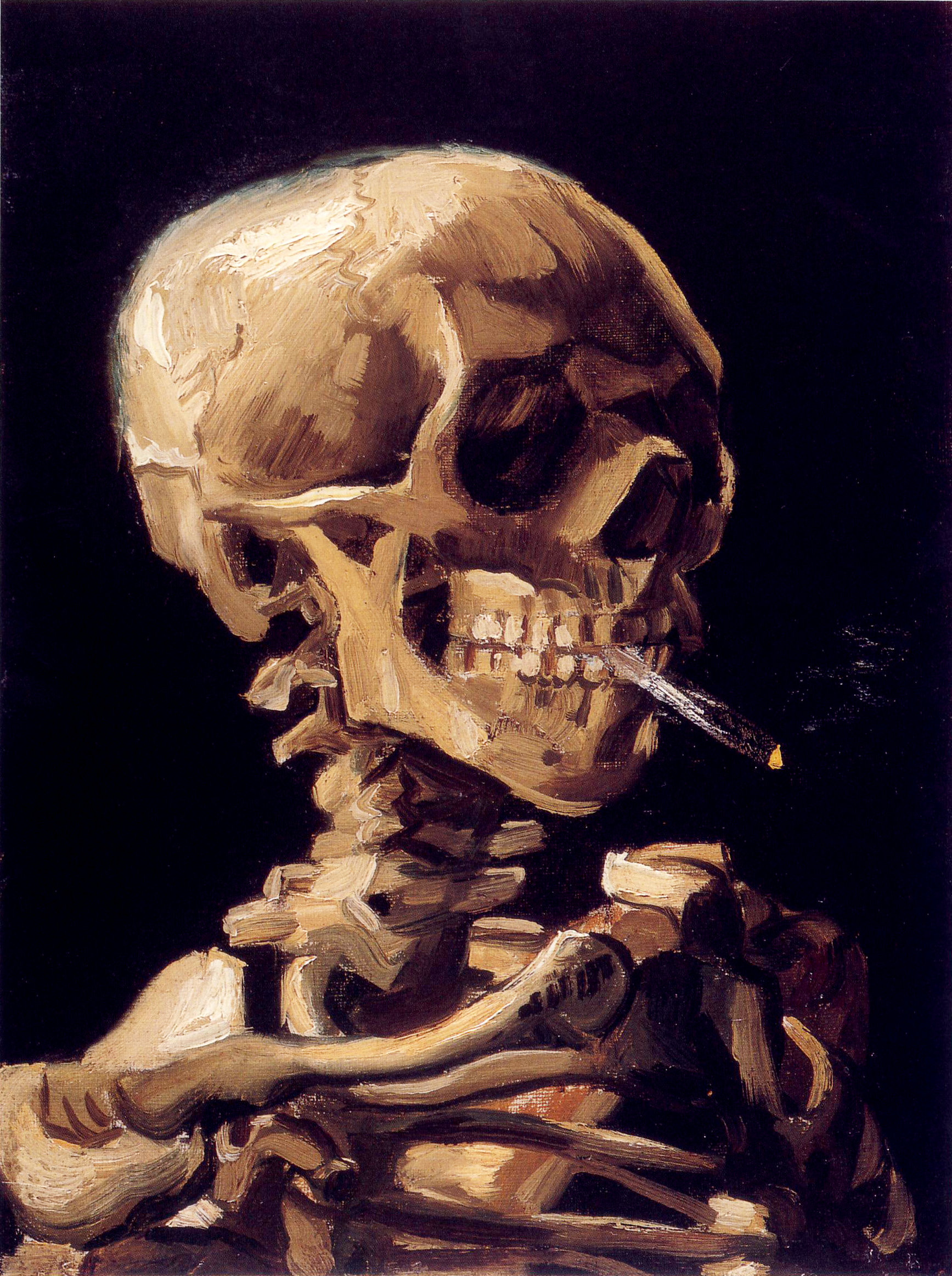 Skull of a Skeleton with Burning Cigarette アントワープ美術アカデミーの解剖学習作。暗いパレットが温かさを帯び始める Open node · Antwerp Academy
 Site curatorial model. Verifiable facts now carry source notes; estimated curves remain model values.